
dado
English edit


Etymology edit
From Italian dado, first attested in 1664.
Pronunciation edit
- (Received Pronunciation) IPA(key): /ˈdeɪdəʊ/
- (US) IPA(key): /ˈdeɪdoʊ/
Audio (US) (file) Audio (AU) (file) - Rhymes: -eɪdəʊ
Noun edit
- (architecture) The section of a pedestal above the base.
- (architecture) The lower portion of an interior wall decorated differently from the upper portion.
- 1912, Arthur Conan Doyle, The Lost World […], London, New York, N.Y.: Hodder and Stoughton, →OCLC:
- Like a dado round the room was the jutting line of splendid heavy game-heads, the best of their sort from every quarter of the world, with the rare white rhinoceros of the Lado Enclave drooping its supercilious lip above them all.
- (carpentry) The rectangular channel in a board cut across the grain.
Translations edit
|
Verb edit
dado (third-person singular simple present dadoes, present participle dadoing, simple past and past participle dadoed)
- (transitive, architecture) To furnish with a dado.
- (transitive, carpentry) To cut a dado.
Translations edit
Derived terms edit
Further reading edit

Anagrams edit
Bikol Central edit
Etymology edit
Pronunciation edit
Noun edit
dádo (plural dados, Basahan spelling ᜇᜇᜓ)
- die (used in board games)
Galician edit
Etymology 1 edit
From Old Galician-Portuguese dado, itself from a form *datu of uncertain origin; possibly from Classical Arabic أَعْدَاد (ʔaʕdād, “numbers”), or from Latin datum.[1] Compare Spanish dado, Catalan dau, Italian dado, French dé.
Pronunciation edit
Noun edit
dado m (plural dados)
Etymology 2 edit
From Old Galician-Portuguese dado, from Latin datus. Equivalent to dar + -ado. Doublet of dato.
Pronunciation edit
Adjective edit
dado (feminine dada, masculine plural dados, feminine plural dadas)
- offered
- Synonym: oferecido
- granted, conceded (given)
- Synonym: concedido
- given, fixed
- Synonym: determinado
- friendly, sociable
- generous
- Synonyms: desinteresado, xeneroso
- prone, inclined
- Synonym: propenso
Participle edit
dado (feminine dada, masculine plural dados, feminine plural dadas)
- past participle of dar
References edit
- “dado” in Dicionario de Dicionarios do galego medieval, SLI - ILGA 2006–2022.
- “dado” in Xavier Varela Barreiro & Xavier Gómez Guinovart: Corpus Xelmírez - Corpus lingüístico da Galicia medieval. SLI / Grupo TALG / ILG, 2006–2018.
- “dado” in Dicionario de Dicionarios da lingua galega, SLI - ILGA 2006–2013.
- “dado” in Tesouro informatizado da lingua galega. Santiago: ILG.
- “dado” in Álvarez, Rosario (coord.): Tesouro do léxico patrimonial galego e portugués, Santiago de Compostela: Instituto da Lingua Galega.
- ^ Joan Coromines, José A. Pascual (1983–1991) “dado”, in Diccionario crítico etimológico castellano e hispánico (in Spanish), Madrid: Gredos
Hiligaynon edit
Noun edit
dadô
- a young fish
Related terms edit
Ilocano edit
Etymology edit
Pronunciation edit
Noun edit
dádo (Kur-itan spelling ᜇᜇᜓ)
References edit
- Andrés Carro (1888) Vocabulario ilocano-español: trabajado por varios religiosos del orden de N.P.S. Agustín / coordinado por Predicador Andrés Carro y ultimamente aumentado y corregido por algunos religiosos del mismo orden[1] (overall work in Spanish and Ilocano), Manila: Est. Tipo-Litográfico de M. Pérez
Italian edit
Etymology edit
Uncertain. Perhaps from a Vulgar Latin *dadu, itself either from Latin datum (“thrown, given”), or from Arabic أَعْدَاد (ʔaʕdād, “numbers”). Compare Spanish and Portuguese dado, Catalan dau, French dé.
Pronunciation edit
Noun edit
dado m (plural dadi)
- (gaming) die, dice
- giocare a dadi ― to play dice
- (by extension) any small cube-shaped object
- (cooking) stock cube
- minestra di dadi ― (please add an English translation of this usage example)
- (engineering) nut (intended to be screwed onto a bolt)
Anagrams edit
Ladino edit
Noun edit
dado m (Latin spelling, plural dados)
Old Galician-Portuguese edit
Etymology edit
From Vulgar Latin *dadu, itself either from Arabic أَعْدَاد (ʔaʕdād, “numbers”), or from Latin dātum.
Pronunciation edit
Noun edit
dado m
- die
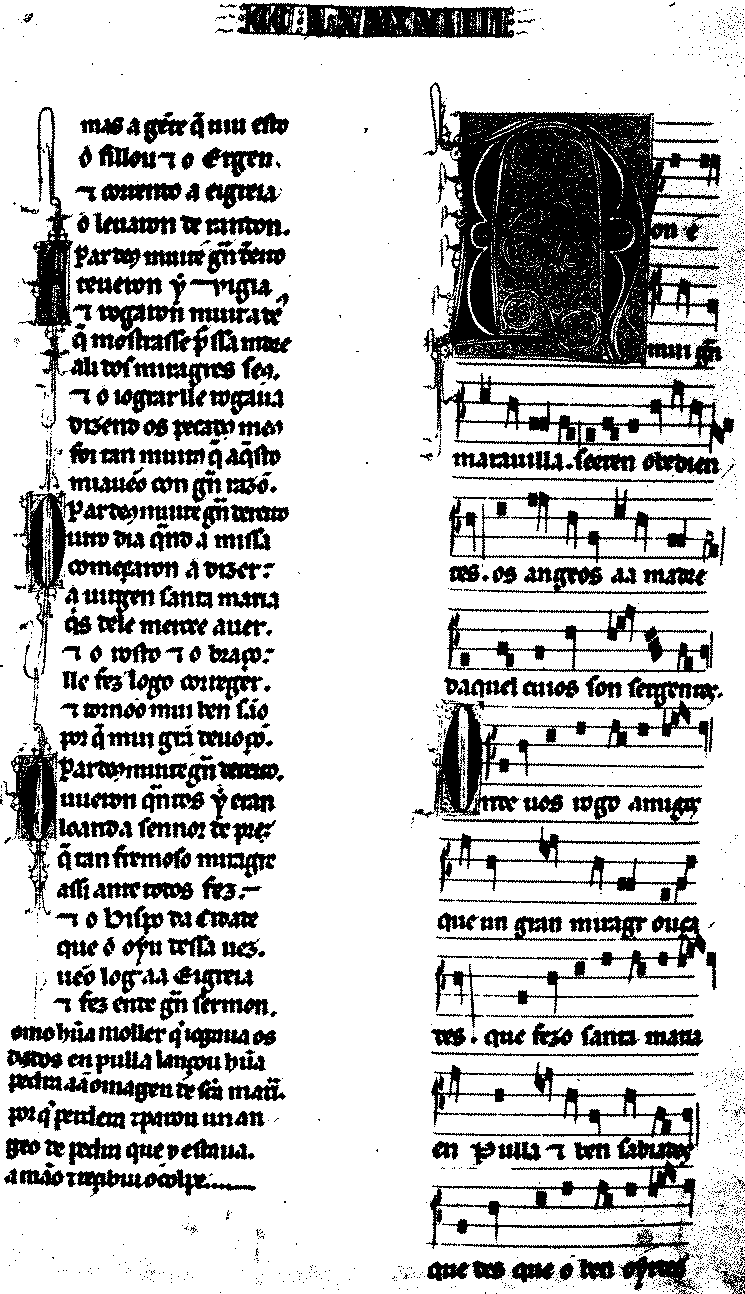
- 13th century CE, Alfonso X of Castile, Cantigas de Santa Maria, E codex, cantiga 294 (facsimile):
- Como hũa moller q̇ iogaua os dados en pulla lançou hũa pedra aa omagen de ſ[ant]a mari[a] por q̇ perdera ⁊ parou un angeo de pedra que y eſtava a mão ⁊ reçibiu o colpe.
- How a woman who was playing dice in Apulia threw a stone at the statue of Holy Mary because she had lost, and an angel of stone which was there reached out its hand and received the blow.
- Como hũa moller q̇ iogaua os dados en pulla lançou hũa pedra aa omagen de ſ[ant]a mari[a] por q̇ perdera ⁊ parou un angeo de pedra que y eſtava a mão ⁊ reçibiu o colpe.
Descendants edit
Pali edit
Alternative forms edit
Verb edit
dado
- second-person singular imperfect active of dadāti (“to give”)
Portuguese edit

Pronunciation edit
- Rhymes: -adu
- Hyphenation: da‧do
Etymology 1 edit
From Old Galician-Portuguese dado, itself from a Vulgar Latin *dadu, of uncertain origin; possibly from Classical Arabic أَعْدَاد (ʔaʕdād, “numbers”), or from Latin datum. Compare Spanish dado, Catalan dau, Italian dado, French dé.
Noun edit
dado m (plural dados)
- (gaming) a die
- Alguns jogos utilizam um dado que vai até 100.
- Some games use a die numbered up to 100.
Descendants edit
Etymology 2 edit
From Old Galician-Portuguese dado, from Latin datus. By surface analysis, dar + -ado. Doublet of data.
Adjective edit
dado (feminine dada, masculine plural dados, feminine plural dadas)
- offered
- Synonym: oferecido
- granted, conceded (given)
- Synonym: concedido
- given, fixed
- Synonym: determinado
- Em um dado momento.
- At a given moment.
- friendly, sociable
- Synonym: afável
- Eles são muito dados.
- They are very friendly.
- prone, inclined
Noun edit
dado m (plural dados)
- (computing, sciences) data; datum (item of information)
- Não encontrei nenhum dado no sistema.
- I did not find any data in the system.
Determiner edit
dado (feminine dada, masculine plural dados, feminine plural dadas)
- a given; a particular; a specific
- Em dado momento, os morcegos sairão da caverna.
- The bats will leave the cave in a given moment.
- A família mora em uma dada localidade no vale.
- The family lives in a given location in the valley.
Usage notes edit
- Optionally used with an article.
Participle edit
dado (feminine dada, masculine plural dados, feminine plural dadas)
- past participle of dar
Spanish edit
Pronunciation edit
Etymology 1 edit
From a Vulgar Latin *dadu, of uncertain origin; perhaps from Arabic أَعْدَاد (ʔaʕdād, “numbers”), or alternatively from Latin dātum. Compare Portuguese dado, Catalan dau, Italian dado. Cf. also French dé.
Noun edit
dado m (plural dados)
Etymology 2 edit
Inherited from Latin dātus. See dar.
Participle edit
dado (feminine dada, masculine plural dados, feminine plural dadas)
- past participle of dar
Derived terms edit
Further reading edit
- “dado”, in Diccionario de la lengua española, Vigésima tercera edición, Real Academia Española, 2014
Tagalog edit
Etymology edit
Borrowed from Spanish dado (“die”).
Pronunciation edit
- (Standard Tagalog) IPA(key): /ˈdado/, [ˈda.do]
- Rhymes: -ado
- Syllabification: da‧do
Noun edit
dado (Baybayin spelling ᜇᜇᜓ)