See also

Translingual

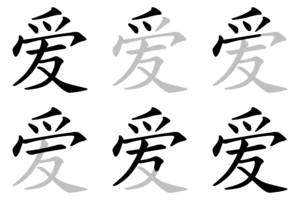
Stroke order
爱-bw.png

Simplified from  ( → )

Han character

(radical 87 +6, 10 strokes, cangjie input 月月大水 (BBKE), composition)

  1. love, be fond of, like

References


↑Jump back a section

Cantonese

Pronunciation

  • IPA: /ɔːi˧/

Hanzi

(traditional , jyutping ngoi3, oi3, Yale ngoi3, oi3)

  1. love

↑Jump back a section

Mandarin

simpl.
trad.

Pronunciation

Hanzi

(traditional , pinyin ài (ai4), Wade-Giles ai4)

Noun

(simplified, Pinyin ài, traditional )

  1. (Beginning Mandarin) love

Verb

(simplified, Pinyin ài, traditional )

  1. (Beginning Mandarin) to love; to be fond of
    ni ai ta ma? "Do you love her/him?"
    ta ai shuohua. "He likes to talk."
    wo bu ai chi zhurou. "I don't like to eat pork."

Usage notes

When the object of the verb is a person, 爱 ài usually refers to romantic love. When used like this, older Mandarin speakers often describe the use of this term as overly 肉麻 (ròumá, adj. something that gives you the creeps, extremely melodramatic). For this reason, the word trad. 喜歡, simpl. 喜欢 (xǐhuān, to like) might be used instead. The word 喜欢 xǐhuān literally means "to like", but when used in a romantic context, can (but does not always) mean "to love." However, Mandarin speakers born since the 1970s are now using the verb 爱 ài much more often than was socially acceptable in the past.

Compounds

References

  • 2000, Jingmin (ed.) Shao, HSK Dictionary (HSK汉语水平考试词典) (in Mandarin/English), Shanghai: Huadong Teachers College Publishers, ISBN 7561720785:

↑Jump back a section

Min Nan

simpl.
trad.

Pronunciation

  • IPA: [ ai˨˩ ]

Noun

(simplified, POJ ài, traditional )

  1. love

Verb

(simplified, POJ ài, traditional )

  1. to love; to like; to be fond of
  2. want; must; need

See also

  • (Mandarin) (yào) want; must; need

References

  • "" (in Taiwanese/English), On-line Taiwanese/Mandarin Dictionary (台文/華文線頂辭典). URL accessed on 2011-01-29.
↑Jump back a section
Last modified on 19 April 2013, at 11:35