
event
English

Etymology 1
From Middle French event, from Latin ēventus (“an event, occurrence”), from ēveniō (“to happen, to fall out, to come out”), from ē (“out of, from”), short form of ex + veniō (“come”); related to venture, advent, convent, invent, convene, evene, etc.
Pronunciation
Noun
event (plural events)
- An occurrence; something that happens.
- 1856 February, [Thomas Babington] Macaulay, “Oliver Goldsmith”, in T[homas] F[lower] E[llis], editor, The Miscellaneous Writings and Speeches of Lord Macaulay, new edition, London: Longman, Green, Reader, & Dyer, published 1871, →OCLC:
- the events of his early years
- 2017, Anthony J. McMichael, Alistair Woodward, Cameron Muir, Climate Change and the Health of Nations, →ISBN, page 67:
- Experience in Australia indicates that after a devastating weather event, up to one-fifth of people suffer the debilitating effects of extreme stress, emotional injury, and despair.
- A prearranged social activity (function, etc.)
- I went to an event in San Francisco last week.
- Where will the event be held?
- One of several contests that combine to make up a competition.
- An end result; an outcome (now chiefly in phrases).
- 1624, Democritus Junior [pseudonym; Robert Burton], The Anatomy of Melancholy: […], 2nd edition, Oxford, Oxfordshire: Printed by John Lichfield and James Short, for Henry Cripps, →OCLC, partition 2, section 3, member 3:
- hard beginnings have many times prosperous events […].
- 1707, Semele, by Eccles and Congrieve; scene 8
- Of my ill boding Dream / Behold the dire Event.
- 1743, [Edward Young], “Night the Fourth. The Christian Triumph.”, in The Complaint: Or, Night-Thoughts on Life, Death, and Immortality, London: […] R[obert] Dodsley, […], →OCLC:
- dark doubts between the promise and event
- In the event, he turned out to have what I needed anyway.
- (figurative, uncommon, dated) A remarkable person.
- Synonym: sensation
- 1985, Miss Marple: The Moving Finger, spoken by Mr. Pye (Richard Pearson):
- Miss Burton, you are an event! Sleepy, old Lymston's going to love you! Bye-bye. Bye.
- (physics) A point in spacetime having three spatial coordinates and one temporal coordinate.
- (computing) A possible action that the user can perform that is monitored by an application or the operating system (event listener). When an event occurs an event handler is called which performs a specific task.
- (probability theory) A set of some of the possible outcomes; a subset of the sample space.
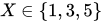
- If is a random variable representing the toss of a six-sided die, then its sample space could be denoted as {1,2,3,4,5,6}. Examples of events could be: , , and .
- (obsolete) An affair in hand; business; enterprise.
- c. 1603–1604 (date written), William Shakespeare, “Measure for Measure”, in Mr. William Shakespeares Comedies, Histories, & Tragedies […] (First Folio), London: […] Isaac Iaggard, and Ed[ward] Blount, published 1623, →OCLC, [Act III, scene ii]:
- Leave we him to his events.
- (medicine) An episode of severe health conditions.



Hyponyms
Derived terms
- adverse event
- after-event
- afterevent
- anoxic event
- at any event
- black swan event
- Bond event
- canon event
- certain event
- Christ event
- combined event
- cosmic event horizon
- doujin event
- energetic event
- event-based
- event-based programming
- event data recorder
- event derivative
- event-driven
- event-driven architecture
- event-driven programming
- eventful
- event-goer
- event handler
- evential
- eventism
- eventless
- event loop
- event marketing
- event recorder
- event-related potential
- event time
- event tree
- eventual
- extinction event
- extinction level event
- field event
- impossible event
- in any event
- in the event of
- in the event that
- it is easy to be wise after the event
- life event
- liquidity event
- mass extinction event
- Miyake event
- never event
- non-event
- road event
- signalling event
- special event
- tail event
- then and in that event
- track event
- transient luminous event
- Triassic-Jurassic extinction event
- Tunguska event
- whiting event
Related terms
Translations
|
|
|
|
|
- The translations below need to be checked and inserted above into the appropriate translation tables. See instructions at Wiktionary:Entry layout § Translations.
Further reading
- “event”, in Webster’s Revised Unabridged Dictionary, Springfield, Mass.: G. & C. Merriam, 1913, →OCLC.
- “event”, in The Century Dictionary […], New York, N.Y.: The Century Co., 1911, →OCLC.
Verb
event (third-person singular simple present events, present participle eventing, simple past and past participle evented)
- (obsolete) To occur, take place.
- 1590, Robert Greene, Greene’s Never Too Late, in The Life and Complete Works in Prose and Verse of Robert Greene, Volume 8, Huff Library, 1881, p. 33,[1]
- […] I will first rehearse you an English Historie acted and evented in my Countrey of England […]
- 1590, Robert Greene, Greene’s Never Too Late, in The Life and Complete Works in Prose and Verse of Robert Greene, Volume 8, Huff Library, 1881, p. 33,[1]
Etymology 2
Verb
event (third-person singular simple present events, present participle eventing, simple past and past participle evented)
- (obsolete, intransitive) To be emitted or breathed out; to evaporate.
- c. 1597, Ben Jonson, The Case is Altered, Act V, Scene 8, in C. H. Herford and Percy Simpson (editors), Ben Jonson, Volume 3, Oxford: Clarendon Press, 1927, p. 178,[2]
- ô that thou sawst my heart, or didst behold
- The place from whence that scalding sigh evented.
- 1615, William Barclay, Callirhoe; commonly called The Well of Spa or The Nymph of Aberdene[3], Aberdeen, published 1799, page 12:
- This is the reason why this water hath no such force when it is carried, as it hath at the spring it self: because the vertue of it consisteth in a spiritual and occulte qualitie, which eventeth and vanisheth by the carriage.
- c. 1597, Ben Jonson, The Case is Altered, Act V, Scene 8, in C. H. Herford and Percy Simpson (editors), Ben Jonson, Volume 3, Oxford: Clarendon Press, 1927, p. 178,[2]
- (obsolete, transitive) To expose to the air, ventilate.
- 1559, attributed to William Baldwin, “How the Lorde Clyfford for his straunge and abhominable cruelty came to as straunge and sodayne a death” in The Mirror for Magistrates, Part III, edited by Joseph Haslewood, London: Lackington, Allen & Co., 1815, Volume 2, p. 198,[4]
- For as I would my gorget have undon
- To event the heat that had mee nigh undone,
- An headles arrow strake mee through the throte,
- Where through my soule forsooke his fylthy cote.
- 1598, George Chapman, The Third Sestiad, Hero and Leander (completion of the poem begun by Christopher Marlowe),[5]
- […] as Phœbus throws
- His beams abroad, though he in clouds be clos’d,
- Still glancing by them till he find oppos’d
- A loose and rorid vapour that is fit
- T’ event his searching beams, and useth it
- To form a tender twenty-colour’d eye,
- Cast in a circle round about the sky […]
- 1559, attributed to William Baldwin, “How the Lorde Clyfford for his straunge and abhominable cruelty came to as straunge and sodayne a death” in The Mirror for Magistrates, Part III, edited by Joseph Haslewood, London: Lackington, Allen & Co., 1815, Volume 2, p. 198,[4]
Danish
Etymology
Borrowed from English event, from Middle French event, from Latin ēventus (“an event, occurrence”), from ēveniō (“to happen, to fall out, to come out”), from ē (“out of, from”), short form of ex + veniō (“come”).
Pronunciation
Noun
event
- An event, a prearranged social activity (function, etc.).
- Det var et stort event i Stockholmsmessen idag.
- There was a big event in the Stockholm fair today.
Declension
| Declension of event | ||||
|---|---|---|---|---|
| Singular | Plural | |||
| Indefinite | Definite | Indefinite | Definite | |
| Nominative | event | eventet | event | eventen |
| Genitive | events | eventets | events | eventens |
Related terms
See also
Polish
Etymology
Unadapted borrowing from English event, from Middle French event, from Latin ēventus, from ēveniō.
Pronunciation
Noun
event m inan
- event (prearranged social activity)
- Hypernym: wydarzenie
Declension
Further reading
Swedish
Etymology
Borrowed from English event, from Middle French event, from Latin ēventus (“an event, occurrence”), from ēveniō (“to happen, to fall out, to come out”), from ē (“out of, from”), short form of ex + veniō (“come”).
Pronunciation
Noun
event n
- An event, a prearranged social activity (function, etc.).
- Det var ett stort event i Stockholmsmässan idag.
- There was a big event in the Stockholm fair today.
Declension
| Declension of event | ||||
|---|---|---|---|---|
| Singular | Plural | |||
| Indefinite | Definite | Indefinite | Definite | |
| Nominative | event | eventet | event | eventen |
| Genitive | events | eventets | events | eventens |