
e
 | ||||||||
| ||||||||
| ||||||||
Translingual edit

Etymology edit
 Modification of capital letter E in uncial script, from Ancient Greek Ε (E, Epsilon).
Pronunciation edit
IPA (file)
Letter edit
e (upper case E)
- The fifth letter of the basic modern Latin alphabet.
See also edit
- (Latin script): Aa Bb Cc Dd Ee Ff Gg Hh Ii Jj Kk Ll Mm Nn Oo Pp Qq Rr Sſs Tt Uu Vv Ww Xx Yy Zz
- (Variations of letter E): Éé Èè Êê Ḙḙ Ěě Ĕĕ Ẽẽ Ḛḛ Ẻẻ Ėė Ëë Ēē Ȩȩ Ęę ᶒ Ɇɇ Ȅȅ Ếế Ềề Ễễ Ểể Ḝḝ Ḗḗ Ḕḕ Ȇȇ Ẹẹ Ệệ ⱸ ᴇ Ee Ææ Ǽǽ Ǣǣ & Œœ ᵫ
- (select similar letters and symbols) ɘ ǝ Ə Ɛ Æ Œ
- (other scripts) ε (epsilon) е
- See Appendix:Variations of "e"
Symbol edit
e
- (mathematics) The base of natural logarithms, also known as Euler's number, a transcendental number with a value of approximately 2.718281828459…
- (sciences, computing) Symbol separating mantissa from the exponent in scientific notation.
- 1.2566e-6 = 1.2566 × 10⁻⁶
- (IPA) a close-mid front unrounded vowel.
- (superscript ⟨ᵉ⟩, IPA) [e]-coloring or a weak, fleeting, epenthetic or echo [e].
- (algebra, group theory) identity element.
- a ∘ e = e ∘ a = a
- (physics) Electron.
- (physics) Elementary charge.
- (mathematics) Eccentricity.
- 2006 August, Alexander V. Krivov, Artem G. Feofilov, Valeri V. Dikarev, “Search for the putative dust belts of Mars: The late 2007 opportunity”, in Planetary and Space Science, volume 54, numbers 9–10 (in English), , page 873:
- In addition, we included here another effect—the modulation of the radiation pressure force by the orbital eccentricity of Mars, —an effect, whose existence was first pointed out by Juhász and Horányi (1995) […]

Usage notes edit
In the sense as a mathematical constant, the symbol is traditionally represented in an italic font.
Synonyms edit
Gallery edit
- Letter styles
-
 Uppercase and lowercase versions of E, in normal and italic type
 -
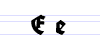 Uppercase and lowercase E in Fraktur
 -
 Approximate form of upper case letter E in uncial script that was the source for lower case e


See also edit
The template Template:Letter does not use the parameter(s):Character=E5Please see Module:checkparams for help with this warning.
Other representations of E:


English edit
Etymology 1 edit
From Middle English and Old English lower case letter e and split of æ, ea, eo, and œ, from five 7th century replacements of Anglo-Saxon Futhorcs by Latin letters:
 Old English lower case letter e, from replacement by Latin letter e of the Anglo-Saxon Futhorc letter ᛖ (e).
 Old English lower case letter æ from replacement by Latin ligature æ of the Anglo-Saxon Futhorc letter ᚫ (æ).
 Old English lower case digraph ea, from replacement by Latin digraph ea of the Anglo-Saxon Futhorc letter ᛠ (ea).
 Old English lower case digraph eo from replacement by Latin digraph eo of Anglo-Saxon Futhorc ᛇ (eo).
 Old English lower case letter œ from replacement by Latin ligature œ of the Anglo-Saxon Futhorc letter ᛟ (œ).


Pronunciation edit
- (letter name): IPA(key): /ˈiː/
- (phoneme): IPA(key): /ɛ/, /iː/, /ɪ/, /ə/, /eɪ/
- In addition to the phonemes noted above, "e" can also be silent, representing no sound itself but indicating which phoneme another letter in the word represents. See the article "Silent e" on Wikipedia.
Letter edit
e (lower case, upper case E, plural es or e's)
- The fifth letter of the English alphabet, called e and written in the Latin script.
Coordinate terms edit
- (Latin script letters) letter; Aa, Bb, Cc, Dd, Ee, Ff, Gg, Hh, Ii, Jj, Kk, Ll, Mm, Nn, Oo, Pp, Qq, Rr, Ss, Tt, Uu, Vv, Ww, Xx, Yy, Zz
Number edit
e (lower case, upper case E)
- The ordinal number fifth, derived from this letter of the English alphabet, called e and written in the Latin script.
Noun edit
e (plural ees)
- The name of the Latin-script letter E.
Alternative forms edit
Coordinate terms edit
- (Latin-script letter names) letter; a, bee, cee, dee, e, ef, gee, aitch, i, jay, kay, el, em, en, o, pee, cue, ar, ess, tee, u, vee, double-u, ex, wye, zee/zed (Category: en:Latin letter names)
Pronoun edit
e (third-person singular, nominative case, accusative em, possessive adjective eir, possessive noun eirs, reflexive emself)
- (rare, epicene, nonstandard) A gender-neutral third-person singular subject pronoun, equivalent to the singular they and coordinate with gendered pronouns he and she.
- 2023, Aimee Ogden, “A Half-Remembered World”, The Magazine of Fantasy & Science Fiction, vol. 145, no. 1-2, whole no. 768 (July/August 2023), pages 146-202
- Empre waded out to help them cross the last stretch. More people, a few hundred, perhaps, had gathered along the shore. One of them came running at Melu with a cry—she threw up her arms in defense. But it was Aeran, only Aeran. E seized Asu and clasped her close, eir eyes closed tightly as e sobbed eir relief.
- 2023, Aimee Ogden, “A Half-Remembered World”, The Magazine of Fantasy & Science Fiction, vol. 145, no. 1-2, whole no. 768 (July/August 2023), pages 146-202
Synonyms edit
Translations edit
Etymology 2 edit
Abbreviations.
- (stenoscript) a word-initial letter ⟨e⟩
- (stenoscript) the long vowel /iː/ at the end of a word, or before a final consonant that is not /dʒ, v, z/. (Note: the final consonant is not written; [ɪə˞] counts as /iːr/.)
- (stenoscript) the words he, me
Etymology 3 edit
- (rare, nonstandard) a gender-neutral third-person singular subject pronoun, equivalent to singular they, and coordinate with gendered pronouns he and she.
- 2000, Jane Love, “Ethics, Plugged and Unplugged: The Pegagogy of Disorderly Conduct”, in James A. Inman, Donna N. Sewell, editors, Taking flight with OWLs: Examining Electronic Writing Center Work, Taylor & Francis, →ISBN, →OL, LCC PE1414.T24 1999, page 193:
Afar edit
Letter edit
e
- The fifth letter of the Afar alphabet, written in the Latin script.
See also edit
Afrikaans edit
Pronunciation edit
Audio (file)
Noun edit
e (plural e's, diminutive e'tjie)
- The name of the Latin-script letter E.
Ainu edit
Pronunciation edit
Verb edit
e (Kana spelling エ)
- (transitive) to eat
Synonyms edit
See also edit
- ku (“to drink”)
Albanian edit
Alternative forms edit
Etymology edit
(This etymology is missing or incomplete. Please add to it, or discuss it at the Etymology scriptorium.)
- Conjunction e (“and, also”): according to Orel from Proto-Albanian *ō(d), from Proto-Indo-European *ēd ~ *ōd (ablative sg. stem of Proto-Indo-European *ē- ~ *ō-).[1]
Pronunciation edit
Conjunction edit
e
Related terms edit
Pronoun edit
e m or f or n
- Third-person singular accusative-case pronominal clitic (him, her, it)
- E di. / S'e di.
- I know it. / I don't know it.
- E bleva.
- I bought it.
Preposition edit
e
- (of)
- Besa e shqiptarit nuk shitet pazarit.
- The honor of an Albanian can not be sold or bought in a bazaar.
Article edit
e
- adjectival article for:
- definite masculine singular adjectives in all accusative case
- indefinite feminine singular adjectives in the nominative case
- definite plural and feminine singular adjectives in the nominative and accusative cases
Related terms edit
See also edit
| masculine | feminine | plural | ||||
|---|---|---|---|---|---|---|
| indefinite | definite | indefinite | definite | indefinite | definite | |
| nominative | i | i | e | e | të | e |
| accusative | të | e | të | e | të | e |
| genitive, dative and ablative | të | të | të | së | të | të |
Notice that while both adjectives require the adjectival article and the same masculine plural agreement, only the first adjectival article takes its definite form, as the second is not in the immediate environment of the modified definite noun.
References edit
- ^ Orel, Vladimir E. (1998) “Conjunction e (and also)”, in Albanian Etymological Dictionary, Leiden, Boston, Köln: Brill, →ISBN, page 85
Alemannic German edit
Etymology edit
(This etymology is missing or incomplete. Please add to it, or discuss it at the Etymology scriptorium.)
Pronunciation edit
Article edit
e f
- (indefinite) a/an
Declension edit
| Declension of en | ||||
|---|---|---|---|---|
| masculine | feminine | neuter | plural | |
| nominative/accusative | en | e | es | - |
| dative | emene | enere | emene | {{{8}}} |
Angolar edit
Etymology edit
(This etymology is missing or incomplete. Please add to it, or discuss it at the Etymology scriptorium.)
Pronoun edit
e
Aromanian edit
Etymology edit
Conjunction edit
e
Synonyms edit
- (and): shi
Azerbaijani edit
Pronunciation edit
Letter edit
e lower case (upper case E)
- The sixth letter of the Azerbaijani alphabet, written in the Latin script.
See also edit
Basque edit
Pronunciation edit
Letter edit
e (lower case, upper case E)
- The fifth letter of the Basque alphabet, called e and written in the Latin script.
See also edit
- (Latin-script letters) A a, B b, C c, (Ç ç), D d, E e, F f, G g, H h, I i, J j, K k, L, l, M m, N n, Ñ ñ, O o, P p, Q q, R r, S s, T t, U u, (Ü ü), V v, W w, X x, Y y, Z z
Noun edit
e (indeclinable)
- The name of the Latin-script letter E.
See also edit
Breton edit
Etymology 1 edit
(This etymology is missing or incomplete. Please add to it, or discuss it at the Etymology scriptorium.)
Pronoun edit
e
Etymology 2 edit
From Proto-Brythonic *ɨn, from Proto-Celtic *eni.
Preposition edit
e
Inflection edit
Usage notes edit
Catalan edit
Pronunciation edit
Noun edit
e f (plural es)
Chinese edit
Etymology 1 edit
(This etymology is missing or incomplete. Please add to it, or discuss it at the Etymology scriptorium.)
Pronunciation edit
Prefix edit
e
- e- (electronic)
Etymology 2 edit
From clipping of English email.
Pronunciation edit
Verb edit
e
- (Hong Kong Cantonese) to email
Corsican edit
Etymology edit
From the earlier le.
Pronunciation edit
- IPA(key): /ˈɛ/
- Homophones: è, hè
Article edit
e f pl (masculine singular u, feminine singular a, masculine plural i)
- the (feminine plural)
Usage notes edit
- Before a vowel, e turns into l'.
Pronoun edit
e f pl
- them (feminine direct object)
Usage notes edit
- Before a vowel, e turns into l'.
See also edit
References edit
Dalmatian edit
Etymology edit
Conjunction edit
e
Dutch edit
Pronunciation edit
Letter edit
e (lower case, upper case E)
- The fifth letter of the Dutch alphabet.
See also edit
Emilian edit
Etymology edit
From Latin et, ultimately from Proto-Indo-European *éti.
Pronunciation edit
Conjunction edit
e
Esperanto edit
Pronunciation edit
Letter edit
e (lower case, upper case E)
- The sixth letter of the Esperanto alphabet, called e and written in the Latin script.
See also edit
- (Latin script letters) litero; Aa, Bb, Cc, Ĉĉ, Dd, Ee, Ff, Gg, Ĝĝ, Hh, Ĥĥ, Ii, Jj, Ĵĵ, Kk, Ll, Mm, Nn, Oo, Pp, Rr, Ss, Ŝŝ, Tt, Uu, Ŭŭ, Vv, Zz
Noun edit
e (accusative singular e-on, plural e-oj, accusative plural e-ojn)
- The name of the Latin-script letter E.
See also edit
Estonian edit
Pronunciation edit
Letter edit
e (lower case, upper case E)
- The fifth letter of the Estonian alphabet, called ee and written in the Latin script.
Conjunction edit
e
- Abbreviation of ehk; or, a.k.a.
See also edit
Fala edit
Conjunction edit
e
- Alternative form of i
Faroese edit
Pronunciation edit
Letter edit
e (upper case E)
- The sixth letter of the Faroese alphabet, written in the Latin script.
See also edit
Finnish edit
Etymology 1 edit
The Finnish orthography using the Latin script was based on those of Swedish, German and Latin, and was first used in the mid-16th century. No earlier script is known. See the Wikipedia article on Finnish for more information, and e for information on the development of the glyph itself.
Pronunciation edit
Letter edit
e (lower case, upper case E)
- The fifth letter of the Finnish alphabet, called ee and written in the Latin script.
See also edit
- (Latin-script letters) kirjain; A a, B b, C c, D d, E e, F f, G g, H h, I i, J j, K k, L l, M m, N n, O o, P p, Q q, R r, S s (Š š), T t, U u, V v (W w), X x, Y y, Z z (Ž ž), Å å, Ä ä, Ö ö
Etymology 2 edit
Noun edit
e
Usage notes edit
Capitalized for the great octave or any octave below that, or in names of major keys; not capitalized for the small octave or any octave above that, or in names of minor keys.
Declension edit
Declension of e (type maa)
|
Derived terms edit
French edit
Pronunciation edit
Noun edit
e m (plural e)
- The name of the Latin-script letter E.
Derived terms edit
Friulian edit
Etymology edit
Conjunction edit
e
Fula edit
Etymology 1 edit
See Translingual section.
Letter edit
e (lower case, upper case E)
- A letter of the Fula alphabet, written in the Latin script.
Usage notes edit
See also edit
- (Latin-script letters) karfeeje; ', A a, B b, Mb mb, Ɓ ɓ, C c, D d, Nd nd, Ɗ ɗ, E e, F f, G g, Ng ng, Ɠ ɠ, H h, I i, J j, Nj nj, K k, L l, M m, N n, Ŋ ŋ, Ñ ñ, Ɲ ɲ, O o, P p, R r, S s, T t, U u, W w, Y y, Ƴ ƴ
Etymology 2 edit
(This etymology is missing or incomplete. Please add to it, or discuss it at the Etymology scriptorium.)
Conjunction edit
e
Usage notes edit
Galician edit
Etymology 1 edit
Pronunciation edit
Conjunction edit
e
- and
- Túa irmá e eu fomos cear e despois ao cine.
- Your sister and I went to have dinner and then to the cinema.
Etymology 2 edit
See Translingual section.
Pronunciation edit
Letter edit
e (lower case, upper case E)
- The fifth letter of the Galician alphabet, written in the Latin script.
Noun edit
e m (plural es)
- e (name of the letter E, e)
See also edit
- (Latin-script letters) letra; A a (Á á), B b, C c, D d, E e (É é), F f, G g, H h, I i (Í í, Ï ï), L l, M m, N n, Ñ ñ, O o (Ó ó), P p, Q q, R r, S s, T t, U u (Ú ú, Ü ü), V v, X x, Z z
Further reading edit
- “e” in Dicionario da Real Academia Galega, Royal Galician Academy.
Gothic edit
Romanization edit
e
- Romanization of 𐌴
Guinea-Bissau Creole edit
Etymology edit
From Portuguese e. Cognate with Kabuverdianu e.
Conjunction edit
e
Gun edit
Etymology 1 edit
Pronunciation edit
Pronoun edit
é
Etymology 2 edit
Pronunciation edit
Pronoun edit
e
See also edit
| Gungbe personal pronouns | ||||||
|---|---|---|---|---|---|---|
| Number | Person | Emphatic Pronoun | Subject Pronoun | Object Pronoun | Possessive Determiner | |
| Singular | First | nyɛ́, yẹ́n | ùn, n | mi | cé, ṣié | |
| Second | jɛ̀, jẹ̀, yẹ̀, hiẹ̀ | à | wè | tòwè | ||
| Third | éɔ̀, úɔ̀, éwọ̀ | é | è | étɔ̀n, étọ̀n | ||
| Plural | First | mílɛ́, mílẹ́ | mí | mítɔ̀n, mítọ̀n | ||
| Second | mìlɛ́, mìlẹ́ | mì | mìtɔ̀n, mìtọ̀n | |||
| Third | yélɛ́, yélẹ́ | yé | yétɔ̀n, yétọ̀n | |||
Hawaiian edit
Etymology edit
(This etymology is missing or incomplete. Please add to it, or discuss it at the Etymology scriptorium.)
Particle edit
e
- used to mark the following verb as an infinitive; to
- used before a name, a noun or a phrase to address someone or something
Preposition edit
e
- by (indicating the agent of a verb in the passive voice)
Hungarian edit
Etymology 1 edit
From Proto-Uralic *e-. Cognates include Finnish että and Estonian et.[1]
Pronunciation edit
Determiner edit
e (demonstrative)
Pronoun edit
e
- (archaic, except before most consonant-initial postpositions) this
- Itt a mozi, e mellett lakunk mi. ― Here is the cinema; we live next to this.
Usage notes edit
A rarer substitute of ez, but unlike ez, it does not take the case of the noun it is attached to, and no definite article is used:
- ezen a helyen ― e helyen ― at this place (literally, “on this place”)
- ebben a házban ― e házban ― in this house
Most consonant-initial postpositions can take e, e.g. e nélkül, e helyett, see Pronominal adverbs from postpositions, in the column “that one, this one”. On the other hand, vowel-initial postpositions take ez (e.g. ez alatt, ez iránt).
Interjection edit
e
- (folksy) look!, hey! (expressing surprise or wanting to get attention)
- E! Hát Józsi meg hová tűnt? ― Hey! Where is Joe?
- Itt van, e! (informal) ― Here it is.
Etymology 2 edit
See Translingual section.
Pronunciation edit
- (letter or phoneme itself; identifier): IPA(key): [ˈɛː][2]
- (musical note): IPA(key): [ˈeː] (in the names of minor scales; see also E)
Letter edit
e (lower case, upper case E)
- The ninth letter of the Hungarian alphabet, called e and written in the Latin script.
Declension edit
| Inflection (stem in long/high vowel, front unrounded harmony) | ||
|---|---|---|
| singular | plural | |
| nominative | e | e-k |
| accusative | e-t | e-ket |
| dative | e-nek | e-knek |
| instrumental | e-vel | e-kkel |
| causal-final | e-ért | e-kért |
| translative | e-vé | e-kké |
| terminative | e-ig | e-kig |
| essive-formal | e-ként | e-kként |
| essive-modal | — | — |
| inessive | e-ben | e-kben |
| superessive | e-n | e-ken |
| adessive | e-nél | e-knél |
| illative | e-be | e-kbe |
| sublative | e-re | e-kre |
| allative | e-hez | e-khez |
| elative | e-ből | e-kből |
| delative | e-ről | e-kről |
| ablative | e-től | e-ktől |
| non-attributive possessive - singular |
e-é | e-ké |
| non-attributive possessive - plural |
e-éi | e-kéi |
| Possessive forms of e | ||
|---|---|---|
| possessor | single possession | multiple possessions |
| 1st person sing. | e-m | e-im |
| 2nd person sing. | e-d | e-id |
| 3rd person sing. | e-je | e-i |
| 1st person plural | e-nk | e-ink |
| 2nd person plural | e-tek | e-itek |
| 3rd person plural | e-jük | e-ik |
Derived terms edit
See also edit
- (Latin-script letters) betű; A a, Á á, B b, C c, Cs cs, D d, Dz dz, Dzs dzs, E e, É é, F f, G g, Gy gy, H h, I i, Í í, J j, K k, L l, Ly ly, M m, N n, Ny ny, O o, Ó ó, Ö ö, Ő ő, P p, Q q, R r, S s, Sz sz, T t, Ty ty, U u, Ú ú, Ü ü, Ű ű, V v, W w, X x, Y y, Z z, Zs zs
- -e (suffix)
References edit
- ^ Entry #125 in Uralonet, online Uralic etymological database of the Hungarian Research Centre for Linguistics.
- ^ Siptár, Péter and Miklós Törkenczy. The Phonology of Hungarian. The Phonology of the World’s Languages. Oxford University Press, 2007. →ISBN, p. 280
Further reading edit
- (sound, letter, abbreviation): e , (musical note, its symbol or key/position): e , (pronoun, alternative form of ez): e , (folksy interjection pointing at something nearby): e , (interjection, rare alternative form of eh): e in Bárczi, Géza and László Országh. A magyar nyelv értelmező szótára (‘The Explanatory Dictionary of the Hungarian Language’, abbr.: ÉrtSz.). Budapest: Akadémiai Kiadó, 1959–1962. Fifth ed., 1992: →ISBN
- e in Ittzés, Nóra (ed.). A magyar nyelv nagyszótára (‘A Comprehensive Dictionary of the Hungarian Language’). Budapest: Akadémiai Kiadó, 2006–2031 (work in progress; published A–ez as of 2024)
Iau edit
Noun edit
e
Further reading edit
- Bill Palmer, The Languages and Linguistics of the New Guinea Area (→ISBN, 2017), page 531, table 95, Comparative basic vocabulary in Lakes Plain Languages
Icelandic edit
Pronunciation edit
Letter edit
e (upper case E)
- The sixth letter of the Icelandic alphabet, written in the Latin script.
See also edit
Ido edit
Pronunciation edit
Letter edit
e (upper case E)
- The fifth letter of the Ido alphabet, written in the Latin script.
See also edit
- (Latin-script letters) litero; A a, B b, C c, D d, E e, F f, G g, H h, I i, J j, K k, L, l, M m, N n, O o, P p, Q q, R r, S s, T t, U u, V v, W w, X x, Y y, Z z
Conjunction edit
e
Related terms edit
Igbo edit
Pronunciation edit
Letter edit
e (upper case E, lower case e)
- The fifth letter of the Igbo alphabet, written in the Latin script.
Alternative forms edit
- a (retracted tongue position)
Pronoun edit
e
- (indefinite) somebody, one, they, people (an unspecified individual).
Usage notes edit
- Often gets translated into English with the passive voice.
See also edit
Indo-Portuguese edit
Etymology edit
From Portuguese e (“and”).
Conjunction edit
e
- and (expresses two elements to be taken together or in addition to each other)
- 1883, Hugo Schuchardt, Kreolische Studien, volume 3:
- Trasê tamêm um vaquinh bem gord e matá par nós comê e par nós regalá
- Bring also a small and very fat cow and kill (it) for us to eat and for us to feast on
Indonesian edit
Pronunciation edit
Letter edit
e (lower case, upper case E)
- The fifth letter of the Indonesian alphabet, written in the Latin script.
See also edit
Interlingua edit
Alternative forms edit
- (rare) et
Conjunction edit
e
Istriot edit
Etymology edit
Conjunction edit
e
- and
- 1877, Antonio Ive, Canti popolari istriani: raccolti a Rovigno, volume 5, Ermanno Loescher, page 128:
- Caro, cun quil visito bianco e russo.
- Dear, with that little white and red face.
Italian edit
Etymology 1 edit
From Latin ē (the name of the letter E).
Pronunciation edit
Letter edit
e f or m (invariable, lower case, upper case E)
- The fifth letter of the Italian alphabet, called e and written in the Latin script.
Noun edit
e f (invariable)
- The name of the Latin-script letter E.; e
See also edit
- (Latin-script letter names) lettera; a, bi, ci, di, e, effe, gi, acca, i, i lunga, kappa, elle, emme, enne, o, pi, cu, erre, esse, ti, u, vu, doppia vu, ics, ipsilon, zeta
Etymology 2 edit
Alternative forms edit
- ed (before a word starting with a vowel, especially /e ɛ/.)
Pronunciation edit
Conjunction edit
e
- and
- (archaic, literary) (e... e) both... and or just ... and (Can we clean up(+) this sense?)
- mid 1300s–mid 1310s, Dante Alighieri, “Canto I”, in Inferno [Hell][3], lines 4–6; republished as Giorgio Petrocchi, editor, La Commedia secondo l'antica vulgata [The Commedia according to the ancient vulgate][4], 2nd revised edition, Florence: publ. Le Lettere, 1994:
Usage notes edit
- Causes syntactic doubling of a following initial consonant.
References edit
- ^ Angelo Prati, "Vocabolario Etimologico Italiano", Torino, 1951
Further reading edit
e in Luciano Canepari, Dizionario di Pronuncia Italiana (DiPI)
Japanese edit
Romanization edit
e
Kabuverdianu edit
Etymology edit
From Portuguese e.
Conjunction edit
e
Kaingang edit
Pronunciation edit
Verb edit
e
Kashubian edit
Etymology edit
The Kashubian orthography is based on the Latin alphabet. No earlier script is known. See the Kashubian alphabet article on Wikipedia for more, and e for development of the glyph itself.
Letter edit
e (lower case, upper case E)
- The seventh letter of the Kashubian alphabet, written in the Latin script.
See also edit
Kosraean edit
Etymology edit
From Proto-Oceanic *api, from Proto-Malayo-Polynesian *hapuy, from Proto-Austronesian *Sapuy. Compare Malay api, Malagasy afo, Tsat pui³³, Palauan ngau, Chuukese ááf, Tongan afi, Samoan afi and Hawaiian ahi.
Pronunciation edit
Noun edit
e
Latin edit
Etymology 1 edit
(This etymology is missing or incomplete. Please add to it, or discuss it at the Etymology scriptorium.)
Letter edit
e
- A letter of the Latin alphabet.
Etymology 2 edit
(This etymology is missing or incomplete. Please add to it, or discuss it at the Etymology scriptorium.)
Pronunciation edit
Noun edit
ē f (indeclinable)
- The name of the letter E.
Coordinate terms edit
- (Latin-script letter names) littera; ā, bē, cē, dē, ē, ef, gē, hā / *acca, ī, kā, el, em, en, ō, pē, kū, er, es, tē, ū, ix / īx / ex, ȳ / ī graeca / ȳpsīlon, zēta
References edit
- e in Charlton T. Lewis (1891) An Elementary Latin Dictionary, New York: Harper & Brothers
- e in Charles du Fresne du Cange’s Glossarium Mediæ et Infimæ Latinitatis (augmented edition with additions by D. P. Carpenterius, Adelungius and others, edited by Léopold Favre, 1883–1887)
- e in Gaffiot, Félix (1934) Dictionnaire illustré latin-français, Hachette.
- e in Harry Thurston Peck, editor (1898), Harper's Dictionary of Classical Antiquities, New York: Harper & Brothers
- Arthur E. Gordon, The Letter Names of the Latin Alphabet (University of California Press, 1973; volume 9 of University of California Publications: Classical Studies), part III: “Summary of the Ancient Evidence”, page 32: "Clearly there is no question or doubt about the names of the vowels A, E, I, O, U. They are simply long A, long E, etc. (ā, ē, ī, ō, ū). Nor is there any uncertainty with respect to the six mutes B, C, D, G, P, T. Their names are bē, cē, dē, gē, pē, tē (each with a long E). Or about H, K, and Q: they are hā, kā, kū—each, again, with a long vowel sound."
Etymology 3 edit
Abbreviated from ex.
Pronunciation edit
Preposition edit
ē (short form of ex)
Derived terms edit
Related terms edit
Latvian edit
Etymology edit
Proposed in 1908 as part of the new Latvian spelling by the scientific commission headed by K. Mīlenbahs, which was accepted and began to be taught in schools in 1909. Prior to that, Latvian had been written in German Fraktur, and sporadically in Cyrillic.
Pronunciation 1 edit
| (file) |
| (file) |
Letter edit

e (lower case, upper case E)
- The seventh letter of the Latvian alphabet, called e and written in the Latin script.
Usage notes edit
The letter E/e (like its long counterpart Ē/ē) represent two sounds, [ɛ] — šaurais e (“narrow e”) — and [æ] — platais e (“broad e”). In principle, [ɛ] is used when there is a palatal element (the vowels i, ī, e, ē, the diphthongs ie, ei, and the palatal consonants j, ķ, ģ, ļ, ņ, š, ž, č, dž, and, in the old spelling, ŗ) either in the same or in the following syllable; otherwise, [æ] is used. Unfortunately, some historical changes have obscured this pattern by removing some previously existing palatal elements; as a result of that, for a number of words the actual pronunciation of the letter e — [ɛ] or [æ] — must be memorized.
See also edit
- (Latvian letters) latviešu burti; Aa, Āā, Bb, Cc, Čč, Dd, Ee, Ēē, Ff, Gg, Ģģ, Hh, Ii, Īī, Jj, Kk, Ķķ, Ll, Ļļ, Mm, Nn, Ņņ, Oo, Pp, Rr, Ss, Šš, Tt, Uu, Ūū, Vv, Zz, Žž
Pronunciation 2 edit
Noun edit
e m (invariable)
- The Latvian name of the Latin script letter E/e.
See also edit
Ligurian edit
Pronunciation edit
Etymology 1 edit
From Latin et, from Proto-Indo-European *éti (“beyond, over”).
Conjunction edit
e
| Ligurian Definite Articles | ||
|---|---|---|
| singular | plural | |
| masculine | o | i |
| feminine | a | e |
Etymology 2 edit
Article edit
e f pl (singular a)
Livonian edit
Pronunciation edit
Letter edit
e (upper case E)
- The eighth letter of the Livonian alphabet, written in the Latin script.
See also edit
Lule Sami edit
Etymology edit
(This etymology is missing or incomplete. Please add to it, or discuss it at the Etymology scriptorium.)
Verb edit
e
Malay edit
Letter edit
e (lower case, upper case E)
- The fifth letter of the Malay alphabet, written in the Latin script.
See also edit
Maltese edit
Etymology 1 edit
Pronunciation edit
- IPA(key): /ɛ/ (short phoneme)
- IPA(key): /a/ (some speakers; when following għ in an unstressed final syllable)
- IPA(key): /ɛː/ (long phoneme)
- In inherited words, long e occurs only next to vowelised għ or h. In Romance words, it can be long on its own.
Letter edit
e (lower case, upper case E)
- The fifth letter of the Maltese alphabet, written in the Latin script.
See also edit
- (Latin-script letters) ittra; A a, B b, Ċ ċ, D d, E e, F f, Ġ ġ, G g, Għ għ, H h, Ħ ħ, I i, Ie ie, J j, K k, L l, M m, N n, O o, P p, Q q, R r, S s, T t, U u, V v, W w, X x, Ż ż, Z z
Etymology 2 edit
Onomatopoeic. Compare Italian eh and English eh.
Interjection edit
e
- In isolation, a request for repetition or clarification of what has just been said: eh, what
- Used as a tag question, to emphasise what goes before or to request that the listener express an opinion about what has been said: eh
- Used to express dissent
Alternative forms edit
Mandarin edit
Romanization edit
- Hanyu Pinyin reading of 呃
e
- Nonstandard spelling of ē.
- Nonstandard spelling of é.
- Nonstandard spelling of ě.
- Nonstandard spelling of è.
- Nonstandard spelling of ê̄.
- Nonstandard spelling of ế.
- Nonstandard spelling of ê̌.
- Nonstandard spelling of ề.
Usage notes edit
- 《汉语拼音方案》 (Scheme for the Chinese Phonetic Alphabet) defines a standard pronunciation for each letter in Hanyu Pinyin with Zhuyin. ㄝ (/ɛ/) typically only occurs in syllables with an initial glide (e.g. ㄧㄝ (-ie /i̯ɛ/)), where it is romanized as e. When it occurs in syllables without an initial glide, however, it is romanized as ê in order to distinguish it from ㄜ (-e /ɤ/). Such instances are rare, and are only found in interjections or neologisms.
- Transcriptions of Mandarin into the Latin script often do not distinguish between the critical tonal differences employed in the Mandarin language, using words such as this one without indication of tone.
Mauritian Creole edit
Etymology 1 edit
Pronunciation edit
Letter edit
e
- the fifth letter of the modern Latin alphabet
Etymology 2 edit
Alternative forms edit
Pronunciation edit
Conjunction edit
e
Mbyá Guaraní edit
Adjective edit
e
Middle English edit
Etymology 1 edit
Noun edit
e
- Alternative form of æ
Etymology 2 edit
Pronoun edit
e
- Alternative form of I (“I”)
Etymology 3 edit
Pronoun edit
e
- Alternative form of he (“he”)
Etymology 4 edit
Pronoun edit
e
- Alternative form of he (“they”)
Middle Low German edit
Alternative forms edit
Etymology edit
From Proto-Germanic *aiwaz, whence also Old Norse ei.
Adverb edit
ê
Descendants edit
- German Low German: Ehe
Mokilese edit
Noun edit
e
Inflection edit
| singular possessor | first person | ehioa | |
|---|---|---|---|
| second person | ehmwen | ||
| third person | ehn | ||
| dual possessors | first person inclusive | ehsa | |
| first person exclusive | ehma | ||
| second person | ehmwa | ||
| third person | ehra | ||
| plural possessors | first person inclusive | ehsai | |
| first person exclusive | ehmai | ||
| second person | ehmwai | ||
| third person | ehrai | ||
| remote plural possessors | first person inclusive | ehs | |
| first person exclusive | ehmi | ||
| second person | ehmwi | ||
| third person | ehr | ||
| construct form | ehn | ||
edit
Letter edit
e
- The eighth letter of the Navajo alphabet:
- e = /ɛ˨/
- ę = /ɛ̃˨/
- é = /ɛ˥/
- ę́ = /ɛ̃˥/
- ee = /ɛː˨˨/
- ęę = /ɛ̃ː˨˨/
- ée = /ɛː˥˨/
- ę́ę = /ɛ̃ː˥˨/
- eé = /ɛː˨˥/
- ęę́ = /ɛ̃ː˨˥/
- éé = /ɛː˥˥/
- ę́ę́ = /ɛ̃ː˥˥/
Neapolitan edit
Pronunciation edit
Etymology 1 edit
Alternative forms edit
Preposition edit
e
- of (used to express ownership)
Etymology 2 edit
Conjunction edit
e
Norwegian edit
Etymology edit
See Translingual section.
Pronunciation edit
Letter edit
e
- The fifth letter of the Norwegian alphabet
Usage notes edit
- /ə/ only appears in unstressed syllables.
Inflection edit
Norwegian Bokmål edit
Article edit
e
- (non-standard since 1938) Alternative form of ei
Norwegian Nynorsk edit
Etymology 1 edit
Pronunciation edit
Verb edit
e
Etymology 2 edit
Pronoun edit
e
- (dialectal, parts of Trøndelag and Western Norway) pronunciation spelling of eg (“I”).
Nupe edit
Etymology 1 edit
Pronunciation edit
Letter edit
e (lower case, upper case E)
- The sixth letter of the Nupe alphabet, written in the Latin script.
See also edit
- (Latin-script letters) banki; A a (Á á, À à), B b, C c, D d, Dz dz, E e (É é, È è), F f, G g, Gb gb, H h, I i (Í í, Ì ì), J j, K k, Kp kp, L l, M m (Ḿ ḿ, M̀ m̀, M̄ m̄), N n (Ń ń, Ǹ ǹ, N̄ n̄), O o (Ó ó, Ò ò), P p, R r, S s, Sh sh, T t, Ts ts, U u (Ú ú, Ù ù), V v, W w, Y y, Z z, Zh zh
Etymology 2 edit
Pronunciation edit
Particle edit
è
- Marks the imperfective aspect, for actions that are not completed.
Nzadi edit
Particle edit
é
- Used to link a possessed noun to its possessor.
Usage notes edit
This particle accompanies several tonal changes, as well as a simplification or elision of the coda of the possessed noun in some cases. Many nouns can be linked directly in possessive constructions without using this particle, chiefly those that denotes humans or animals when used in the singular, although it is impossible to predict exactly which nouns will follow which pattern based on semantics, ancestral noun class, or morphology.
Further reading edit
- Crane, Thera, Larry Hyman, Simon Nsielanga Tukumu (2011) A grammar of Nzadi [B.865]: a Bantu language of the Democratic Republic of the Congo, Berkeley, CA: University of California Press, →ISBN
Occitan edit
Etymology 1 edit
From Old Occitan e, from Latin et.
Conjunction edit
e
Etymology 2 edit
Noun edit
e f (plural es)
- e (the letter e, E)
Old French edit
Conjunction edit
e
- Alternative form of et
Old Galician-Portuguese edit
Etymology 1 edit
From Latin et, from Proto-Indo-European *éti.
Alternative forms edit
Pronunciation edit
Conjunction edit
e
- and (expresses two elements to be taken together or in addition to each other)
Descendants edit
Etymology 2 edit
Alternative form of é
Verb edit
e
- Alternative form of é
- 13th century CE, Alfonso X of Castile, Cantigas de Santa Maria, E codex, cantiga 7 (facsimile):
- Eſta e como ſanta Maria liurou a Abadeſſa prenne q̇ adormecera anto ſeu Altar chorando.
- This one is about how Holy Mary acquitted the pregnant abbess who had fallen asleep crying in front of her altar.
- Eſta e como ſanta Maria liurou a Abadeſſa prenne q̇ adormecera anto ſeu Altar chorando.
Old Occitan edit
Etymology edit
Conjunction edit
e
Descendants edit
- Occitan: e
Old Spanish edit
Alternative forms edit
Etymology edit
From Latin et, from Proto-Indo-European *éti.
Pronunciation edit
Conjunction edit
e
- and
- c. 1200: Almerich, Fazienda de Ultramar, f. 64v.
- e el reẏ con ſana q́ auie mando que mataſen todos los ſabios de babilonna e demandaron a danel e aſos conpaneros por matar
- And the king, full of anger, ordered all the wise men of Babylon be put to death, and they sought Daniel and his companions to put them to death.
- c. 1200: Almerich, Fazienda de Ultramar, f. 64v.
Descendants edit
Ometepec Nahuatl edit
Noun edit
e
- bean.
Papiamentu edit
Etymology 1 edit
From Portuguese ele and Spanish él and Kabuverdianu el.
Pronoun edit
e
Etymology 2 edit
From Portuguese este and Spanish este and Kabuverdianu es.
Article edit
e
- the (definite article)
Pohnpeian edit
Etymology 1 edit
(This etymology is missing or incomplete. Please add to it, or discuss it at the Etymology scriptorium.)
Pronoun edit
e
Etymology 2 edit
(This etymology is missing or incomplete. Please add to it, or discuss it at the Etymology scriptorium.)
Alternative forms edit
Determiner edit
e
- his, her, hers, its, third person possessive pronoun
- Liho iang eh pwoud.
- The woman joined her husband.
Etymology 3 edit
Of Onomatopoeic origin.
Interjection edit
e
- what, in response to being called
Polish edit
Etymology edit
The Polish orthography is based on the Latin alphabet. No earlier script is known. See the history of Polish orthography article on Wikipedia for more, and e for development of the glyph itself.
Pronunciation edit
Letter edit
e (lower case, upper case E)
- The seventh letter of the Polish alphabet, called e and written in the Latin script.
See also edit
- (Latin-script letters) A a, Ą ą, B b, C c, Ć ć, D d, E e, Ę ę, F f, G g, H h, I i, J j, K k, L l, Ł ł, M m, N n, Ń ń, O o, Ó ó, P p, R r, S s, Ś ś, T t, U u, W w, Y y, Z z, Ź ź, Ż ż
Interjection edit
e
- (colloquial) hey! (used to call someone's attention)
Portuguese edit
Etymology 1 edit
From Old Galician-Portuguese e (“and”), from Latin et (“and”), from Proto-Indo-European *éti.
Pronunciation edit
- (Brazil, sometimes when emphasised) IPA(key): /e/
- (Caipira dialect, before a vowel) IPA(key): /j/
Audio (file) - Homophone: i
Conjunction edit
e
- and (connects two clauses indicating that the events occurred together, one after the other or without any special implication)
- Synonym: &
- Eu vim e eles saíram.
- I came and they left.
- 2007, J. K. Rowling, Harry Potter e as Relíquias da Morte [Harry Potter and the Deathly Hallows] (Harry Potter; 7), Rio de Janeiro: Rocco, →ISBN, page 211:
- Mandaram lacrar todas as saídas e não deixar ninguém...
- They ordered me to seal all the exits and not to let anyone...
- and (connects the last and penultimate elements in a list)
- Eu e ele vamos embora.
- He and I are going away.
- Tenho quatro frutas: uma maçã, uma pera, uma laranja e uma uva.
- I have four fruits: an apple, a pear, an orange and a grape.
- (emphatic) and (connects every element of a list)
- Ela é baixa, e burra, e preguiçosa, e feia.
- She is short, and stupid, and lazy, and ugly.
- 2003, J. K. Rowling, Harry Potter e a Ordem da Fênix [Harry Potter and the Order of the Phoenix] (Harry Potter; 5), Rio de Janeiro: Rocco, →ISBN, page 308:
- Você notou os cabelos dela, são negros e brilhantes e macios...
- You noticed her hair, it's dark and brilliant and soft...
- (logic) and (indicates a conjunction operation)
- Verdadeiro e falso dá falso.
- True and false yields false.
- (in the format “X e X”) and (indicates a great number of something)
- Esperei por anos e anos.
- I waited for years and years.
Quotations edit
For quotations using this term, see Citations:e.
Descendants edit
Noun edit
e m (uncountable)
- (logic) and, conjunction
Quotations edit
For quotations using this term, see Citations:e.
Etymology 2 edit
See Translingual section.
Pronunciation edit
- Hyphenation: e
Letter:
Noun:
Letter edit
e (lower case, upper case E)
- The fifth letter of the Portuguese alphabet, written in the Latin script.
See also edit
- (Latin-script letters) letra; A a (Á á, À à, Â â, Ã ã), B b, C c (Ç ç), D d, E e (É é, Ê ê), F f, G g, H h, I i (Í í), J j, K k, L l, M m, N n, O o (Ó ó, Ô ô, Õ õ), P p, Q q, R r, S s, T t, U u (Ú ú), V v, W w, X x, Y y, Z z
- The fifth letter of the Portuguese alphabet, called ê or é and written in the Latin script.
- 2005, J. K. Rowling, Harry Potter e o Enigma do Príncipe [Harry Potter and the Half-Blood Prince] (Harry Potter; 6), Rio de Janeiro: Rocco, →ISBN, page 141:
- Quero conversar com os senhores e exijo sua total e absoluta atenção.
- I want to talk with you and I demand your total and absolute attention.
Etymology 3 edit
Abbreviation of este
Noun edit
e m (uncountable)
- Abbreviation of este (east)
Etymology 4 edit
Verb edit
e
- (Internet slang, text messaging) Alternative form of é (“is”)
Rapa Nui edit
Pronunciation edit
Etymology 1 edit
From Proto-Polynesian *e. Cognates include Hawaiian e and Maori e.
Particle edit
e
- Used to mark the subject of a non-stative verb.
- Used to form a vocative of the following (proper) noun.
Usage notes edit
- The particle is only obligatory when used with verbs describing first-hand sensing:
- He tike'a koe e au. ― I see you.
- With other verbs, e has an emphatic undertone.
Etymology 2 edit
From Proto-Polynesian *e. Cognates include Hawaiian e and Maori e.
Particle edit
e
- Used to indicate the imperfective aspect.
- Used to indicate the exhortative mood.
- Used before numerals to form cardinal numbers.
References edit
Rawang edit
Pronunciation edit
Verb edit
e
- to exist.
Suffix edit
e
- verbal suffix for marking non-past declarative clause.
Romagnol edit
Etymology edit
Article edit
e m
- Alternative form of e’ (“the”)
Romani edit
Pronunciation edit
Letter edit
e (lower case, upper case E)
- (International Standard) The seventh letter of the Romani alphabet, written in the Latin script.
- (Pan-Vlax) The eighth letter of the Romani alphabet, written in the Latin script.
See also edit
- (Latin-script letters) A a, B b, C c, D d, E e, F f, G g, H h, X x, I i, J j, K k, Kh kh, L l, M m, N n, O o, P p, Ph ph, R r, S s, T t, Th th, U u, V v, Z z International Standard: (À à, Ä ä, Ǎ ǎ), Ć ć, Ćh ćh, (È è, Ë ë, Ě ě), (Ì ì, Ï ï, Ǐ ǐ), (Ò ò, Ö ö, Ǒ ǒ), Rr rr, Ś ś, (Ù ù, Ü ü, Ǔ ǔ), Ź ź, Ʒ ʒ, Q q, Ç ç, ϴ θ. Pan-Vlax: Č č, Čh čh, Dž dž, (Dź dź), Ř ř, Š š, (Ś ś), Ž ž, (Ź ź).
Romanian edit
Etymology 1 edit
See Translingual section.
Pronunciation edit
Letter edit
e (lower case, upper case E)
- The seventh letter of the Romanian alphabet, called e and written in the Latin script.
Usage notes edit
See E for pronunciation notes.
See also edit
- (Latin script letters) Aa, Ăă, Ââ, Bb, Cc, Dd, Ee, Ff, Gg, Hh, Ii, Îî, Jj, Kk, Ll, Mm, Nn, Oo, Pp, Qq, Rr, Ss, Șș, Tt, Țț, Uu, Vv, Ww, Xx, Yy, Zz
Noun edit
e n (plural e-uri)
- The name of the Latin-script letter E.
Declension edit
Etymology 2 edit
(This etymology is missing or incomplete. Please add to it, or discuss it at the Etymology scriptorium.)
Interjection edit
e
- expression of annoyance, irritation
- expression of boredom, indifference
- (when prolonged…eee) expression of surprise, satisfaction, admiration
Etymology 3 edit
Pronunciation edit
Verb edit
e
Etymology 4 edit
Conjunction edit
e
Samoan edit
Etymology edit
(This etymology is missing or incomplete. Please add to it, or discuss it at the Etymology scriptorium.)
Preposition edit
e
- by (a person or animate object)
Sardinian edit
Etymology edit
From Latin et, ultimately from Proto-Indo-European *éti.
Pronunciation edit
Conjunction edit
e
Sassarese edit
Etymology edit
From Latin et, ultimately from Proto-Indo-European *éti or *h₁eti.
Pronunciation edit
Conjunction edit
e
Scottish Gaelic edit
Etymology 1 edit
Letter edit
e (lower case, upper case E)
- The fifth letter of the Scottish Gaelic alphabet, written in the Latin script. It is preceded by d and followed by f. Its traditional name is eadha (“aspen”).
See also edit
- (Latin-script letters) litir; A a (À à), B b (Bh bh), C c (Ch ch), D d (Dh dh), E e (È è), F f (Fh fh), G g (Gh gh), H h, I i (Ì ì), L l, M m (Mh mh), N n, O o (Ò ò), P p (Ph ph), R r, S s (Sh sh), T t (Th th), U u (Ù ù)
- (diacritics) ◌̀
- (obsolete vowels) Á á É é Ó ó
Etymology 2 edit
From Old Irish é. Cognates include Irish é and Manx eh.
Pronunciation edit
Pronoun edit
e (emphatic esan)
See also edit
| simple | emphatic | |||
|---|---|---|---|---|
| singular | plural | singular | plural | |
| First person | mi | sinn | mise | sinne |
| Second person | thu, tu1) | sibh | thusa, tusa1) | sibhse |
| Third person m | e | iad | esan | iadsan |
| Third person f | i | ise | ||
| *) sibh and sibhse also act as the polite singular pronouns. **) To mark a direct object of a verbal noun, the derivatives of gam are used. 1) used when following a verb ending in -n, -s or -dh. | ||||
References edit
- Edward Dwelly (1911) “e”, in Faclair Gàidhlig gu Beurla le Dealbhan [The Illustrated Gaelic–English Dictionary][6], 10th edition, Edinburgh: Birlinn Limited, →ISBN
- G. Toner, M. Ní Mhaonaigh, S. Arbuthnot, D. Wodtko, M.-L. Theuerkauf, editors (2019), “1 é, hé”, in eDIL: Electronic Dictionary of the Irish Language
Serbo-Croatian edit
Etymology 1 edit
See Translingual section.
Alternative forms edit
- (uppercase): E
Pronunciation edit
Letter edit
e (Cyrillic spelling е)
Usage notes edit
Its name is е /e/ and it has the sound of e in net.
Etymology 2 edit
Interjection edit
e (Cyrillic spelling е)
- (rare) well, now
- (informal, at the beginning of the sentence) hey
- (informal, at the beginning of the sentence) Used to emphasize the sentence
- E, šta ima? ― Hey, what's up?
- (informal, at the beginning of the sentence) Used to express surprise
- E, otkud ti? ― Hey, where did you come from?
- (informal, at the beginning of the sentence) Used to get attention or change the topic of conversation, especially if followed by a (“and; but”)
- E, a vidi ovo. ― And look at this.
Sicilian edit
Etymology edit
From Latin et, ultimately from Proto-Indo-European *éti.
Pronunciation edit
Conjunction edit
e
Silesian edit
Etymology edit
The Silesian orthography is based on the Latin alphabet. No earlier script is known. See the Silesian language article on Wikipedia for more, and e for development of the glyph itself.
Letter edit
e (lower case, upper case E)
- The seventh letter of the Silesian alphabet, written in the Latin script.
See also edit
Skolt Sami edit
Pronunciation edit
Letter edit
e (upper case E)
- The tenth letter of the Skolt Sami alphabet, written in the Latin script.
See also edit
Slovene edit
Alternative forms edit
Etymology 1 edit
From Gaj's Latin alphabet e, from Czech alphabet e, from Latin e, which is a modification of capital letter E in uncial script, from Ancient Greek Ε (E, Epsilon).
Pronunciation edit
- (phoneme, Standard Slovene): IPA(key): /éː/, /èː/, /ɛ́/, /ɛ́ː/, /ɛ̀ː/, /ə́/, /ə̀/, /e/, /ɛ/, [ɪ́], [ɪ̀], [é̞], [è̞]
- (phoneme, Resian): IPA(key): /ɛ/
- (phoneme, Natisone Valley dialect): IPA(key): /ɛː/, /ɛ/, /ɛ̆/
- (letter name): IPA(key): /èː/, /éː/
- (letter name, archaic): IPA(key): /ɛ̀ː/, /ɛ́ː/
Audio (letter name, non-tonal) (file) - Rhymes: -eː, -ɛː
- Homophones: e, E
Letter edit
e (lower case, upper case E)
- The sixth letter of the Slovene alphabet, written in the Latin script.
- The eighth letter of the Resian alphabet, written in the Latin script.
- The sixth letter of the Natisone Valley alphabet, written in the Latin script.
Derived terms edit
Symbol edit
e
Noun edit
e m inan or n
- The name of the Latin script letter E / e.
Usage notes edit
Nowadays, it is hardly ever neuter gender, so it is considered obsolete.[1]
Inflection edit
- Overall more common

| Masculine inan., soft o-stem | |||
|---|---|---|---|
| nom. sing. | e | ||
| gen. sing. | e-ja | ||
| singular | dual | plural | |
| nominative (imenovȃlnik) |
e | e-ja | e-ji |
| genitive (rodȋlnik) |
e-ja | e-jev | e-jev |
| dative (dajȃlnik) |
e-ju | e-jema | e-jem |
| accusative (tožȋlnik) |
e | e-ja | e-je |
| locative (mẹ̑stnik) |
e-ju | e-jih | e-jih |
| instrumental (orọ̑dnik) |
e-jem | e-jema | e-ji |
- More common when with a definite adjective
| Masculine inan., no endings | |||
|---|---|---|---|
| nom. sing. | e | ||
| gen. sing. | e | ||
| singular | dual | plural | |
| nominative | e | e | e |
| accusative | e | e | e |
| genitive | e | e | e |
| dative | e | e | e |
| locative | e | e | e |
| instrumental | e | e | e |
- Obsolete
| Neuter, no endings | |||
|---|---|---|---|
| nom. sing. | e | ||
| gen. sing. | e | ||
| singular | dual | plural | |
| nominative | e | e | e |
| accusative | e | e | e |
| genitive | e | e | e |
| dative | e | e | e |
| locative | e | e | e |
| instrumental | e | e | e |
Etymology 2 edit
Pronunciation edit
- IPA(key): /èː/, /éː/
- (third definition also): IPA(key): [ẽ́ː], [ẽ̀ː]
Audio (file) - Rhymes: -eː, -ẽː
- Homophones: e, E
Interjection edit
e
- (informal, rare, at the beginning of sentences) Used to express happiness when saying something
- E, do smrti bom živel!
- Hey, I will live till I die!
- (informal, at the beginning of sentences) Used to express uneasyness
- E, da, seveda.
- Um, sure, of course
- (informal, rare, at the end of sentences) Used to form questions
- Synonym: a
- Kdo je to naredil, e?
- Who did that, huh?
Etymology 3 edit
(This etymology is missing or incomplete. Please add to it, or discuss it at the Etymology scriptorium.)
Pronunciation edit
- IPA(key): /ɛ́/
- Rhymes: -ɛ
- Homophones: e, E
Interjection edit
e
- (informal, at the beginning of sentences) Used to express indifference to what was said before
- (informal, at the beginning of sentences) Used to express unhappiness
- E, pa kaj še!
- Yeah, sure!
See also edit
- (Latin script letters) Aa, Bb, Cc, Čč, Dd, Ee, Ff, Gg, Hh, Ii, Jj, Kk, Ll, Mm, Nn, Oo, Pp, Rr, Ss, Šš, Tt, Uu, Vv, Zz, Žž
- ë
- ē
- è
- é
- ê
- ȩ
- ɛ
- ḙ
- ė
- ẹ
- ə
References edit
- Krvina, Domen, Žele, Andreja (2017) O MEDMETIH, ZLASTI O NJIHOVIH RAZLOČEVALNIH LASTNOSTIH: POUDARJEN SLOVARSKI VIDIK[7] (in Slovene)
- Kenda-Jež, Karmen (2017 February 27) Fonetična trankripcija [Phonetic transcription][8] (in Slovene), Znanstvenoraziskovalni center SAZU, Inštitut za slovenski jezik Frana Ramovša, archived from the original on January 22, 2022, pages 27–30
Further reading edit
- “e”, in Slovarji Inštituta za slovenski jezik Frana Ramovša ZRC SAZU, portal Fran
Spanish edit
Pronunciation edit
Etymology 1 edit
See Translingual section.
Letter edit
e (lower case, upper case E)
- The fifth letter of the Spanish alphabet, written in the Latin script.
Noun edit
e f (plural es)
- Name of the letter E
Etymology 2 edit
Alternative forms edit
Conjunction edit
e
- and
- Yo hablo francés e inglés.
- I speak French and English.
Usage notes edit
- Used instead of y when the following word starts with the vowel sound /i/.
See also edit
Sranan Tongo edit
Etymology edit
Reduced form of de (“to be”)
Particle edit
e
- Verbal marker for continuous aspect.
Sumerian edit
Romanization edit
e
- Romanization of 𒂊
Swedish edit
Etymology 1 edit
See Translingual section.
Pronunciation edit
Letter edit
e (lower case, upper case E)
- The fifth letter of the Swedish alphabet, called e and written in the Latin script.
See also edit
- (Latin-script letters) bokstav; A a, B b, C c, D d, E e, F f, G g, H h, I i, J j, K k, L l, M m, N n, O o, P p, Q q, R r, S s, T t, U u, V v, W w, X x, Y y, Z z, Å å, Ä ä, Ö ö
- é
Etymology 2 edit
Verb edit
e
- (colloquial, Internet slang, text messaging) Pronunciation spelling of är.
- 2014 January 17, Veronica Maggio (lyrics and music), “Hela huset”[9] ft. Håkan Hellström:
- Går runt i t-shirt och e trött
- Walking tired around in a t-shirt
Derived terms edit
Etymology 3 edit
From Old Norse æ, ei, ey, from Proto-Germanic *aiwi (“forever”), *aiwaz.
Adverb edit
e (not comparable)
Related terms edit
Tagalog edit
Etymology 1 edit
From Spanish e. Each pronunciation has a different source:
- Filipino alphabet pronunciation is influenced by English e.
- Abakada alphabet pronunciation is influenced by the Baybayin character ᜁ (i).
- Abecedario pronunciation is from Spanish e.
Pronunciation edit
- (letter name, Filipino alphabet):
- IPA(key): /ʔi/, [ʔɪ]
- (letter name, Abakada alphabet, Abecedario): IPA(key): /ʔe/, [ʔɛ]
- (phoneme): IPA(key): /e/, [ɛ]
- Rhymes: -i, -e
Letter edit
e (lower case, upper case E, Baybayin spelling ᜁ)
- The fifth letter of the Tagalog alphabet (Filipino alphabet), called i and written in the Latin script.
- The fifth letter of the Tagalog alphabet (Abakada alphabet), called e and written in the Latin script.
- (historical) The sixth letter of the Tagalog alphabet (Abecedario), called e and written in the Latin script.
See also edit
- (Latin-script letters) titik; A a, B b, C c, D d, E e, F f, G g, H h, I i, J j, K k, L l, M m, N n, Ñ ñ, Ng ng, O o, P p, Q q, R r, S s, T t, U u, V v, W w, X x, Y y, Z z
- ë
Noun edit
e (Baybayin spelling ᜁ)
- the name of the Latin-script letter E, in the Abakada alphabet.
- Synonym: (in the Filipino alphabet) i
- (historical) the name of the Latin-script letter E, in the Abecedario.
- Synonym: (in the Filipino alphabet) i
See also edit
Etymology 2 edit
Compare Spanish eh and English eh.
Alternative forms edit
Pronunciation edit
Interjection edit
e (Baybayin spelling ᜂ) (informal)
- Used to acknowledge a statement or situation: well; so
- E, ganoon e!
- Well, it's like that!
- E, ano ngayon?
- So, what now?
- Nandoon siya, e.
- Well, he/she was/is there.
- Used to rhetorically express surprise or suspicion: so; oh; well
- E, sino naman 'yun?
- Oh so then, who was that?
- E, ikaw lang din naman 'yun.
- Well anyways, that was also only just you.
- Used to express indignance: well; but
- E, hindi mo naman kinailangan gawin iyon.
- But, you didn't need to do that.
- Used to introduce the continuation of narration from a previous understood point: and; well; so
- E, magkano naman ito?
- And, how much is this one?
Derived terms edit
See also edit
Further reading edit
- “e”, in Pambansang Diksiyonaryo | Diksiyonaryo.ph, Manila, 2018
Tahitian edit
Etymology edit
(This etymology is missing or incomplete. Please add to it, or discuss it at the Etymology scriptorium.)
Particle edit
e
- indicates that an action is unfinished when inserted before the verb
Teop edit
Etymology edit
(This etymology is missing or incomplete. Please add to it, or discuss it at the Etymology scriptorium.)
Pronoun edit
e
Further reading edit
Tokelauan edit
Pronunciation edit
Etymology 1 edit
From Proto-Polynesian *e. Cognates include Hawaiian e and Samoan e.
Preposition edit
e
- Marks the subject of a transitive verb; by
Etymology 2 edit
From Proto-Polynesian *e. Cognates include Hawaiian e and Samoan e.
Particle edit
e
- Indicates indefinite present tense.
- 1948, Tūlāfono fakavae a Tokelau [Constitution of Tokelau][10], page 1:
- Ko kimatou, ia tagata o Tokelau, e takutino
- We, the people of Tokelau, (do) speak openly
- Indicates future tense.
References edit
- R. Simona, editor (1986), Tokelau Dictionary[11], Auckland: Office of Tokelau Affairs, page 24
Tongan edit
Etymology edit
(This etymology is missing or incomplete. Please add to it, or discuss it at the Etymology scriptorium.)
Pronunciation edit
Preposition edit
e
Tooro edit
Pronunciation edit
Pronoun edit
-e (declinable)
Usage notes edit
- This modifier, when used in the indefinite forms, causes the word before it to move its high tone to the ultimate syllable.
Inflection edit
See also edit
References edit
Turkish edit
Pronunciation edit
Letter edit
e (lower case, upper case E)
- The sixth letter of the Turkish alphabet, called e and written in the Latin script.
See also edit
- (Latin script letters) harf; Aa, Bb, Cc, Çç, Dd, Ee, Ff, Gg, Ğğ, Hh, Iı, İi, Jj, Kk, Ll, Mm, Nn, Oo, Öö, Pp, Rr, Ss, Şş, Tt, Uu, Üü, Vv, Yy, Zz
Noun edit
e
- The name of the Latin-script letter E.
See also edit
Turkmen edit
Pronunciation edit
Letter edit
e (upper case E)
- The fifth letter of the Turkmen alphabet, called e and written in the Latin script.
See also edit
Tuvaluan edit
Etymology edit
(This etymology is missing or incomplete. Please add to it, or discuss it at the Etymology scriptorium.)
Particle edit
e
- present tense marker, inserted immediately before the relevant verb
Vietnamese edit
Pronunciation edit
Etymology 1 edit
Borrowed from Portuguese é.
Noun edit
e
- The name of the Latin-script letter E.
Etymology 2 edit
Compare Pacoh e (“to guard, to watch over”).
Verb edit
- to fear; to be apprehensive, to be afraid
- Tôi e cô ta không đến.
- I am afraid she will not come.
- to be slightly ashamed
See also edit
Etymology 3 edit
Pronoun edit
e
- (slang, Internet, text messaging) Abbreviation of em.
References edit
- "e" in Hồ Ngọc Đức, Free Vietnamese Dictionary Project (details)
- Lê Sơn Thanh, "Nom-Viet.dat", WinVNKey (details)
Vilamovian edit
Etymology edit
(This etymology is missing or incomplete. Please add to it, or discuss it at the Etymology scriptorium.)
Pronunciation edit
Audio (file)
Noun edit
e n
Volapük edit
Alternative forms edit
- (before a vowel) ed
Etymology edit
(This etymology is missing or incomplete. Please add to it, or discuss it at the Etymology scriptorium.)
Conjunction edit
e
Related terms edit
Welsh edit
Etymology 1 edit
Alternative forms edit
- (with grave accent to indicate otherwise unpredictable short vowel): è
- (with acute accent to indicate unusually stressed short vowel): é
- (with circumflex to indicate otherwise unpredictable or unusually stressed long vowel): ê
- (with diaeresis to indicate disyllabicity): ë
Pronunciation edit
Letter edit
e (lower case, upper case E)
- The seventh letter of the Welsh alphabet, called e and written in the Latin script. It is preceded by dd and followed by f.
Mutation edit
- e cannot be mutated but, being a vowel, does take h-prothesis, for example with the word eliffant (“elephant”):
| Welsh mutation | |||
|---|---|---|---|
| radical | soft | nasal | h-prothesis |
| eliffant | unchanged | unchanged | heliffant |
| Note: Some of these forms may be hypothetical. Not every possible mutated form of every word actually occurs. | |||
Derived terms edit
See also edit
Noun edit
e f (plural eau)
- The name of the Latin-script letter E.
Mutation edit
| Welsh mutation | |||
|---|---|---|---|
| radical | soft | nasal | h-prothesis |
| e | unchanged | unchanged | he |
| Note: Some of these forms may be hypothetical. Not every possible mutated form of every word actually occurs. | |||
See also edit
- (Latin-script letters) llythyren; A a (Á á, À à, Â â, Ä ä), B b, C c, Ch ch, D d, Dd dd, E e (É é, È è, Ê ê, Ë ë), F f, Ff ff, G g, Ng ng, H h, I i (Í í, Ì ì, Î î, Ï ï), J j, L l, Ll ll, M m, N n, O o (Ó ó, Ò ò, Ô ô, Ö ö), P p, Ph ph, R r, Rh rh, S s, T t, Th th, U u (Ú ú, Ù ù, Û û, Ü ü), W w (Ẃ ẃ, Ẁ ẁ, Ŵ ŵ, Ẅ ẅ), Y y (Ý ý, Ỳ ỳ, Ŷ ŷ, Ÿ ÿ)
- (Latin-script letter names) llythyren; a, bi, ec, èch, di, èdd, e, èf, èff, èg, eng, aetsh, i / i dot, je, ce, el, èll, em, en, o, pi, ffi, ciw, er, rhi, ès, ti, èth, u / u bedol / u gwpan, fi, w, ecs, y, sèd
Etymology 2 edit
Reduction of literary ef
Pronunciation edit
Pronoun edit
e
Usage notes edit
E is used predominantly in the south of Wales, while o is used in the north, with fe and fo as variants of e and o respectively. In formal Welsh, the equivalent pronoun is ef.
West Makian edit
Pronunciation edit
Verb edit
e
- (transitive) to fetch
- (transitive) to take
Conjugation edit
| Conjugation of e (action verb) | ||||
|---|---|---|---|---|
| singular | plural | |||
| inclusive | exclusive | |||
| 1st person | tee | mee | ae | |
| 2nd person | nee | fee | ||
| 3rd person | inanimate | ie | dee | |
| animate | ||||
| imperative | nee, e | fee, e | ||
References edit
- Clemens Voorhoeve (1982) The Makian languages and their neighbours[13], Pacific linguistics
Yola edit
Article edit
e
- Alternative form of a (“one”)
- 1927, “YOLA ZONG O BARONY VORTH”, in THE ANCIENT DIALECT OF THE BARONIES OF FORTH AND BARGY, COUNTY WEXFORD, page 132, line 11:
- Fan the loughraan itzel feight e big bawl,
- When the ghost itself gave a loud bawl,
References edit
- Kathleen A. Browne (1927) The Journal of the Royal Society of Antiquaries of Ireland Sixth Series, Vol.17 No.2, Royal Society of Antiquaries of Ireland, page 132
Yoruba edit
Etymology 1 edit
Pronunciation edit
Letter edit
e (lower case, upper case E)
- The fourth letter of the Yoruba alphabet, called é and written in the Latin script.
Noun edit
é
- The name of the Latin-script letter E.
See also edit
- (Latin-script letters) lẹ́tà; A a (Á á, À à, Ā ā), B b, D d, E e (É é, È è, Ē ē), Ẹ ẹ (Ẹ́ ẹ́, Ẹ̀ ẹ̀, Ẹ̄ ẹ̄), F f, G g, Gb gb, H h, I i (Í í, Ì ì, Ī ī), J j, K k, L l, M m (Ḿ ḿ, M̀ m̀, M̄ m̄), N n (Ń ń, Ǹ ǹ, N̄ n̄), O o (Ó ó, Ò ò, Ō ō), Ọ ọ (Ọ́ ọ́, Ọ̀ ọ̀, Ọ̄ ọ̄), P p, R r, S s, Ṣ ṣ, T t, U u (Ú ú, Ù ù, Ū ū), W w, Y y
- (Benin) (Latin-script letters) lɛ́tà; A a, B b, D d, E e, Ɛ ɛ, F f, G g, Gb gb, H h, I i, J j, K k, Kp kp, L l, M m, N n, O o, Ɔ ɔ, P p, R r, S s, Sh sh, T t, U u, W w, Y y
- (Latin-script letter names) lẹ́tà; á, bí, dí, é, ẹ́, fí, gí, gbì, hí, í, jí, kí, lí, mí, ní, ó, ọ́, pí, rí, sí, ṣí, tí, ú, wí, yí
Etymology 2 edit
Pronunciation edit
Pronoun edit
e
- him, her, it (third-person singular object pronoun following a monosyllabic verb with a high-tone /e/)
Pronoun edit
é
- him, her, it (third-person singular object pronoun following a monosyllabic verb with a low- or mid-tone /e/)
Zazaki edit
Etymology edit
(This etymology is missing or incomplete. Please add to it, or discuss it at the Etymology scriptorium.)
Pronunciation edit

Interjection edit
e
Particle edit
e
Antonyms edit
Zulu edit
Letter edit
e (lower case, upper case E)
- The fifth letter of the Zulu alphabet, written in the Latin script.