
祭
| ||||||||
| ||||||||
Translingual edit
Alternative forms edit
In Japanese handwriting, the diagonals of the upper right component cross: the short upper-right to lower-left stroke crosses the long upper-left to lower-right stroke, rather than abutting there.
Han character edit
祭 (Kangxi radical 113, 示+6, 11 strokes, cangjie input 月人一一火 (BOMMF), four-corner 27901, composition ⿱⿰𱼀⿺㇏㇇示)
Derived characters edit
References edit
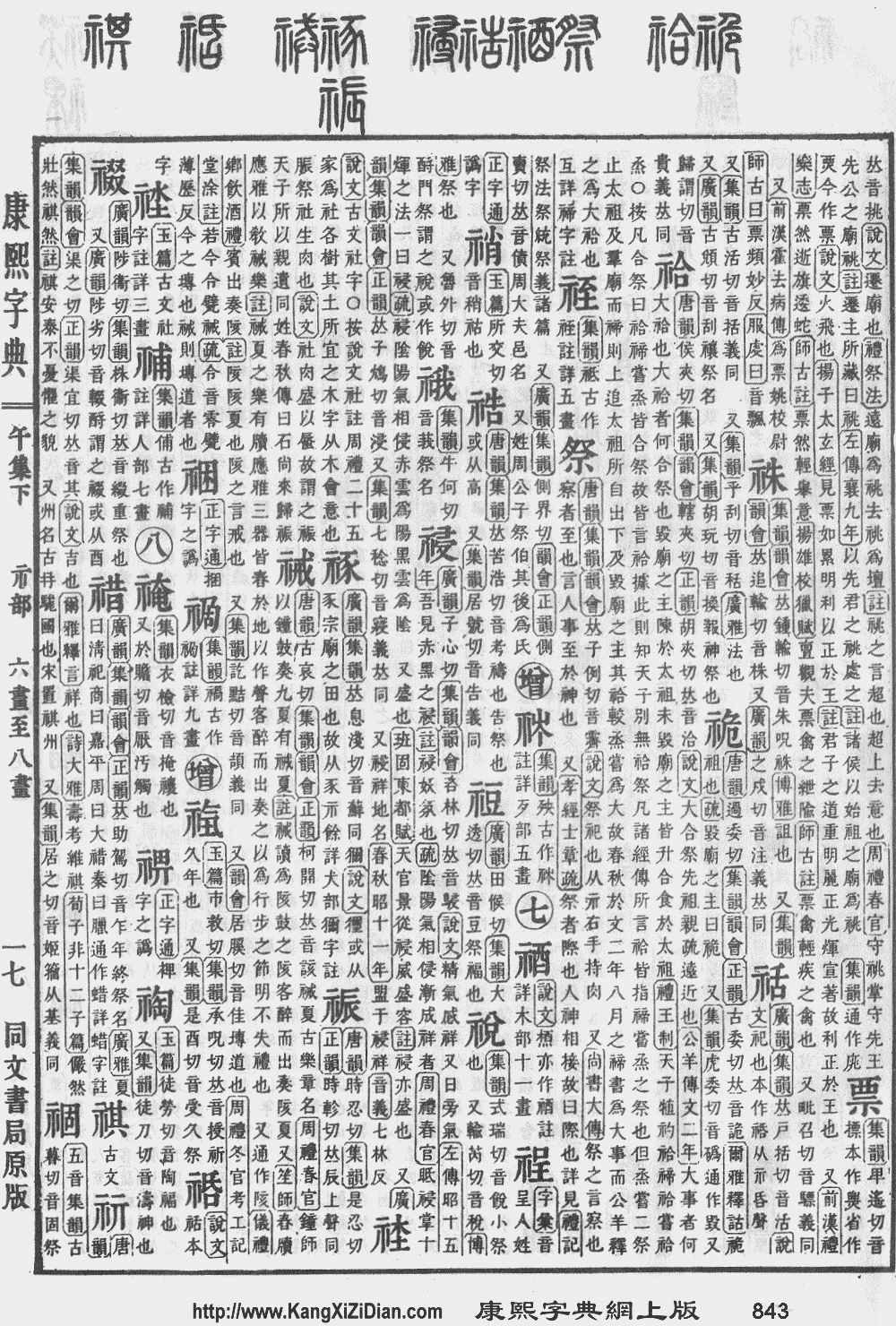
- Kangxi Dictionary: page 843, character 7
- Dai Kanwa Jiten: character 24700
- Dae Jaweon: page 1263, character 8
- Hanyu Da Zidian (first edition): volume 4, page 2397, character 7
- Unihan data for U+796D
Chinese edit
| trad. | 祭 | |
|---|---|---|
| simp. # | 祭 | |
| 2nd round simp. | 𥙊 | |
| alternative forms | 𥙊 | |
Glyph origin edit
| Historical forms of the character 祭 | ||||
|---|---|---|---|---|
| Shang | Western Zhou | Warring States | Shuowen Jiezi (compiled in Han) | Liushutong (compiled in Ming) |
| Oracle bone script | Bronze inscriptions | Bronze inscriptions | Small seal script | Transcribed ancient scripts |

|

|

|

|

|
Ideogrammic compound (會意/会意) : ⺼ (“meat”) + 又 (“hand”) + 示 (“altar, ceremony”) – the hand offers a piece of meat at the altar during a ceremony.
The top is not related to but may be corrupted to 癶 in calligraphy and handwriting; 癶 also served as the second-round simplified form of the component. The left part is ⺼ twisted to the left (compare 將, 然). The right part is a form of 又.
Pronunciation 1 edit
Definitions edit
祭
- to make offerings to; to sacrifice to; to worship
- a ceremony where one offers sacrifices to one's ancestors
Compounds edit
- 丁祭
- 丁祭肉
- 上祭
- 主祭 (zhǔjì)
- 人祭 (rénjì)
- 公祭 (gōngjì)
- 別宮祭江/别宫祭江
- 喪祭/丧祭
- 墓祭 (mùjì)
- 大祭
- 大祭司
- 奠祭 (diànjì)
- 家祭
- 巷祭
- 弔祭/吊祭
- 打牙祭 (dǎ yájì)
- 打祭
- 打祭銀/打祭银
- 打耳祭
- 拜祭 (bàijì)
- 旱祭
- 春祭 (chūnjì)
- 望祭
- 牙祭 (yájì)
- 獺祭/獭祭
- 獻祭/献祭 (xiànjì)
- 獺祭魚/獭祭鱼
- 瓜祭
- 生芻致祭/生刍致祭
- 矮靈祭/矮灵祭
- 祭丁
- 祭主
- 祭五臟廟/祭五脏庙
- 祭亡如在
- 祭享
- 祭儀/祭仪
- 祭典 (jìdiǎn)
- 祭司 (jìsī)
- 祭告 (jìgào)
- 祭品 (jìpǐn)
- 祭器 (jìqì)
- 祭堂 (jìtáng)
- 祭塔
- 祭墳/祭坟
- 祭壇/祭坛 (jìtán)
- 祭天 (jìtiān)
- 祭奠 (jìdiàn)
- 祭妹文
- 祭孔 (jìkǒng)
- 祭尸
- 祭弔/祭吊 (jìdiào)
- 祭弔文/祭吊文
- 祭悼
- 祭拜 (jìbài)
- 祭掃/祭扫
- 祭文 (jìwén)
- 祭旗 (jìqí)
- 祭月
- 祭服
- 祭東施娘/祭东施娘
- 祭桌
- 祭灶 (jìzào)
- 祭灶神
- 祭物 (jìwù)
- 祭獻/祭献 (jìxiàn)
- 祭王爺/祭王爷
- 祭祀 (jìsì)
- 祭祖 (jìzǔ)
- 祭神
- 祭禮/祭礼 (jìlǐ)
- 祭禱/祭祷
- 祭酌
- 祭酒 (jìjiǔ)
- 籩祭/笾祭
- 練祭/练祭
- 臘祭/腊祭
- 致祭 (zhìjì)
- 薦新祭/荐新祭
- 虞祭
- 蜡祭
- 血祭
- 豐年祭/丰年祭 (fēngniánjì)
- 路祭
- 遙祭/遥祭
- 郊祭 (jiāojì)
- 野祭
- 野祭巷哭
- 陪祭
- 雪祭
- 雩祭 (yújì)
Pronunciation 2 edit
Definitions edit
祭
- (~國) Zhai (a state during the Spring and Autumn period (祭國))
- a surname
Compounds edit
References edit
- Dictionary of Chinese Character Variants (教育部異體字字典), A02896
- (Min Nan) “Entry #7709”, in 臺灣閩南語常用詞辭典 (overall work in Mandarin and Hokkien), Ministry of Education, R.O.C., 2023.
- “祭”, in 漢語多功能字庫 (Multi-function Chinese Character Database)[1], 香港中文大學 (the Chinese University of Hong Kong), 2014–
Japanese edit
Kanji edit
Readings edit
- Go-on: さい (sai, Jōyō)
- Kan-on: せい (sei)
- Kun: はれ (hare); まつる (matsuru, 祭る, Jōyō); まつり (matsuri, 祭り, Jōyō)
Etymology edit
| Kanji in this term |
|---|
| 祭 |
| まつ(り) Grade: 3 |
| kun’yomi |
| For pronunciation and definitions of 祭 – see the following entry. | ||
| ||
| (This term, 祭, is an alternative spelling of the above term.) |
Korean edit
Hanja edit
祭 • (je, chae) (hangeul 제, 채, revised je, chae, McCune–Reischauer che, ch'ae, Yale cey, chay)
- This term needs a translation to English. Please help out and add a translation, then remove the text
{{rfdef}}.
Vietnamese edit
Han character edit
- This term needs a translation to English. Please help out and add a translation, then remove the text
{{rfdef}}.