
万
| ||||||||

Translingual edit
| Stroke order | |||
|---|---|---|---|

| |||
| Stroke order | |||
|---|---|---|---|

| |||
Han character edit
万 (Kangxi radical 1, 一+2, 3 strokes, cangjie input 一尸 (MS), four-corner 10227, composition ⿸丆𠃌)
Derived characters edit
Related characters edit
- 萬 (Orthodox traditional form)
Descendants edit
Further reading edit
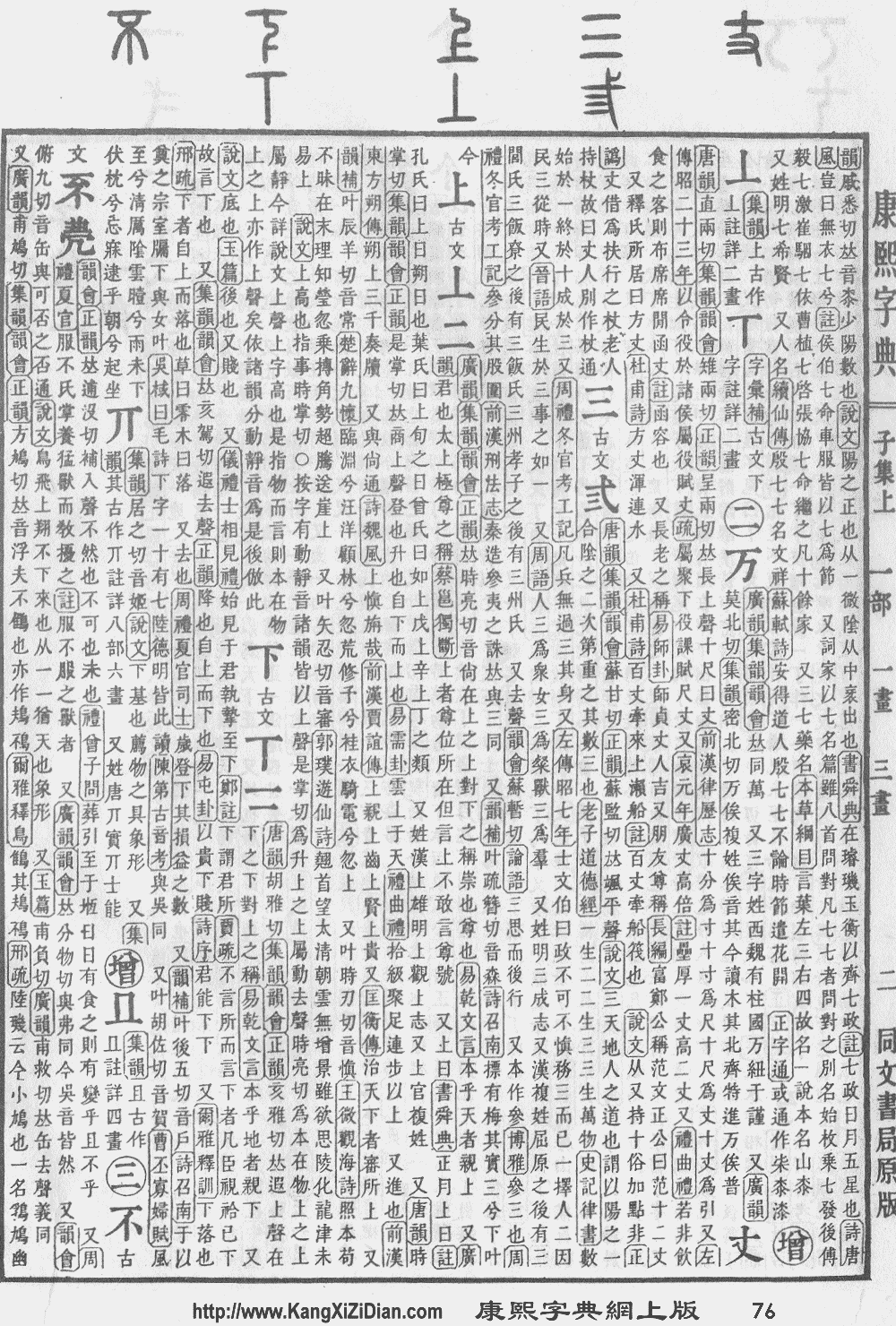
- Kangxi Dictionary: page 76, character 3
- Dai Kanwa Jiten: character 10
- Dae Jaweon: page 137, character 7
- Hanyu Da Zidian (first edition): volume 1, page 9, character 3
- Unihan data for U+4E07
 万 on Wikidata.Wikidata

Chinese edit
Glyph origin edit
| Historical forms of the character 万 | |
|---|---|
| Shang | Western Zhou |
| Oracle bone script | Bronze inscriptions |

|

|
Unknown. Used as a tribal name in oracle inscriptions. Used as a number since the Spring and Autumn and Warring States periods.
Various theories have been proposed for its original meaning:
- Qu Wanli, Qiu Xigui and others propose that it originally refers to a type of dancer-musicians. This usage is attested in the oracle inscriptions. This may be supported by ancient literature, e.g. Shijing, which mentions a type of dance called 萬舞/万舞.
- Lin Yiguang proposes that it is an ancient form of 丏 (OC *meːnʔ), acting as a phonetic component in 賓 (OC *mpin).
- Some propose that it is a differentiated form of 亥.
Etymology 1 edit
| For pronunciation and definitions of 万 – see 萬 (“scorpion; etc.”). (This character is the simplified and variant form of 萬). |
Notes:
|
Compounds edit
- 万紐于 (Wànniǔyú)
Etymology 2 edit
| simp. and trad. |
万 | |
|---|---|---|
| alternative forms | 𢄏 | |
Pronunciation edit
Definitions edit
万
- Only used in 万俟 (Mòqí).
References edit
Japanese edit
| 万 | |
| 萬 |
Kanji edit
(grade 2 “Kyōiku” kanji, shinjitai kanji, kyūjitai form 萬)
Readings edit
As a simplification and variant of 萬:
- Go-on: もん (mon)
- Kan-on: ばん (ban, Jōyō)
- Kan’yō-on: まん (man, Jōyō)
- Kun: よろず (yorozu, 万)←よろづ (yorodu, 万, historical)
- Nanori: かず (kazu); かつ (katsu); すすむ (susumu); たか (taka); つむ (tsumu); つもる (tsumoru); ま (ma); ゆる (yuru); よし (yoshi)
As part of the surname 万俟:
Compounds edit
Etymology 1 edit
| Kanji in this term |
|---|
| 万 |
| まん Grade: 2 |
| kan’yōon |
| Alternative spelling |
|---|
| 萬 (kyūjitai) |
From Middle Chinese 萬 (MC mjonH). Compare modern Cantonese 萬/万 (maan6), Hokkien 萬/万 (bān).
Pronunciation edit
Noun edit
- ten thousand, myriad
- 1999 October 17, “3万年の白亀 [30,000-Year White Turtle]”, in BOOSTER 5, Konami:
- 3万年も生きつづけている巨大カメ。守備力が高い。
- Sanman-nen mo ikitsuzukete iru kyodai kame. Shubiryoku ga takai.
- A giant turtle that has lived for over 30,000 years. It has high defense strength.
- 3万年も生きつづけている巨大カメ。守備力が高い。
Derived terms edit
Etymology 2 edit
| Kanji in this term |
|---|
| 万 |
| ばん Grade: 2 |
| kan’on |
| Alternative spelling |
|---|
| 萬 (kyūjitai) |
From Middle Chinese 萬 (MC mjonH). Compare modern Hokkien 萬/万 (bān).
Pronunciation edit
Adverb edit
- (followed by a negative) even if, never
- (followed by a negative) no matter what
Prefix edit
Derived terms edit
- 万感 (bankan, “flood of emotions”)
- 万軍 (bangun)
- 万芸 (bangei, “versatility”)
- 万古 (banko, “old time, all this time, eternity”)
- 万斛 (bankoku)
- 万劫 (bangō, “an extremely long period of time”)
- 万死 (banshi, “critical state of the life”)
- 万寿 (banju), 万寿 (manju, “longevity”)
- 万丈 (banjō, “hurrah”)
- 万乗 (banjō, “sovereignty”)
- 万状 (banjō, “diversification”)
- 万博 (banpaku, “international exposition”)
- 万万 (banban, “very much”)
- 万民 (banmin, “all the people, the entire nation”)
- 万有 (ban'yū)
Etymology 3 edit
| Kanji in this term |
|---|
| 万 |
| よろず Grade: 2 |
| kun’yomi |
| Alternative spelling |
|---|
| 萬 (kyūjitai) |
⟨yo2ro2du⟩ → */jərədu/ → /jorod͡zu/ → /jorozu/
From Old Japanese. First attested in the Nihon Shoki of 720 CE.[4]
Appears to be a compound or inflection, but the derivation is unclear. Possibly related to Korean 여러 (yeoreo, “several, various”), in which case the final /-du/ in the Old Japanese might be a voiced version of the generic numeral nominalizer つ (tsu).
Pronunciation edit
- (Tokyo) よろず [yóꜜròzù] (Atamadaka – [1])[1][2][3]
- (Tokyo) よろず [yòrózú] (Heiban – [0])[1][2][3]
- IPA(key): [jo̞ɾo̞zɨᵝ]
Noun edit
Derived terms edit
See also edit
| Japanese numerals from Old Japanese using 万 (yorozu) | |||||||||
|---|---|---|---|---|---|---|---|---|---|
| 10,000 | 20,000 | 30,000 | 40,000 | 50,000 | 60,000 | 70,000 | 80,000 | 90,000 | |
| 万 (yorozu) | 二万 (futayorozu) | 三万 (miyorozu) | 四万 (yoyorozu) | 五万 (iyorozu) | 六万 (muyorozu) | 七万 (nanayorozu) | 八万 (yayorozu) | 九万 (kokonoyorozu) | |
References edit
- ↑ 1.0 1.1 1.2 1.3 Matsumura, Akira, editor (2006), 大辞林 [Daijirin] (in Japanese), Third edition, Tōkyō: Sanseidō, →ISBN
- ↑ 2.0 2.1 2.2 2.3 NHK Broadcasting Culture Research Institute, editor (1998), NHK日本語発音アクセント辞典 [NHK Japanese Pronunciation Accent Dictionary] (in Japanese), Tōkyō: NHK Publishing, →ISBN
- ↑ 3.0 3.1 3.2 3.3 Kindaichi, Kyōsuke et al., editors (1997), 新明解国語辞典 [Shin Meikai Kokugo Jiten] (in Japanese), Fifth edition, Tōkyō: Sanseidō, →ISBN
- ^ “万”, in 日本国語大辞典 (Nihon Kokugo Daijiten, “Nihon Kokugo Daijiten”)[1] (in Japanese), concise edition, Tōkyō: Shogakukan, 2000
Korean edit
Hanja edit
- Alternative form of 萬.
References edit
- Supreme Court of the Republic of Korea (대한민국 대법원, Daehanmin'guk Daebeobwon) (2018). Table of hanja for personal names (인명용 한자표 / 人名用漢字表, Inmyeong-yong hanja-pyo). [2]
Vietnamese edit
Han character edit
万: Hán Việt readings: vạn, mặc[1][2]
万: Nôm readings: vàn[2][3], vạn[1], muôn[2]
- Alternative form of 萬.