
燹
| ||||||||
Translingual edit
Han character edit
燹 (Kangxi radical 86, 火+14, 18 strokes, cangjie input 一人火 (MOF), four-corner 11809, composition ⿱豩火)
Derived characters edit
References edit
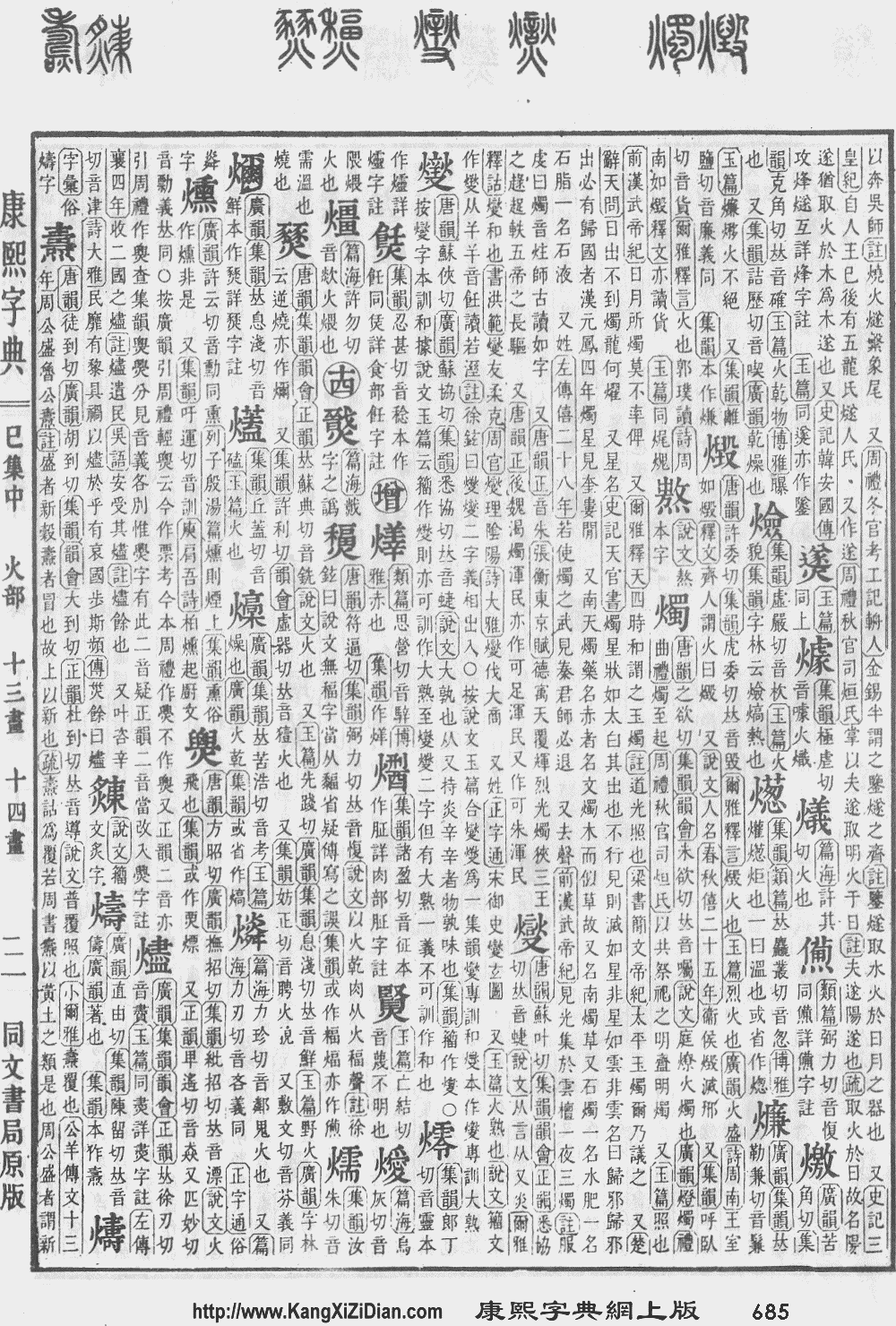
- Kangxi Dictionary: page 685, character 24
- Dai Kanwa Jiten: character 19508
- Dae Jaweon: page 1098, character 13
- Hanyu Da Zidian (first edition): volume 3, page 2242, character 23
- Unihan data for U+71F9
Chinese edit
| trad. | 燹 | |
|---|---|---|
| simp. # | 燹 | |
| alternative forms | 𤐨 | |
Glyph origin edit
| Historical forms of the character 燹 | ||
|---|---|---|
| Western Zhou | Shuowen Jiezi (compiled in Han) | Liushutong (compiled in Ming) |
| Bronze inscriptions | Small seal script | Transcribed ancient scripts |

|

|

|
Ideogrammic compound (會意/会意) - a group of pigs (豩) fleeing from a fire (火). The bronze script form has a hand with a stick (攴), indicating that the fire would have been started on purpose, in manner to get rid of the pigs. The large seal script form also has what looks like 爾 on the right side.
Pronunciation edit
Definitions edit
燹
Compounds edit
- 兵燹 (bīngxiǎn)
Japanese edit
Kanji edit
Readings edit
Compounds edit
Etymology 1 edit
| Kanji in this term |
|---|
| 燹 |
| のび Hyōgaiji |
| kun’yomi |
Compound of 野 (no, “field”) + 火 (hi, “fire”).[1][2] The hi changes to bi as an instance of rendaku (連濁).
An ancient variant seen in eastern Japan uses the dialectal reading nu for 野.[1]
Use of this kanji 燹 is rare, and is an example of jukujikun. The standard spelling is 野火.[1][2]
Pronunciation edit
Noun edit
- a wildfire
Usage notes edit
Spelled using this kanji, 燹 excludes the "controlled agricultural burn" sense found found under the 野火 spelling.
Alternative forms edit
- 野火 (standard spelling)
Etymology 2 edit
| Kanji in this term |
|---|
| 燹 |
| ほそけ Hyōgaiji |
| kun’yomi |
Compound of 火 (ho, “fire”) + 退く (soku, “to push away, to make distant”).[1]
The kun'yomi for 火 is usually hi, but it can appear as ho or fu, particularly in older compounds.
The soku changes to soke due to conjugation of the verb. Grammatically, the 連用形 (ren'yōkei, “continuative or stem form”) of soke indicates the transitive.[1]
Use of this kanji 燹 is rare, and is an example of jukujikun. The more common spelling is 火退.
Pronunciation edit
Noun edit
- a backburn: a controlled fire deliberately set in the path of a wildfire to create a firebreak by removing combustible material
Usage notes edit
The more common word for this is 向火, 向かい火 (mukaibi).[1]
Alternative forms edit
Synonyms edit
References edit
Korean edit
Hanja edit
燹 (eum 희 (hui))
- fire
- wild fires
Vietnamese edit
Han character edit
- This term needs a translation to English. Please help out and add a translation, then remove the text
{{rfdef}}.