
corn
English edit
Pronunciation edit
- (Received Pronunciation) IPA(key): /kɔːn/
- (US, Canada) IPA(key): /kɔɹn/
Audio (US) (file) Audio (AU) (file) - Rhymes: -ɔː(ɹ)n
Etymology 1 edit
From Middle English corn, from Old English corn, from Proto-West Germanic *korn, from Proto-Germanic *kurną, from Proto-Indo-European *ǵr̥h₂nóm (“grain; worn-down”), from *ǵerh₂- (“grow old, mature”).
Cognate with Dutch koren, German Low German Koorn, German Korn, Danish korn, Norwegian Bokmål korn, Norwegian Nynorsk korn and Swedish korn; see also Albanian grurë,[1] Russian зерно́ (zernó), Czech zrno, Latin grānum and Lithuanian žirnis. Doublet of grain, gram, and granum.
In sense 'maize' a shortening from earlier Indian corn.
Noun edit
corn (usually uncountable, plural corns)
- (Commonwealth English, but not Canada, Australia, or New Zealand, uncountable) Any cereal plant (or its grain) that is the main crop or staple of a country or region.
- 1611, The Holy Bible, […] (King James Version), London: […] Robert Barker, […], →OCLC, Genesis 42:2, column 2:
- And hee ſaid, Beholde, I haue heard that there is corne in Egypt: get you downe thither and buy for vs from thence, that we may liue, and not die.
- 1847, John Mason Neale, Stories from heathen mythology and Greek history, page 115:
- Among the divinities that dwelt on Mount Olympus, none was more friendly to the husbandman than Demeter, goddess of corn.
- 1887, Karl Marx, “The Working Day”, in Samuel Moore and Edward Aveling, transl., edited by Frederick [i.e., Friedrich] Engels, Capital: A Critical Analysis of Capitalist Production: Translated from the Third German Edition, volume I, London: Swan Sonnenschein, Lowrey, & Co., […], →OCLC, part III (The Production of Absolute Surplus-value), section 6 (The Struggle for the Normal Working Day. […]), page 267:
- Moreover, however much the individual manufacturer might give the rein to his old lust for gain, the spokesmen and political leaders of the manufacturing class ordered a change of front and of speech towards the workpeople. They had entered upon the contest for the repeal of the Corn Laws, and needed the workers to help them to victory. They promised, therefore, not only a double-sized loaf of bread, but the enactment of the Ten Hours' Bill in the Free Trade millenium.
- 1887, James Death, The Beer of the Bible: One of the Hitherto Unknown Leavens of Exodus. […], page 12:
- [T]here exists arguments in favour of regarding one of the eatable varieties of "leaven," Machmetzeth, as the beer of the Hebrews. The mention of beer by the Egyptians is frequent; under the name of Hek, two intoxicating beverages are included. The components of these beers, individually, are not known: one was made from corn, the other was a medicated or sweetened beer, due to the addition of honey, or system of brewing.
- 1909, Johann David Wyss (Susannah Mary Paull, translator), The Swiss Family Robinson, page 462:
- I found that we had nearly a hundred bushels of corn, including wheat, maize, and barley, to add to our store.
- (US, Canada, Australia, New Zealand, uncountable) Maize, a grain crop of the species Zea mays.
- 1809, Edward Augustus Kendall, Travels Through the Northern Parts of the United States[2]:
- The planting or sowing of maize, exclusively called corn, was just accomplished on the Town Hill, when I reached it.
- 1998 February 18, Colin G. Calloway, New Worlds for All: Indians, Europeans, and the Remaking of Early America[3], JHU Press, →ISBN, pages 51–52:
- Corn was the staff of life for many Indian people before contact, and it became the staff of life for many European colonists. Corn was higher in nutrition than most other grain crops. John Lawson, who travelled in South Carolina and into the interior Indian country in 1701, was one of the many colonists who sang the praises of corn.
- A grain or seed, especially of a cereal crop.
- He paid her the nominal fee of two corns of barley.
- 1611, The Holy Bible, […] (King James Version), London: […] Robert Barker, […], →OCLC, John 12:24, column 2:
- Verely, verely, I ſay vnto you, Except a corne of wheat fall into the ground, and die, it abideth alone: but if it die, it bringeth forth much fruit.
- A small, hard particle.
- 1612–1626, Joseph Hall, “[Contemplations upon the Principal Passages in the Holy Story. Book I.] Of Man.”, in Josiah Pratt, editor, The Works of the Right Reverend Father in God, Joseph Hall, D.D. […], volume I (Contemplations), London: […] C[harles] Whittingham, […]; for Williams and Smith, […], published 1808, →OCLC, part IV (Contemplations on the Old Testament), page 8:
- The least corn of sand is not so small to the whole earth, as man is to the heaven: […]
- 1852, Thomas Antisell, Hand-book of the Useful Arts:
- corns of powder
- (uncountable) A type of granular snow formed by repeated melting and refreezing, often in mountain spring conditions.
- Synonym: corn snow
- (Jamaica, MLE, slang, firearms, uncountable) Bullets, ammunition, charge and discharge of firearms.
- (Jamaica, slang, uncountable) Money.
- 1984, Smiley Culture, Cockney Translator (song title)[6]:
- You know dem have wedge while we have corn. Say Cockney say be first, my son! We just say Gwan!

Derived terms edit
- acknowledge the corn
- Asian corn borer
- baby corn
- blue corn
- broom corn
- calico corn
- California corn flakes
- candy corn
- can of corn
- carry corn
- cornball
- corn blotch leafminer
- corn bunting
- corn chip
- corn circle
- corncob
- corn-cob
- corn cockle
- corn cracker
- corn-cracker
- corn crake
- corn-crake
- corn crib
- corn-dodger
- corn dog
- corn doll
- corn dolly
- corn earworm
- corn exchange
- corn-factor
- corn-fed
- corn-flag
- corn flake
- corn flakes
- cornflour
- corn-hog ratio
- corn house
- cornhusker
- corn juice
- corn law
- corn liquor
- corn marigold
- cornmeal
- corn mint
- corn moon
- corn mother
- corn mummy
- corn oil
- corn on the cob
- corn oyster
- corn parsley
- corn planting moon
- corn plaster
- corn-pone
- corn pone
- corn poppy
- corn pudding
- corn rice
- corn roast
- corn roaster
- corn rye bread
- corn salad
- corn silk
- corn smut
- corn snake
- corn snow
- corn squeezing
- corn starch
- cornstarch
- corn sugar
- corn syrup
- corn thistle
- corn whiskey
- cream corn
- creamed corn
- cute as corn
- dent corn
- earn one's corn
- eat one's seed corn
- eat the seed corn
- eggcorn
- European corn borer
- field corn
- flint corn
- flour corn
- grain corn
- grind the corn
- Guinea corn
- high fructose corn syrup
- high-fructose corn syrup
- hog-corn ratio
- kaffir corn
- kafir corn
- kernel corn
- kettle corn
- negro corn
- off-corn
- peppercorn
- pib-corn
- pod corn
- popped corn
- reindeer corn
- sea corn
- seed corn
- shoepeg corn
- skillet corn bread
- sour corn
- squirrel corn
- sweetcorn
- sweet corn
- waxy corn
- what does that have to do with the price of corn
- white corn
Descendants edit
Translations edit
| ||||||


See also edit
Verb edit
corn (third-person singular simple present corns, present participle corning, simple past and past participle corned) (transitive)
- (US, Canada) To granulate; to form (a substance) into grains.
- to corn gunpowder
- (US, Canada) To preserve using coarse salt, e.g. corned beef.
- (US, Canada) To provide (an animal) with corn (typically maize; or, in Scotland, oats) for feed.
- Corn the horses.
- (transitive, obsolete) To render intoxicated.
- ale strong enough to corn one
- (Jamaica, MLE, slang) To shoot up with bullets as by a shotgun (corn).
Translations edit
Etymology 2 edit
From Middle English corne, from Old French corn (modern French cor), from Latin cornu. Doublet of corno and cornu.


Noun edit
corn (plural corns)
- A type of callus, usually on the feet or hands.
- Synonym: clavus
- c. 1591–1595 (date written), William Shakespeare, “The Tragedie of Romeo and Ivliet”, in Mr. William Shakespeares Comedies, Histories, & Tragedies […] (First Folio), London: […] Isaac Iaggard, and Ed[ward] Blount, published 1623, →OCLC, [Act I, scene v], page 57, column 2:
- Welcome Gentlemen, / Ladies that haue their toes / Vnplagu’d with Cornes, will walke about with you: […]
- (veterinary medicine) An inflammatory disease of a horse's hoof, at the caudal part of the sole.
- (veterinary medicine) Skin hyperplasia with underlying fibroma between both digits of cattle.
Hyponyms edit
Translations edit
|
Etymology 3 edit
From corny.
Noun edit
corn (uncountable)
- (US, Canada) Something (e.g. acting, humour, music, or writing) which is deemed old-fashioned or intended to induce emotion.[2]
- 1975, Tschirlie, Backpacker:
- He had a sharp wit, true enough, but also a good, healthy mountaineer's love of pure corn, the slapstick stuff, the in-jokes that get funnier with every repetition and never amuse anybody who wasn't there.
- 1986, Linda Martin, Kerry Segrave, Women in Comedy:
- There were lots of jokes on the show and they were pure corn, but the audience didn't mind.
- 2007, Bob L. Cox, Fiddlin' Charlie Bowman: an East Tennessee old-time music pioneer and his musical family:
- The bulk of this humor was pure corn, but as hillbilly material it was meant to be that way.
Derived terms edit
Etymology 4 edit
For the rhyme, and with influence from the emoji substitute 🌽.
Noun edit
corn (uncountable)
References edit
- ^ An Albanian Historical Grammar, Suart E. Mann, Buske, 1977, p.55
- ^ “Corn (emotion)”, in Cambridge Advanced Learner's Dictionary[1], Cambridge University Press, 2007 November 23 (last accessed), archived from the original on 4 December 2007
Anagrams edit
Catalan edit
Etymology edit
Pronunciation edit
Noun edit
corn m (plural corns)
Derived terms edit
Related terms edit
Further reading edit
- “corn” in Diccionari de la llengua catalana, segona edició, Institut d’Estudis Catalans.
Irish edit
Etymology edit
From Old Irish corn (“drinking horn, goblet; trumpet, horn; curl”), from Latin cornū.
Pronunciation edit
Noun edit
corn m (genitive singular coirn, nominative plural coirn)
- horn (musical instrument)
- drinking-horn
- (sports) cup
- (motor racing) plate
Declension edit
Derived terms edit
Verb edit
corn (present analytic cornann, future analytic cornfaidh, verbal noun cornadh, past participle corntha)
- (transitive) roll, coil
Conjugation edit
* indirect relative
† archaic or dialect form
‡‡ dependent form used with particles that trigger eclipsis
Alternative forms edit
Mutation edit
| Irish mutation | ||
|---|---|---|
| Radical | Lenition | Eclipsis |
| corn | chorn | gcorn |
| Note: Some of these forms may be hypothetical. Not every possible mutated form of every word actually occurs. | ||
Further reading edit
- Ó Dónaill, Niall (1977) “corn”, in Foclóir Gaeilge–Béarla, Dublin: An Gúm, →ISBN
- Entries containing “corn” in English-Irish Dictionary, An Gúm, 1959, by Tomás de Bhaldraithe.
- Entries containing “corn” in New English-Irish Dictionary by Foras na Gaeilge.
Middle English edit
Etymology 1 edit
Inherited from Old English corn, from Proto-West Germanic *korn, from Proto-Germanic *kurną, from Proto-Indo-European *ǵr̥h₂nóm. Doublet of greyn.
Alternative forms edit
Pronunciation edit
Noun edit
corn (plural corn or cornes)
- Any plant that bears grain, especially wheat.
- A field planted with such plants.
- Any kind of grain (especially as food)
- p. 1154, “AD 1137”, in Anglo-Saxon Chronicle (MS. Laud Misc. 636, continuation), Peterborough, folio 89, verso; republished at Oxford: Digital Bodleian, 2018 February 8:
- þa ƿaſ coꝛn dære: ⁊ flec ⁊ cæſe ⁊ butere. foꝛ nan ƿæſ o þe land. Ƿreccemen ſturuen of hungær.
- Grain was precious then, and meat, cheese, and butter, because there wasn't any in the country. Wretched men died from hunger.
- c. 1395, John Wycliffe, John Purvey [et al.], transl., Bible (Wycliffite Bible (later version), MS Lich 10.)[8], published c. 1410, Matheu 3:12, page 2r, column 1; republished as Wycliffe's translation of the New Testament, Lichfield: Bill Endres, 2010:
- whos wynewing cloþ is in his hond .· ⁊ he ſchal fulli clenſe his coꝛn flooꝛ / and he ſchal gadere his wheete in to his berne .· but þe chaf he ſchal bꝛenne wiþ fier þat mai not be quenchid
- His winnowing fan is in his hand; he'll fully clean his threshing-floor, he'll gather up his wheat into his barn, and he'll burn the chaff with unquenchable fire.
- A seed of a non-grain plant.
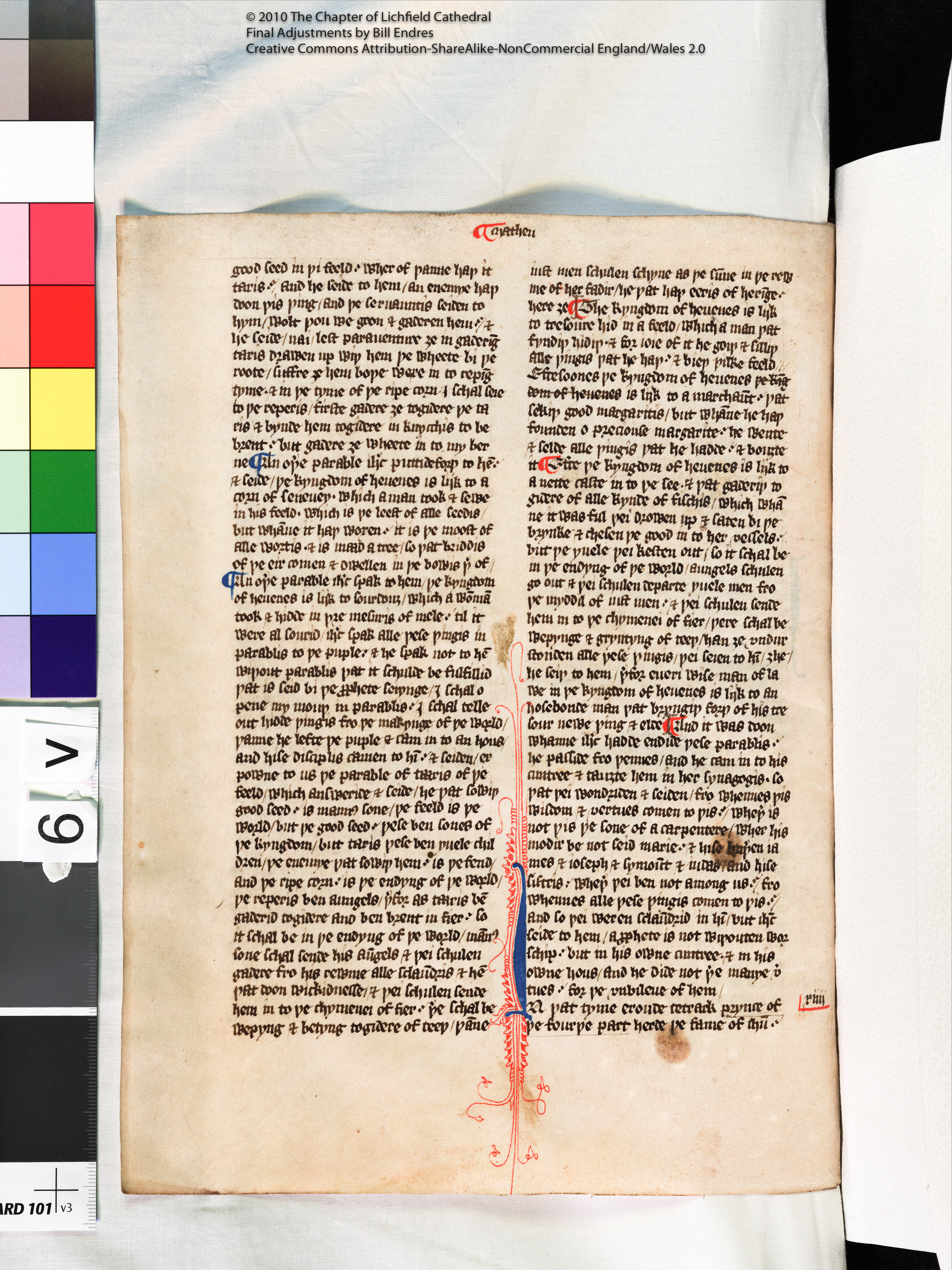
- c. 1395, John Wycliffe, John Purvey [et al.], transl., Bible (Wycliffite Bible (later version), MS Lich 10.)[9], published c. 1410, Matheu 13:31-32, page 6v, column 1; republished as Wycliffe's translation of the New Testament, Lichfield: Bill Endres, 2010:
- An oþer parable iheſus puttide foꝛþ to hem. / ⁊ ſeide / þe kyngdom of heuenes is lijk to a coꝛn of ſeneuey · which a man took ⁊ ſewe in his feeld · / which is þe leeſt of alle ſeedis / but whanne it haþ woxen .· it is the mooſt of alle woꝛtis · ⁊ is maad a tre / ſo þe bꝛiddis of þe eir comen ⁊ dwellen in þe bowis þerof.
- Jesus put another parable forwards to them, saying: "The Kingdom of Heaven is like a mustard seed that a person took and sowed in their field; / it is the smallest of all seeds, but when it has grown, it is the largest of all plants; it becomes a tree, so the birds of the air come and nest in its branches."
- A grain or seed used as a unit of weight.
- The optimum product; the superior portion.
- The deserving; those who are morally right.
- A bole (external tumourous growth).

Related terms edit
Descendants edit
References edit
- “cō̆rn, n.”, in MED Online, Ann Arbor, Mich.: University of Michigan, 2007, retrieved 2018-07-08.
Etymology 2 edit
Noun edit
corn
- Alternative form of corne (“callus”)
Old English edit
Etymology edit
From Proto-West Germanic *korn, from Proto-Germanic *kurną, from Proto-Indo-European *ǵr̥h₂nóm (“grain”).
Cognate with Old Frisian korn, Old Saxon korn (Low German Koorn), Dutch koren, Old High German korn, Old Norse korn, Gothic 𐌺𐌰𐌿𐍂𐌽 (kaurn).
Pronunciation edit
Noun edit
corn n
- corn, a grain or seed
- 880-1150, Anglo-Saxon Chronicle
- Hīe wǣron benumene æġðer ġe ðæs ċēapes ġe ðæs cornes.
- They were deprived both of cattle and of corn.
- 880-1150, Anglo-Saxon Chronicle
- a cornlike pimple, a corn on the foot
Declension edit
Descendants edit
Old French edit
Alternative forms edit
Etymology edit
Noun edit
corn oblique singular, m (oblique plural corns, nominative singular corns, nominative plural corn)
- horn (bony projection on the head of some animals)
- corner, angle, secluded place
- (figurative) strength, power
- horn (instrument used to create sound)
Descendants edit
- French: cor
References edit
- Godefroy, Frédéric, Dictionnaire de l’ancienne langue française et de tous ses dialectes du IXe au XVe siècle (1881) (corn)
Romanian edit
Pronunciation edit
Etymology 1 edit
Noun edit
corn n (plural coarne)
Declension edit
Derived terms edit
Related terms edit
Etymology 2 edit
Noun edit

corn m (plural corni)
- cornel, European cornel, Cornus mas
- rafter (of a house)
Declension edit
Related terms edit
See also edit
Scots edit
Etymology edit
From Middle English corn, from Old English corn.
Noun edit
corn (plural corns)
Verb edit
corn (third-person singular simple present corns, present participle cornin, simple past cornt, past participle cornt)
- to feed (a horse) with oats or grain
Welsh edit
Etymology edit
From Middle Welsh corn, from Proto-Brythonic *korn, from Latin cornū.
Pronunciation edit
Noun edit
corn m (plural cyrn)
Derived terms edit
- corn Ffrengig (“ French horn”)
- corn Seisnig (“English horn”)
- corn yr hydd (“broomrape, hartshorn”)
- corniog (“horned, having horns”)
- cornwyd (“boil, abscess”)
- deugorn (“two-pronged”)
- rhewi'n gorn (“to freeze solid”)
- Siôn Corn (“Father Christmas”)
- ungorn (“unicorn”)
- utgorn (“trumpet”)
Mutation edit
| Welsh mutation | |||
|---|---|---|---|
| radical | soft | nasal | aspirate |
| corn | gorn | nghorn | chorn |
| Note: Some of these forms may be hypothetical. Not every possible mutated form of every word actually occurs. | |||
Further reading edit
- R. J. Thomas, G. A. Bevan, P. J. Donovan, A. Hawke et al., editors (1950–present), “corn”, in Geiriadur Prifysgol Cymru Online (in Welsh), University of Wales Centre for Advanced Welsh & Celtic Studies