
ar
Translingual edit
Etymology edit
Abbreviation of English Arabic
Symbol edit
ar
English edit
Pronunciation edit
- (Received Pronunciation) IPA(key): /ˈɑː/
- (General American) IPA(key): /ˈɑɹ/
- (Ireland) IPA(key): /ˈaɹ/, /ˈäːɹ/
- (AAVE) IPA(key): /ˈɑɹə/
Audio (US) (file) - Rhymes: -ɑː, -ɑɹ, -ɔɹ, -ɑɹə
Etymology 1 edit
From Middle English *ar, arres pl, from earlier *er.
Noun edit
ar (plural ars)
- The name of the Latin-script letter R.
- All the ars in the inscription.
- 2004, Will Rogers, The Stonking Steps, page 170:
- I have drunk en-ee-cee-tee-ay-ar from the ef-ell-oh-doubleyou-ee-ar-ess in his gee-ay-ar-dee-ee-en many a time.
- 2016 CCEB, Communications Instructions Radiotelephone Procedures: ACP125 (G), p. 3-5
- RV [is spoken] as "ar-vee" instead of "I SPELL Romeo Victor".
Derived terms edit
Descendants edit
Translations edit
|
See also edit
- (Latin-script letter names) letter; a, bee, cee, dee, e, ef, gee, aitch, i, jay, kay, el, em, en, o, pee, cue, ar, ess, tee, u, vee, double-u, ex, wye, zee / zed
Etymology 2 edit
Interjection edit
ar
- (UK, West Country, West Midlands) Alternative form of arr
Derived terms edit
Particle edit
ar
- (UK, West Country, West Midlands) Alternative form of arr
Etymology 3 edit
Verb edit
ar
- Obsolete spelling of are
- 1570, Roger Ascham, The Scholemaster:
- But commonlie, the fairest bodies, ar bestowed on the foulest purposes.
Etymology 4 edit
Particle edit
ar
Anagrams edit
Abinomn edit
Noun edit
ar
Albanian edit
Alternative forms edit
Etymology 1 edit
Borrowed through Vulgar Latin from Latin aurum (“gold”).[2][3] Considering the rendering of Latin au- as Albanian ā-, it is a relatively archaic borrowing. Although Arbëresh dialects preserve the original Latin neuter, in standard Albanian it is masculine.
Pronunciation edit
Noun edit
- (chemistry) gold
- 1555, Gjon Buzuku, Meshari:
- Të provuomitë e fesë saj të jetë mā e pāçmuome se ari.
- The temptations of her religion are more precious than (the) gold.
- (figurative) treasure, gem
- Synonym: thesar
- golden thread
Declension edit
Derived terms edit
Adjective edit
ar (feminine are)
- golden
- (figurative) precious
- Synonym: çmueshëm
- (figurative) yellow; white, bright
- (figurative) blonde, bright, light (hair)
- Synonym: biond
Etymology 2 edit
Probably via French are (“are”).
Pronunciation edit
Noun edit
ar m (plural arë, definite ari, definite plural arët)[5]
Declension edit
References edit
- ^ Jungg, G. (1895) “aar”, in Fialuur i voghel sccȣp e ltinisct [Small Albanian–Italian dictionary], page 1
- ^ Orel, Vladimir E. (1998) “ar”, in Albanian Etymological Dictionary, Leiden, Boston, Köln: Brill, →ISBN, page 7
- ^ Topalli, K. (2017) “ar”, in Fjalor Etimologjik i Gjuhës Shqipe, Durrës, Albania: Jozef, page 111
- ^ “ar”, in FGJSH: Fjalor i gjuhës shqipe [Dictionary of the Albanian language] (in Albanian), 2006
- ^ “ar”, in FGJSH: Fjalor i gjuhës shqipe [Dictionary of the Albanian language] (in Albanian), 2006
Aromanian edit
Alternative forms edit
Etymology edit
From Latin arō. Compare Daco-Romanian ara, ar.
Verb edit
ar first-singular present indicative (third-person singular present indicative arã, past participle aratã)
- to plough
Related terms edit
Azerbaijani edit
Etymology edit
Borrowed from Arabic عَار (ʕār).
Pronunciation edit
Noun edit
ar (definite accusative arı, plural arlar)
- feeling of shame
Declension edit
| Declension of ar | ||||||||
|---|---|---|---|---|---|---|---|---|
| singular | plural | |||||||
| nominative | ar |
arlar | ||||||
| definite accusative | arı |
arları | ||||||
| dative | ara |
arlara | ||||||
| locative | arda |
arlarda | ||||||
| ablative | ardan |
arlardan | ||||||
| definite genitive | arın |
arların | ||||||
Synonyms edit
Derived terms edit
Basque edit
Pronunciation edit
Audio (file)
Noun edit
ar inan or anim
Declension edit
| indefinite | singular | plural | ||
|---|---|---|---|---|
| absolutive | ar | arra | arrak | |
| ergative | arrek | arrak | arrek | |
| dative | arri | arrari | arrei | |
| genitive | arren | arraren | arren | |
| comitative | arrekin | arrarekin | arrekin | |
| causative | arrengatik | arrarengatik | arrengatik | |
| benefactive | arrentzat | arrarentzat | arrentzat | |
| instrumental | arrez | arraz | arrez | |
| inessive | anim. | arrengan | arrarengan | arrengan |
| inanim. | arretan | arrean | arretan | |
| locative | anim. | — | — | — |
| inanim. | arretako | arreko | arretako | |
| allative | anim. | arrengana | arrarengana | arrengana |
| inanim. | arretara | arrera | arretara | |
| terminative | anim. | arrenganaino | arrarenganaino | arrenganaino |
| inanim. | arretaraino | arreraino | arretaraino | |
| directive | anim. | arrenganantz | arrarenganantz | arrenganantz |
| inanim. | arretarantz | arrerantz | arretarantz | |
| destinative | anim. | arrenganako | arrarenganako | arrenganako |
| inanim. | arretarako | arrerako | arretarako | |
| ablative | anim. | arrengandik | arrarengandik | arrengandik |
| inanim. | arretatik | arretik | arretatik | |
| partitive | arrik | — | — | |
| prolative | artzat | — | — | |
Breton edit
Article edit
ar
See also edit
Chuukese edit
Determiner edit
ar
- third person plural general possessive; their
Related terms edit
| Small objects, concepts | Large objects, living things | Suffix | ||
|---|---|---|---|---|
| Singular | First person | ai | nei | -ei |
| Second person | omw, om | noum | -om | |
| Third person | an | noun | -an | |
| Plural | First person | äm (exclusive) ach (inclusive) |
nöu̇m (exclusive) nöüch (inclusive) |
-em (exclusive) -ach (inclusive) |
| Second person | ämi, ami | noumi | -emi | |
| Third person | ar | nour | -er |
Cimbrian edit
Etymology 1 edit
From Middle High German ahorn, from Old High German ahorn. Cognate with German Ahorn.
Noun edit
ar m
Alternative forms edit
References edit
- Patuzzi, Umberto, ed., (2013) Luserna / Lusérn: Le nostre parole / Ünsarne börtar / Unsere Wörter [Our Words], Luserna, Italy: Comitato unitario delle isole linguistiche storiche germaniche in Italia / Einheitskomitee der historischen deutschen Sprachinseln in Italien
Etymology 2 edit
Pronoun edit
ar
- (Sette Comuni) Short for èar (“he”).
- Ar khimmet lóofanten.
- He comes running.
References edit
- “ar” in Martalar, Umberto Martello, Bellotto, Alfonso (1974) Dizionario della lingua Cimbra dei Sette Communi vicentini, 1st edition, Roana, Italy: Instituto di Cultura Cimbra A. Dal Pozzo
Czech edit
Etymology edit
From French are, created during the French Revolution as a learned formation from Latin area, a piece of level ground.[1]
Pronunciation edit
Noun edit
ar m inan
- are (unit of area equal to 100 square metres)
Declension edit
Related terms edit
References edit
- ^ "ar" in Jiří Rejzek, Český etymologický slovník, electronic version, Leda, 2007
Further reading edit
Danish edit
Pronunciation edit
Etymology 1 edit
Noun edit
ar n (singular definite arret, plural indefinite ar)
Inflection edit
Derived terms edit
Verb edit
ar
- imperative of arre
Etymology 2 edit
From French are, from Latin ārea (“open space”).
Noun edit
ar c (singular definite aren, plural indefinite ar)
- are (square decametre, 100 m²)
Inflection edit
Further reading edit
 ar on the Danish Wikipedia.Wikipedia da
- Ar (sår) on the Danish Wikipedia.Wikipedia da

Dutch edit
Pronunciation edit
Etymology 1 edit
From Middle Dutch arre, erre, irre, from Old Dutch *irri, from Proto-Germanic *irzijaz.
Adjective edit
ar (comparative arder, superlative arst)
- (archaic) sorry, sad, regrettable
Derived terms edit
Etymology 2 edit
Back-formation from arrenslee (see there for further etymology).
Noun edit
ar m or f (plural arren, diminutive arretje n)
Related terms edit
East Central German edit
Etymology edit
Pronoun edit
ar
Further reading edit
- 2020 June 11, Hendrik Heidler, Hendrik Heidler's 400 Seiten: Echtes Erzgebirgisch: Wuu de Hasen Hoosn haaßn un de Hosen Huusn do sei mir drhamm: Das Original Wörterbuch: Ratgeber und Fundgrube der erzgebirgischen Mund- und Lebensart: Erzgebirgisch – Deutsch / Deutsch – Erzgebirgisch[1], 3. geänderte Auflage edition, Norderstedt: BoD – Books on Demand, →ISBN, →OCLC, page 17:
Galician edit
Etymology 1 edit
From Old Galician-Portuguese aar, from an older aere, from Latin aēr.
Alternative forms edit
Pronunciation edit
Noun edit
ar m (plural ares)
Etymology 2 edit
Unknown
Pronunciation edit
Adverb edit
ar
References edit
- “ar” in Dicionario de Dicionarios do galego medieval, SLI - ILGA 2006–2022.
- “aar” in Dicionario de Dicionarios do galego medieval, SLI - ILGA 2006–2022.
- “aere” in Xavier Varela Barreiro & Xavier Gómez Guinovart: Corpus Xelmírez - Corpus lingüístico da Galicia medieval. SLI / Grupo TALG / ILG, 2006–2018.
- “ar” in Dicionario de Dicionarios da lingua galega, SLI - ILGA 2006–2013.
- “ar” in Tesouro informatizado da lingua galega. Santiago: ILG.
- “ar” in Álvarez, Rosario (coord.): Tesouro do léxico patrimonial galego e portugués, Santiago de Compostela: Instituto da Lingua Galega.
Hausa edit
Pronunciation edit
Interjection edit
ar̃
Irish edit
Etymology 1 edit
From a conflation of three Old Irish prepositions:
- ar (“for”) (triggering lenition), from Proto-Celtic *ɸare (“in front of”), from Proto-Indo-European *pr̥h₂i. Cognates include Ancient Greek παρά (pará, “beside”) and English fore.
- for (“on”) (triggering no mutation), from Proto-Celtic *uɸor (“over, on”) (compare Welsh ar, Breton war), from Proto-Indo-European *upér (compare Latin super, Ancient Greek ὑπέρ (hupér), Old English ofer).
- íar (“after”) (triggering eclipsis), from Proto-Celtic *eɸirom (“after, behind”), from Proto-Indo-European *h₁epi.
The pronunciation is taken from the third-person singular masculine inflected form air, although the spellings remain distinct in the standard language.
Pronunciation edit
Preposition edit
ar (plus dative, triggers no mutation in general references but lenition in qualified or particularized references, triggers eclipsis in a few fixed expressions)
- on
- Used with a variety of nouns to indicate feelings and minor medical conditions
- Tá áthas orm.
- I am glad.
- (literally, “Joy is on me.”)
- Tá ocras orm.
- I am hungry.
- (literally, “Hunger is on me.”)
- Tá slaghdán orm.
- I have a cold.
- (literally, “A cold is on me.”)
- Used with a verbal noun to indicate a state
- ar crith ― trembling
- ar foluain ― hovering
- ar díol ― for sale
- upon (with a verbal noun plus personal form of do indicating the subject of the verb)
- ar éirí dom ― when I get/got up; upon my rising
- upon (with a (“his, her, their”)—indicating the subject of an intransitive verb or the object of a transitive verb—plus verbal noun to indicate completion of an action)
- ar a theacht / arna theacht ― when he comes/came; on his coming
- ar a chríochnú dom / arna chríochnú dom ― when I (had) completed it; upon my completion of it
- (in conjunction with the verb bí) must, have to
- Bhí orainn anailís a dhéanamh ar bhlúirí a bhí bainte as téacs.
- We had to analyse fragments abstracted from a text.
Inflection edit
Derived terms edit
- ar aba (“on account of”)
- ar aghaidh (“in front of, opposite, facing”)
- ar ais (“back”)
- ar ala na huaire (“on the spur of the moment”)
- ar amharc (“in sight”)
- ar an gcéad dul síos (“firstly, first of all”)
- ar aon chaoi (“at any rate, anyway, anyhow”)
- ar ball (“a while ago; in a while, presently, by and by”)
- ar bith
- ar buile (“mad, furious, on the warpath”)
- ar bun (“going on, happening, afoot; established, set up”)
- ar chor ar bith (“at all, any at all”)
- ar chúl (“behind, in back of”)
- ar dtús (“at first”)
- ar fad (“still; all, fully; always; quite, clean; altogether; away”)
- ar feadh (“for, during”)
- ar iarraidh (“missing”)
- ar lóistín (“lodging; in lodgings”)
- ar maidin (“in the morning”)
- ar meisce (“drunk”)
- ar na rópaí (“on the ropes”)
- ar ndóiche
- ar ndóigh (“of course”)
- ar nós (“in the style or manner of, like”)
- ar olca le (“to spite”)
- ar oscailt (“open”)
- arna (“upon his/her/their; when he/she/they”)
- arnár (“upon our; when we”)
- cuir ar (“put on”)
- cuir caoi ar (“put in order, fix, repair; fix up”)
- cuir pionós ar (“punish”)
- de bhreis ar (“over and above”)
- de gheall ar (“for the sake of; disposed to, intending to”)
- déan caimiléireacht ar
- déan cneámhaireacht ar
- faigh locht ar (“find fault with/in”)
- feall ar (“cheat”)
- gabh seilbh ar (“confiscate”)
- i ngeall ar (“on account of”)
- mar gheall ar (“on account of, because of, concerning”)
- tabhair ar (“call; make, cause, compel”)
See also: Category:Irish phrasal verbs with particle (ar)
Etymology 2 edit
Particle edit
ar (triggers lenition except of past autonomous forms; used only in the past tense of regular and some irregular verbs)
- Used to form direct and indirect questions
- Ar chuala tú mé? ― Did you hear me?
- Níl a fhios agam ar chas sé an t-amhrán. ― I don’t know if/whether he sang the song.
- Ar ól an cat an bainne? ― Did the cat drink the milk?
- Ar cuireadh an síol? ― Was the seed sown?
- Used to form direct and indirect copular questions; used before consonants
- Ar mhúinteoir tú? ― Were you a teacher?
Related terms edit
- an (used with non-past tenses and in the past tense of some irregular verbs)
Etymology 3 edit
Particle edit
ar (triggers lenition except of past autonomous forms; used only in the past tense of regular and some irregular verbs)
- Introduces an indirect relative clause
- an chathaoir ar shuigh an gasúr air ― the chair the boy sat on
- an cailín ar ól a cat an bainne ― the girl whose cat drank the milk
- an gort ar cuireadh an síol ann ― the field the seed was sown in
Related terms edit
- a (used with non-past tenses and with the past of some irregular verbs)
Pronoun edit
ar (triggers lenition except of past autonomous forms; used only in the past tense of regular and some irregular verbs)
- all that, whatever
- Sin ar chonnaic mé ann.
- That’s all that I saw there.
- Ar thuig tú ar canadh?
- Did you understand all that was sung?
- Cheannaigh mé ar íoc tú as.
- I bought whatever you paid for.
Related terms edit
- a (form used with non-past tenses and with the past of some irregular verbs)
Etymology 4 edit
Particle edit
ar (triggers lenition except of past autonomous forms; used only in the past tense of regular and some irregular verbs)
- Introduces a direct or indirect interrogative
- Ar iarr sé ar phós sí?
- Did he ask whether she married?
Related terms edit
- an (form used with non-past tenses and with the past of some irregular verbs)
Particle edit
ar (copular form used before consonants and nouns beginning with vowels; triggers lenition in the past/conditional)
- Introduces an indirect relative clause; present/future tense
- an fear ar múinteoir a mhac ― the man whose son is a teacher
- an fear ar iascaire a mhac ― the man whose son is a fisherman
- Introduces an indirect relative clause; past/conditional tense
- an fear ar mhúinteoir a mhac ― the man whose son was a teacher
- Introduces a direct or indirect interrogative; past/conditional tense
- Ar mhaith leat cupán tae?
- Would you like a cup of tea?
- Níl a fhios agam ar mhaith léi cupán tae.
- I don’t know if she would like a cup of tea.
Related terms edit
Simple copular forms
|
Compound copular forms
| |||||||||||||||||||||||||||||||||||||||||||||||||||||||||||||||||||||||||||||||||||||||||||||||||||||
| v Used before vowel sounds | ||||||||||||||||||||||||||||||||||||||||||||||||||||||||||||||||||||||||||||||||||||||||||||||||||||||
Etymology 5 edit
From Middle Irish ol, from Old Irish ol.
Verb edit
ar (used only with 3rd-person pronouns, usually emphatic)
- said, says
- “Tar isteach,” ar seisean.
- “Come in,” he said.
- “Ní thuigim,” ar sise.
- “I don’t understand,” she says.
- “Cén fáth?” ar siadsan.
- “Why?” they said.
Related terms edit
- arsa (used with other persons and with full nouns)
Etymology 6 edit
Noun edit
ar m (genitive singular air)
- verbal noun of air (“plough”)
- (literary, agriculture) tillage
Declension edit
|
Bare forms (no plural of this noun)
|
Forms with the definite article:
|
Mutation edit
| Irish mutation | |||
|---|---|---|---|
| Radical | Eclipsis | with h-prothesis | with t-prothesis |
| ar | n-ar | har | t-ar |
| Note: Some of these forms may be hypothetical. Not every possible mutated form of every word actually occurs. | |||
References edit
- ^ Quiggin, E. C. (1906) A Dialect of Donegal, Cambridge University Press, page 100
Further reading edit
- Ó Dónaill, Niall (1977) “ar”, in Foclóir Gaeilge–Béarla, Dublin: An Gúm, →ISBN
- Entries containing “ar” in English-Irish Dictionary, An Gúm, 1959, by Tomás de Bhaldraithe.
- Entries containing “ar” in New English-Irish Dictionary by Foras na Gaeilge.
Italian edit
Pronunciation edit
Contraction edit
ar
Jamaican Creole edit
Etymology 1 edit
Conjunction edit
ar
- or
- 2023, Yuunivorshal Deklarieshan a Yuuman Raits, United Nations, Aatikl 17:
- Evribadi av di rait fi uon prapati bai demself ar wid ada piipl.
- Everyone has the right to own property alone as well as in association with others.
- (literally, “Everybody have the right to own property by themselves or with other people.”)
Etymology 2 edit
Pronoun edit
ar
- her
- 2012, Di Jamiekan Nyuu Testiment, Edinburgh: DJB, published 2012, →ISBN, Maak 7:30:
- Wen shi riich uom shi si ar pikni lai dong pan ar bed an di diiman gaan outa ar.
- She went home and found the child lying on the bed, the demon gone.
- (literally, “When she went home she saw her child lying on the bed and the demon had gone out of her.”)
Further reading edit
- ar at majstro.com
Kalasha edit
Etymology edit
From Sanskrit आरा (ārā), from Proto-Indo-European *h₁óleh₂ (“awl”). Cognate with German Ahle, English awl.
Noun edit
ar
Khasi edit
| < 1 | 2 | 3 > |
|---|---|---|
| Cardinal : ar | ||
Etymology edit
From Proto-Khasian *ʔaːr, from Proto-Mon-Khmer *ɓaar. Cognate with Pnar ar, Blang lál, Bahnar ʼbar, Khmer ពីរ (pii), Vietnamese hai, Santali ᱵᱟᱨ (bar).
Numeral edit
ar
Latgalian edit
Etymology edit
From Proto-Balto-Slavic *ár. Cognates include Latvian ar (“with”) and dialectal Lithuanian ar (“and”).
Pronunciation edit
Preposition edit
ar (+ instrumental)
References edit
- Nicole Nau (2011) A short grammar of Latgalian, München: LINCOM GmbH, →ISBN
Latvian edit
Etymology edit
From Proto-Indo-European *h₂er- Cognate with Lithuanian ar (“whether, if, and”), Ancient Greek ἄρα (ára, “then”).
Preposition edit
ar (with instrumental)
Verb edit
ar
- inflection of art:
- (with the particle lai) third-person singular imperative of art
- (with the particle lai) third-person plural imperative of art
Lithuanian edit
Alternative forms edit
Etymology edit
From Proto-Indo-European *h₂er- (“thus, so”), thought to be a specialized conjunctional usage of the Proto-Indo-European root's usual "to fit" meaning. Cognate with Latvian ar (“whether, if, with”), Ancient Greek ἄρα (ára, “then”).
Conjunction edit
ar̃
Usage notes edit
Although commonly placed at the start of a sentence to form a yes/no question, it is not necessary to use ar to form such a question. Intonation alone can accomplish that. Additionally, there are other particles that can be used for the same purpose: ar̃gi, bè, benè, gál, kažìn, nègi, nejaũ, nejaũgi.
See also edit
- czy (word with the same function in Polish, which has significant historical presence in Lithuania)
References edit
- Vytautas Ambrazas (2006) Lithuanian Grammar, 2nd revised edition, →ISBN, pages 400, 428, 597, 712–713
- Derksen, Rick (2015) “ar”, in Etymological Dictionary of the Baltic Inherited Lexicon (Leiden Indo-European Etymological Dictionary Series; 13), Leiden, Boston: Brill, →ISBN, page 59
Further reading edit
- “ar”, in Lietuvių kalbos žodynas [Dictionary of the Lithuanian language], lkz.lt, 1941–2024
- “ar”, in Dabartinės lietuvių kalbos žodynas [Dictionary of contemporary Lithuanian], ekalba.lt, 1954–2024
Malay edit
Etymology edit
Pronunciation edit
- (Johor-Selangor) IPA(key): /ˈa(r)/, [ˈa(r)]
- (Northern Peninsular Malay, Bahasa Baku) IPA(key): /ˈar/, [ˈar]
Noun edit
ar (plural ar-ar)
- The name of the Latin-script letter R/r.
Synonyms edit
See also edit
Middle English edit
Etymology 1 edit
Determiner edit
ar
Etymology 2 edit
Noun edit
ar
- (Northern) Alternative form of ore (“honour”)
Middle Welsh edit
Alternative forms edit
Pronunciation edit
Etymology 1 edit
From Proto-Brythonic *ar, from Proto-Celtic *ɸare.
Preposition edit
ar (triggers lenition)
- on, upon
- over, of (of a ruler with respect to the area ruled)
Inflection edit
- First-person singular: arnaf
- Second-person singular: arnat
- Third-person singular masculine: arnaw
- Third-person singular feminine: arnei, erni
- First-person plural: arnam
- Second-person plural: arnawch
- Third-person plural: arnunt
Derived terms edit
Descendants edit
- Welsh: ar
Etymology 2 edit
Pronoun edit
ar
- he/she who, whoever
- Pwyll Pendeuic Dyuet:
- Ar ny del yn uuyd, kymmeller o nerth cledyueu.
- Whoever does not come with obedience shall be compelled by the force of swords.
- Ar ny del yn uuyd, kymmeller o nerth cledyueu.
- Pwyll Pendeuic Dyuet:
- that which, whatever
- Pwyll Pendeuic Dyuet:
- Pa amgen uedwl yssyd yndaw ef heno noc ar a uu yr blwydyn y heno?
- What is the different mind that is in him tonight than that which has been since a year ago tonight?
- Pa amgen uedwl yssyd yndaw ef heno noc ar a uu yr blwydyn y heno?
- Pwyll Pendeuic Dyuet:
Northern Kurdish edit
Pronunciation edit
Etymology 1 edit
From Proto-Iranian *āθ(a)r-, from *HáHtr̥š, from Proto-Indo-Iranian *HáHtr̥š (“fire”), from Proto-Indo-European *h₂eh₁ter- (“fire”).
Noun edit
ar m (Arabic spelling ئار)
Declension edit
Derived terms edit
Etymology 2 edit
Noun edit
ar m (Arabic spelling ئار)
Declension edit
Etymology 3 edit
Noun edit
ar ?
- shame, disgrace
- Synonym: 'ar
- are (square decametre, 100 m²)
- Abbreviation of argon.
References edit
- Chyet, Michael L. (2020) “ar I”, in Ferhenga Birûskî: Kurmanji–English Dictionary (Language Series; 1), volume 1, London: Transnational Press, page 10
- Chyet, Michael L. (2020) “ar II”, in Ferhenga Birûskî: Kurmanji–English Dictionary (Language Series; 1), volume 1, London: Transnational Press, page 10
Norwegian Bokmål edit


Etymology edit
From French are (“are”), from Latin ārea (“a piece of level ground, vacant ground, house ground”), either from Proto-Italic *āzeā, from Proto-Indo-European *h₂eHs-e-yeh₂, from *h₂eHs- (“to become dry, burn; hearth, ashes”), or from Proto-Italic *āreā, from Proto-Indo-European *h₂eh₂r-e-yeh₂, from *h₂eh₂rh₃- (“threshing tool”).
Noun edit
ar n (definite singular aret, indefinite plural ar, definite plural ara or arene)
- an are, area of 100 square metres
Derived terms edit
References edit
Norwegian Nynorsk edit
Etymology edit
From French are, from Latin area.
Noun edit
ar n (definite singular aret, indefinite plural ar, definite plural ara)
- an are, area of 100 square metres
Derived terms edit
References edit
- “ar” in The Nynorsk Dictionary.
Old English edit
Pronunciation edit
Etymology 1 edit
From Proto-West Germanic *aiʀu (“respect, honour”). Cognate with German Ehre.
Alternative forms edit
Noun edit
ār f
- honour, glory, grace
- Exeter Book, The Wanderer
- Oft him ānhaga · āre gebīdeð,
Metudes miltse, · þēah þe hē mōdcearig- A loner oft waits a grace for himself,
Creator's mercy, even if he is sorrowful
- A loner oft waits a grace for himself,
- Exeter Book, The Wanderer
Declension edit
Derived terms edit
Descendants edit
Etymology 2 edit
From Proto-West Germanic *aiʀ. Cognate with Old Norse eir (“brass, copper”), German ehern (“of metal, of iron”), Gothic 𐌰𐌹𐌶 (aiz, “ore”), from Proto-Indo-European *áyos, h₂éyos. Compare Dutch oer (“iron-holding earth”). Compare Latin aes (“bronze, copper”), Avestan 𐬀𐬌𐬌𐬀𐬵 (aiiah), Sanskrit अयस् (áyas, “copper, iron”).
Noun edit
ār n
Declension edit
Descendants edit
Etymology 3 edit
From Proto-West Germanic *airu (“oar”), from Proto-Germanic *airō (“oar”). Cognate with Old Norse ár, Danish åre, Swedish åra.
Noun edit
ār f
Declension edit
Descendants edit
Etymology 4 edit
From Proto-West Germanic *airu (“messenger”), from Proto-Germanic *airuz. Cognate with Old Saxon ēru, Old Norse árr, Gothic 𐌰𐌹𐍂𐌿𐍃 (airus).
Noun edit
ār m
- messenger, herald
- 8th-11th century, Beowulf, ll. 335-6:
- Ic eom Hroðgares ar ond ombiht.
- I am Hrothgar's herald and officer.
- angel
- missionary
Declension edit
Old Galician-Portuguese edit
Alternative forms edit
Etymology edit
Pronunciation edit
Adverb edit
ar
- also
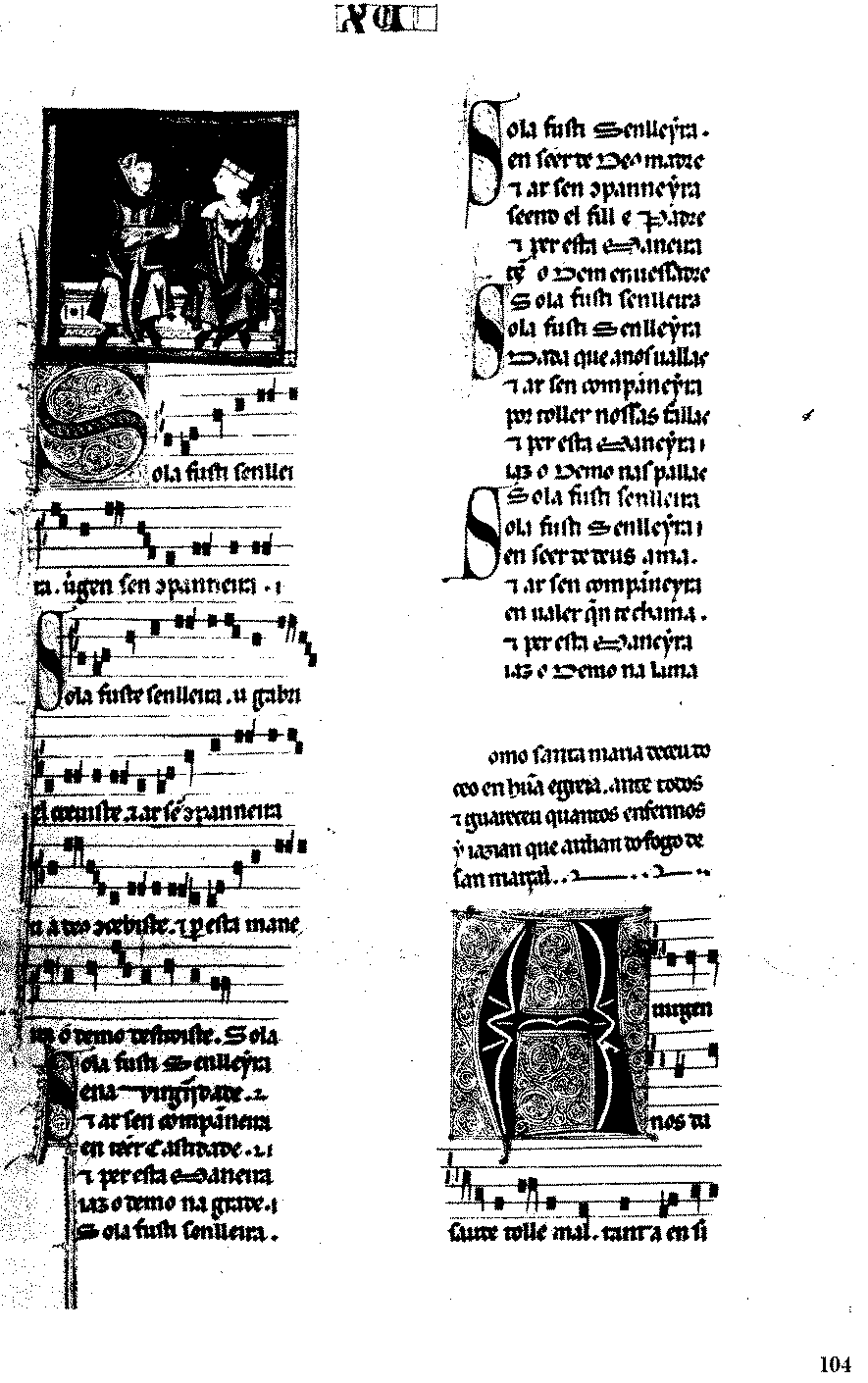
- 13th century CE, Alfonso X of Castile, Cantigas de Santa Maria, E codex, cantiga 90 (facsimile):
- & ar ſẽ (com)panneira u a de(us) (con)cebiſte
- and also without equal when you conceived God
- & ar ſẽ (com)panneira u a de(us) (con)cebiſte
- again
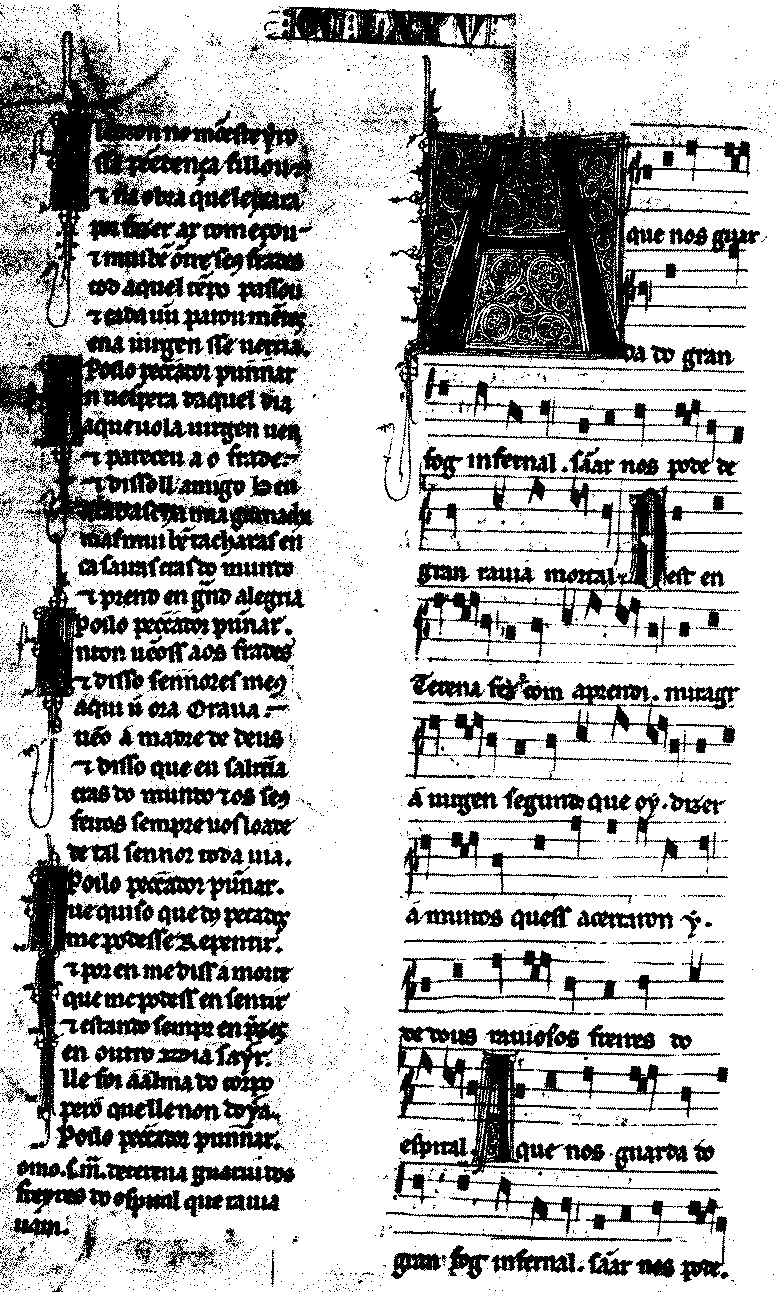
- 13th century CE, Alfonso X of Castile, Cantigas de Santa Maria, E codex, cantiga 274 (facsimile):
- na obra que leyxara / por fazer ar começou
- (He) started working again on his unfinished work
- na obra que leyxara / por fazer ar começou
Descendants edit
- Portuguese: er
Old Irish edit
Pronunciation edit
Etymology 1 edit
From Proto-Celtic *ɸare (“in front of”), from Proto-Indo-European *pr̥h₂í. Cognates include Ancient Greek παραί (paraí, “beside”) and Old English fore (modern English for and fore).
Preposition edit
ar (with accusative or dative)
For quotations using this term, see Citations:ar.
Inflection edit
| Person | Normal | Emphatic |
|---|---|---|
| 1st person sing. | airium, erum, erumm, erom | erumsa |
| 2d person sing. | airiut, aurut, erut, ærut, airut | erutsu |
| 3d sing. masc./neut., dative | airiu | |
| 3d sing. masc./neut., accusative | airi | |
| 3d sing. fem., dative | ||
| 3d sing. fem., accusative | airri, airre | |
| 1st person pl. | airiund, erunn, erund, erond, eronn, airriun, airund | |
| 2d person pl. | airib | airibsi, airiu(i)bsi, eruibsi |
| 3d person pl., dative | airib, airaib | |
| 3d person pl., accusative | air(r)iu, err(i)u, erro, erthu, airthiu, airtho | air(r)iusom, err(i)usom |
Forms combined with the definite article:
- masculine/feminine accusative singular: arin
- neuter accusative singular: ara
- dative singular all genders: arin(d), airind(í)
- accusative plural all genders: arna
- dative plural all genders: a(i)rnaib
Forms combined with a possessive determiner:
Form combined with the relative particle: ara
Derived terms edit
Descendants edit
Conjunction edit
ar
- Alternative spelling of air (“for, since”)
Further reading edit
- G. Toner, M. Ní Mhaonaigh, S. Arbuthnot, D. Wodtko, M.-L. Theuerkauf, editors (2019), “1 ar (‘for’)”, in eDIL: Electronic Dictionary of the Irish Language
- Thurneysen, Rudolf (1940, reprinted 2003) D. A. Binchy and Osborn Bergin, transl., A Grammar of Old Irish, Dublin Institute for Advanced Studies, →ISBN, pages 275–76, 497–99
Etymology 2 edit
From Proto-Celtic *anserom, from Proto-Indo-European *n̥serōm, from *nos (“we, us”); compare German unser.
Determiner edit
ar (triggers eclipsis)
For quotations using this term, see Citations:ar.
Descendants edit
Further reading edit
- G. Toner, M. Ní Mhaonaigh, S. Arbuthnot, D. Wodtko, M.-L. Theuerkauf, editors (2019), “5 ar (‘our’)”, in eDIL: Electronic Dictionary of the Irish Language
- Thurneysen, Rudolf (1940, reprinted 2003) D. A. Binchy and Osborn Bergin, transl., A Grammar of Old Irish, Dublin Institute for Advanced Studies, →ISBN, § 440, pages 277–78
Old Swedish edit
Etymology edit
From Old Norse ár, from Proto-Germanic *jērą.
Noun edit
ār n
Declension edit
Descendants edit
- Swedish: år
Pnar edit
| < 1 | 2 | 3 > |
|---|---|---|
| Cardinal : ar Ordinal : wa ar | ||
Etymology edit
From Proto-Khasian *ʔaːr, from Proto-Mon-Khmer *ɓaar. Cognate with Khasi ar, Blang lál, Bahnar ʼbar, Khmer ពីរ (pii), Vietnamese hai, Santali ᱵᱟᱨ (bar).
Pronunciation edit
Numeral edit
ar
Polabian edit
Etymology 1 edit
Borrowed from Low German or.
Conjunction edit
ar
Etymology 2 edit
Borrowed from Low German her.
Adverb edit
ar
Alternative forms edit
References edit
- The template Template:R:pox:SejDp does not use the parameter(s):
3=1
Please see Module:checkparams for help with this warning.Lehr-Spławiński, T., Polański, K. (1962) “I. ar”, in Słownik etymologiczny języka Drzewian połabskich [Etymological Dictionary of the Polabian Drevani Language] (in Polish), numbers 1 (A – ďüzd), Wrocław, Warszawa etc.: Ossolineum, page 19 - The template Template:R:pox:SejDp does not use the parameter(s):
3=1
Please see Module:checkparams for help with this warning.Lehr-Spławiński, T., Polański, K. (1962) “II. ar||er”, in Słownik etymologiczny języka Drzewian połabskich [Etymological Dictionary of the Polabian Drevani Language] (in Polish), numbers 1 (A – ďüzd), Wrocław, Warszawa etc.: Ossolineum, page 19 - Polański, Kazimierz, James Allen Sehnert (1967) “ar I.”, in Polabian-English Dictionary, The Hague, Paris: Mouton & Co, page 34
- Polański, Kazimierz, James Allen Sehnert (1967) “ar//er II.”, in Polabian-English Dictionary, The Hague, Paris: Mouton & Co, page 34
- Olesch, Reinhold (1962) “ar”, in Thesaurus Linguae Dravaenopolabicae [Thesaurus of the Drevani language] (in German), volumes 1: A – O, Cologne, Vienna: Böhlau Verlag, →ISBN, page 7
- Olesch, Reinhold (1962) “Err”, in Thesaurus Linguae Dravaenopolabicae [Thesaurus of the Drevani language] (in German), volumes 1: A – O, Cologne, Vienna: Böhlau Verlag, →ISBN, page 266
Polish edit
Pronunciation edit
Etymology 1 edit
Noun edit
ar m inan (abbreviation a)
Declension edit
Etymology 2 edit
See the etymology of the corresponding lemma form.
Noun edit
ar f pl
Further reading edit
Portuguese edit
Etymology edit
From Old Galician-Portuguese aar, aire, aere, from Latin āēr, from Ancient Greek ἀήρ (aḗr, “air”), from Proto-Indo-European *h₂weh₁- (“to blow”).
Pronunciation edit
- (Caipira Brazil) IPA(key): /ˈaɹ/
- Rhymes: (Portugal, São Paulo) -aɾ, (Portugal) -aʁ
- Hyphenation: ar
Audio (Brazil - São Paulo) (file)
Noun edit
ar m (plural ares)
Quotations edit
For quotations using this term, see Citations:ar.
Derived terms edit
Related terms edit
Romanian edit
Pronunciation edit
Etymology 1 edit
From older Romanian ară, are, presumably from Latin habēret (for the singular) and habērent (for the plural). See also are.
Verb edit
(el/ea) ar (modal auxiliary, third-person singular form of avea, used with infinitives to form conditional tenses)
- (he/she) would
Verb edit
(ele/ei) ar (modal auxiliary, third-person plural form of avea, used with infinitives to form conditional tenses)
- (they) would
Related terms edit
Etymology 2 edit
Verb edit
ar
Etymology 3 edit
Noun edit
ar m (plural ari)
- an are (a unit of area equal to 100 square metres)
Declension edit
Scottish Gaelic edit
Etymology 1 edit
From Old Irish ar. Cognates include Irish ár.
Pronunciation edit
Determiner edit
ar (triggers eclipsis)
- our
- ar n-athair. ― our father.
- Tha ar nighean ruadh. ― Our daughter is red-haired.
- Tha ar n-oilthigh ùr. ― Our university is new.
See also edit
Etymology 2 edit
Pronunciation edit
Verb edit
ar (defective)
Usage notes edit
- Only has the present and past tense, which both have the same form ar.
- Always followed by the preposition le or a prepositional pronoun:
- ar le mòran nach fhaod seo a bhith ― many thought this can't be
- ar leam gun... ― it seems/seemed to me that...
Etymology 3 edit
Adjective edit
ar (comparative aire)
Serbo-Croatian edit
Noun edit
ar m (Cyrillic spelling ар)
- are (square decametre, 100 m²)
Declension edit
Swedish edit
Etymology 1 edit
Ultimately from Latin area, probably via French are. This etymology is incomplete. You can help Wiktionary by elaborating on the origins of this term.
Noun edit
ar c or n
- are (square decametre, 100 m²)
Declension edit
| Declension of ar | ||||
|---|---|---|---|---|
| Singular | Plural | |||
| Indefinite | Definite | Indefinite | Definite | |
| Nominative | ar | aren | ar | aren |
| Genitive | ars | arens | ars | arens |
| Declension of ar | ||||
|---|---|---|---|---|
| Singular | Plural | |||
| Indefinite | Definite | Indefinite | Definite | |
| Nominative | ar | aret | ar | aren |
| Genitive | ars | arets | ars | arens |
Related terms edit
Etymology 2 edit
Ultimately from Proto-Germanic *arô.
Noun edit
ar m
References edit
- ar in Svenska Akademiens ordlista över svenska språket (8th ed., 1923)
- ar in Svenska Akademiens ordlista (SAOL)
Tagalog edit
Etymology edit
Borrowed from English ar, the English name of the letter R/r.
Pronunciation edit
- (Standard Tagalog) IPA(key): /ʔaɾ/, [ʔɐɾ]
- Rhymes: -aɾ
Noun edit
ar (Baybayin spelling ᜀᜇ᜔)
- the name of the Latin-script letter R, in the Filipino alphabet.
See also edit
- (Latin-script letter names) titik; ey, bi, si, di, i, ef, dyi, eyts, ay, dyey, key, el, em, en, enye, en dyi, o, pi, kyu, ar, es, ti, yu, vi, dobolyu, eks, way, zi
Further reading edit
- “ar”, in Pambansang Diksiyonaryo | Diksiyonaryo.ph, Manila, 2018
Turkish edit
Etymology 1 edit
From Ottoman Turkish عار (ar), from Arabic عَار (ʕār).
Noun edit
ar (definite accusative arı, plural arlar)
- feeling of shame
- 2023 November 22, Owen Jones, Annwn’da yaşam: Willy jones'un ölümden sonraki hikâyesi (Annwn)[2], Tektime, →ISBN:
- ... pek arsız değil . ” " Evet , tamam . Bazen biraz arsız olsan da bağımsız olmanı daha çok seviyorum . Bana gençliğimizi hatırlatıyorsun ... Ergenlik çağında flört ettiğimiz zamanları . Sende aynı çizgi o zamanlarda vardı ... " " Öyle mi ...
- not very cheeky. ” " Yes , okay . Even though you can be a little cheeky sometimes , I like it more when you are independent . You remind me of our youth ... when we used to flirt in adolescence . You had the same streak back then
- (Can we date this quote?), Mo Yan, İri Memeler ve Geniş Kalçalar (Dünya Edebiyatı)[3], Can Yayınları, →ISBN:
- ... ar kalmamış! Sen onunla birlikteyken eniştesini çalan baldızı oynuyordun, herkesin kitabında bunun utanç verici olduğu yazar!” Ablam bir an şaşırdı, hemen arkasından, “Ana, sen çok değiştin,” dedi. Annem, “Evet, değiştim ama ben yine de ...
- No decency at all! When you were with him, you were playing the sister-in-law who stole his brother-in-law, it is written in everyone's book that this is shameful!” My sister was surprised for a moment, then said, "Mother, you have changed a lot." My mother said, “Yes, I have changed, but I still...
Derived terms edit
- arsız (“shameless”)
- arlı (“scrupulous”) (Often in negation, such as "anladım o sana fena davrandı ama sende pek arlı değilsin.)
- (I see she treated you meanly, yet you are no angel either)
- arsızlık yapmak (“act cheekily”) (or sentence structure "arsızca davranmak")
- ar kalmamış (“unscrupulous”) (it is a fixed phrase and in negation only, see quotes.)
- arsız köpek (“cheeky bastard”) (vulgar, offensive)
Etymology 2 edit
Noun edit
ar (definite accusative arı, plural arlar)
- are (unit of area)
Welsh edit
Etymology edit
From Middle Welsh ar, from Proto-Brythonic *ar, from Proto-Celtic *ɸare.
Pronunciation edit
Preposition edit
ar (triggers soft mutation or h-prothesis if before ugain)
- on
- about to (with a verbal noun)
- King, Gareth (1993) Modern Welsh: A Comprehensive Grammar (Routledge Grammars), London and New York: Routledge, →ISBN, page 131:
- Brysiwch, mae’r trên ar fynd!
- Hurry up, the train’s about to leave!
- King, Gareth (1993) Modern Welsh: A Comprehensive Grammar (Routledge Grammars), London and New York: Routledge, →ISBN, page 131:
Inflection edit
Yola edit
Alternative forms edit
Etymology edit
From Middle English or; partially contracted from other, auther, from Old English āþor, āwþer, āhwæþer.
Pronunciation edit
- IPA(key): /ɔː/
- Homophones: oer, owr
Conjunction edit
ar
- or
- 1867, “CASTEALE CUDDE'S LAMENTATION”, in SONGS, ETC. IN THE DIALECT OF FORTH AND BARGY, number 4, page 104:
- Ar aany noor dhing at woode comfoort mee,
- Or any other thing that would comfort me,
- 1867, “ABOUT AN OLD SOW GOING TO BE KILLED”, in SONGS, ETC. IN THE DIALECT OF FORTH AND BARGY, number 2, page 106:
- Gooude var nat oan dhing, niether treesh ar thraame;
- Good for not one thing; neither for the trace, nor the car.
- 1867, “ABOUT AN OLD SOW GOING TO BE KILLED”, in SONGS, ETC. IN THE DIALECT OF FORTH AND BARGY, number 3, page 106:
- Ich woode be pitcht ee kurkeen, ar zippeen, to a coolaan.
- I would be poked into the mow or the stack up to the back of my head.
References edit
- Jacob Poole (d. 1827) (before 1828) William Barnes, editor, A Glossary, With some Pieces of Verse, of the old Dialect of the English Colony in the Baronies of Forth and Bargy, County of Wexford, Ireland, London: J. Russell Smith, published 1867, page 104