
o
 | ||||||||
| ||||||||
| ||||||||
Translingual edit

Letter edit
o (upper case O)
- The fifteenth letter of the basic modern Latin alphabet.
- (superscript) See º.
Pronunciation edit
Symbol edit
o
- (IPA) a close-mid back rounded vowel.
- (superscript ⟨ᵒ⟩, IPA) [o]-coloring or a weak, fleeting, epenthetic or echo [o].
- (phonetics, superscript ⟨ᵒ⟩) marks a labialized consonant.
Gallery edit
- Letter styles
-
 Uppercase and lowercase versions of O, in normal and italic type
 -
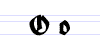 Uppercase and lowercase O in Fraktur


See also edit
- (Latin script): Aa Bb Cc Dd Ee Ff Gg Hh Ii Jj Kk Ll Mm Nn Oo Pp Qq Rr Sſs Tt Uu Vv Ww Xx Yy Zz
- (Variations of letter O): Óó Òò Ŏŏ Ôô Ốố Ồồ Ỗỗ Ổổ Ǒǒ Öö Ȫȫ Őő Õõ Ṍṍ Ṏṏ Ȭȭ Ȯȯ Ȱȱ Øø Ǿǿ Ǫǫ Ǭǭ Ōō Ṓṓ Ō̂ō̂ Ṑṑ Ỏỏ Ȍȍ Ȏȏ Ơơ Ớớ Ờờ Ỡỡ Ởở Ợợ Ọọ Ộộ Ɵɵ ⱺ ᴏ Oo Ꜵꜵ Œœ Ꝏꝏ Ꝍꝍ Ȣȣ
Character=OPlease see Module:checkparams for help with this warning.
Other representations of O:


English edit
Etymology 1 edit
Pronunciation edit
- (UK) IPA(key): /ˈəʊ/
Audio (RP) (file) - (US) IPA(key): /ˈoʊ/
Audio (GA) (file) - Homophones: oh, owe
- Rhymes: -əʊ
Letter edit
o (lower case, upper case O, plural os or o's)
- The fifteenth letter of the English alphabet, called o and written in the Latin script.
- Alternative form of ο, the fifteenth letter of the Classical and Modern Greek alphabets, called omicron and (astronomy) used as an abbreviation of omicron in star names.
- The system's Bayer designation is o Persei.
See also edit
- (Latin script letters) letter; Aa, Bb, Cc, Dd, Ee, Ff, Gg, Hh, Ii, Jj, Kk, Ll, Mm, Nn, Oo, Pp, Qq, Rr, Ss, Tt, Uu, Vv, Ww, Xx, Yy, Zz
Number edit
o (lower case, upper case O)
- The ordinal number fifteenth, derived from this letter of the English alphabet, called o and written in the Latin script.
Noun edit
o (plural oes)
- The name of the Latin-script letter O.
- A zero (used in reading out numbers).
- It is currently two-o-five in the afternoon (2:05 PM).
- The first permanent English settlement in America was in Jamestown in sixteen-o-seven (1607).
Alternative forms edit
Derived terms edit
Translations edit
See also edit
- (Latin-script letter names) letter; a, bee, cee, dee, e, ef, gee, aitch, i, jay, kay, el, em, en, o, pee, cue, ar, ess, tee, u, vee, double-u, ex, wye, zee/zed (Category: en:Latin letter names)
- oh
Etymology 2 edit
Particle edit
o
- (nonstandard) alternative form of O (vocative particle)
- 2007, The Bay Psalm Book, Cosimo Classics, published 1640, p.37, 41 & 46:
- I lift my soule to thee o Lord
mee, o Iehovah, heare
In thee, o Lord, I put my trust
Translations edit
Interjection edit
o
- Alternative form of oh
Noun edit
o
Adjective edit
o
Etymology 3 edit
See o'.
Preposition edit
o
- Alternative form of of
Etymology 4 edit
Abbreviations.
- (stenoscript) a word-initial letter ⟨o⟩.
- (stenoscript) the long vowel /oʊ/ at the end of a word, or before a final consonant that is not /dʒ, v, z/. (Note: the final consonant is not written; [ɔə˞], [ɔː˞] count as /oʊr/.)
- (stenoscript) the words on, so.
Albanian edit
Alternative forms edit
Etymology edit
(This etymology is missing or incomplete. Please add to it, or discuss it at the Etymology scriptorium.)
Pronunciation edit
Particle edit
o
Usage notes edit
Used with indefinite forms only. Can be placed either before or after the noun:
- Qup (“Coby”, indefinite) + -o → Qup-o (“O Coby”).
- o + Qup → o Qup (“O Coby”).
Further reading edit
- "o pjesëz", in Fjalor Shqip (Albanian Dictionary)
Aragonese edit
Etymology edit
From Latin illum, accusative form of ille (“that”).
Article edit
o m (definite singulars)
- the
- O río Ebro ― The Ebro River
Usage notes edit
Asturian edit
Etymology edit
Conjunction edit
o
Azerbaijani edit
Etymology 1 edit
Pronunciation edit
Letter edit
o lower case (upper case O)
- The twenty-first letter of the Azerbaijani alphabet, written in the Latin script.
See also edit
- (Latin script letters) hərf; Aa, Bb, Cc, Çç, Dd, Ee, Əə, Ff, Gg, Ğğ, Hh, Xx, Iı, İi, Jj, Kk, Qq, Ll, Mm, Nn, Oo, Öö, Pp, Rr, Ss, Şş, Tt, Uu, Üü, Vv, Yy, Zz
Etymology 2 edit
From Old Anatolian Turkish اول (ol), Proto-Turkic *ol.
Pronoun edit
| Cyrillic | о | |
|---|---|---|
| Abjad | او | |
o (definite accusative onu, plural onlar)
Declension edit
| singular | plural | ||||||
|---|---|---|---|---|---|---|---|
| 1st person | 2nd person | 3rd person | 1st person | 2nd person | 3rd person | ||
| nominative | mən | sən | o | biz | siz | onlar | |
| accusative | məni | səni | onu | bizi | sizi | onları | |
| dative | mənə | sənə | ona | bizə | sizə | onlara | |
| locative | məndə | səndə | onda | bizdə | sizdə | onlarda | |
| ablative | məndən | səndən | ondan | bizdən | sizdən | onlardan | |
| genitive | mənim | sənin | onun | bizim | sizin | onların | |
Derived terms edit
Determiner edit
o
Basque edit
Pronunciation edit
Letter edit
o (lower case, upper case O)
- The sixteenth letter of the Basque alphabet, called o and written in the Latin script.
See also edit
- (Latin-script letters) A a, B b, C c, (Ç ç), D d, E e, F f, G g, H h, I i, J j, K k, L, l, M m, N n, Ñ ñ, O o, P p, Q q, R r, S s, T t, U u, (Ü ü), V v, W w, X x, Y y, Z z
Noun edit
o (indeclinable)
- The name of the Latin-script letter O.
See also edit
Borôro edit
Pronunciation edit
Noun edit
o
Breton edit
Determiner edit
o (requires spirant mutation)
Catalan edit
Etymology 1 edit
Pronunciation edit
Noun edit
o f (plural os)
Etymology 2 edit
Pronunciation edit
Conjunction edit
o
Derived terms edit
Corsican edit
Etymology edit
From Latin aut. Cognates include Italian o and Spanish o.
Conjunction edit
o
References edit
Crimean Tatar edit
Etymology edit
From Proto-Turkic *ol. Compare Turkish o and Azerbaijani o.
Pronoun edit
o
Czech edit
Etymology edit
From Proto-Slavic *o(b), from Proto-Indo-European *h₃ebʰi.
Pronunciation edit
Preposition edit
o [+locative]
Preposition edit
o [+accusative]
Further reading edit
Danish edit
Particle edit
o
- (higher register or humorous) Vocative particle.
- For quotations using this term, see Citations:o.
Dutch edit
Pronunciation edit
Interjection edit
o
Letter edit
o (lower case, upper case O)
- The fifteenth letter of the Dutch alphabet, written in the Latin script.
See also edit
Esperanto edit
Pronunciation edit
Letter edit
o (lower case, upper case O)
- The nineteenth letter of the Esperanto alphabet, called o and written in the Latin script.
See also edit
- (Latin script letters) litero; Aa, Bb, Cc, Ĉĉ, Dd, Ee, Ff, Gg, Ĝĝ, Hh, Ĥĥ, Ii, Jj, Ĵĵ, Kk, Ll, Mm, Nn, Oo, Pp, Rr, Ss, Ŝŝ, Tt, Uu, Ŭŭ, Vv, Zz
Noun edit
o (accusative singular o-on, plural o-oj, accusative plural o-ojn)
- The name of the Latin-script letter O.
See also edit
Estonian edit
Pronunciation edit
Letter edit
o (lower case, upper case O)
- The fifteenth letter of the Estonian alphabet, called oo and written in the Latin script.
See also edit
Extremaduran edit
Etymology edit
From Latin aut. Cognates include Spanish o and Italian o.
Conjunction edit
o
Fala edit
Etymology 1 edit
From Old Galician-Portuguese o, from Latin illo (“he”).
Article edit
o m sg (plural os, feminine a, feminine plural as)
- (Mañegu) Masculine singular definite article; the
- 2000, Domingo Frades Gaspar, Vamus a falal: Notas pâ coñocel y platical en nosa fala, Editora regional da Extremadura, Chapter 1: Lengua Española:
- O términu de Valverdi, mais grandi, limita con Portugal, precisamenti con dois distintius Departamentos, que eran Beira Alta con capital en Guarda, a Beira Baixa con capital en Castelo Branco.
- The Valverde locality, the biggest, borders Portugal, more precisely with two distinct departments, which were Beira Alta with Guarda as its capital, and Beira Baixa with Castelo Branco as its capital.
Pronoun edit
o
See also edit
| nominative | dative | accusative | disjunctive | |||
|---|---|---|---|---|---|---|
| first person | singular | ei | me, -mi | mi | ||
| plural | common | nos | musL nusLV nos, -nusM |
nos | ||
| masculine | noshotrusM | noshotrusM | ||||
| feminine | noshotrasM | noshotrasM | ||||
| second person | singular | tú | te, -ti | ti | ||
| plural | common | vos | vusLV vos, -vusM |
vos | ||
| masculine | voshotrusM | voshotrusM | ||||
| feminine | voshotrasM | voshotrasM | ||||
| third person | singular | masculine | el | le, -li | uLV, oM | el |
| feminine | ela | a | ela | |||
| plural | masculine | elis | usLV, osM | elis | ||
| feminine | elas | as | elas | |||
| reflexive | — | se, -si | sí | |||
Etymology 2 edit
From Old Galician-Portuguese ou, from Latin aut (“or”).
Conjunction edit
o
- or
- 2000, Domingo Frades Gaspar, Vamus a falal: Notas pâ coñocel y platical en nosa fala, Editora regional da Extremadura, Theme 6:
- Poin encontralsi, a o millol, hasta “oito” o mais.
- There can be found, at best, up to “eight” or more.
References edit
Faroese edit
Pronunciation edit
- IPA(key): /oː/
- Homophones: og, ov
Letter edit
o (upper case O)
- The seventeenth letter of the Faroese alphabet, written in the Latin script.
See also edit
Finnish edit
Etymology edit
The Finnish orthography using the Latin script was based on those of Swedish, German and Latin, and was first used in the mid-16th century. No earlier script is known. See the Wikipedia article on Finnish for more information, and o for information on the development of the glyph itself.
Pronunciation edit
Letter edit
o (lower case, upper case O)
- The fifteenth letter of the Finnish alphabet, called oo and written in the Latin script.
See also edit
French edit
Pronunciation edit
Noun edit
o m (plural os)
- The name of the Latin-script letter O.
Derived terms edit
Symbol edit
o
Derived terms edit
Fula edit
Etymology 1 edit
Letter edit
o (lower case, upper case O)
- A letter of the Fula alphabet, written in the Latin script.
Usage notes edit
See also edit
- (Latin-script letters) karfeeje; ', A a, B b, Mb mb, Ɓ ɓ, C c, D d, Nd nd, Ɗ ɗ, E e, F f, G g, Ng ng, Ɠ ɠ, H h, I i, J j, Nj nj, K k, L l, M m, N n, Ŋ ŋ, Ñ ñ, Ɲ ɲ, O o, P p, R r, S s, T t, U u, W w, Y y, Ƴ ƴ
Etymology 2 edit
Suffix edit
o (plural ɓe)
- Noun class indicator for nouns (singular) having to do with people, and for loan words
Usage notes edit
Pronoun edit
o
Usage notes edit
- Common to all varieties of Fula (Fulfulde / Pulaar / Pular).
- This is used in all conjugations except for affirmative non-accomplished (where the long form is used).
Alternative forms edit
Derived terms edit
- makko (possessive pronoun)
Related terms edit
- omo (second person singular subject pronoun; long form)
- himo (second person singular subject pronoun; long form; variant in Pular)
- kanko (emphatic form)
Article edit
o
- (definite) the (when it follows the noun)
- Debbo o ― the woman
Usage notes edit
Determiner edit
o
- used in indicating someone
- O debbo ― this/that woman
Usage notes edit
Galician edit
Pronunciation edit
Etymology 1 edit
From Old Galician-Portuguese o, from Latin illum, from ille.
Alternative forms edit
Article edit
o m sg (feminine singular a, masculine plural os, feminine plural as)
- masculine singular definite article; the
Usage notes edit
- The definite article o (in all its forms), due to historical sandhi, regularly forms contractions when it follows the prepositions a (“to”), con (“with”), de (“of, from”), and en (“in”). For example, con o (“with the”) contracts to co, and en o (“in the”) contracts to no.
- The definite article o (in all its forms), due to historical sandhi, contracts with preceding words which ends in [s] or [r] into the second form of the article lo (la, los, las); this feature, frequent in spoken Galician, is not always marked in the written language. When done, a hyphen is used to separate both words:
- Debes comer o caldo ~ Debes come-lo caldo ― You should eat the soup
Derived terms edit
Etymology 2 edit
See the etymology of the corresponding lemma form.
Pronoun edit
o
- accusative of el
Usage notes edit
The Galician pronouns, being atones, are usually appended to the verb; though sandhi, o could acquire the form -no (for example, when appended to a verb form ended in a falling diphthong or in a nasal consonant, the nasal in -no having an antihiatic epenthetic origin) or -lo (when appended to a verb form ended in a -s or -r, the l having its origin in the assimilation of the -s or -r with the l present in the pronoun before the 12th century).
Further reading edit
- “o” in Dicionario da Real Academia Galega, Royal Galician Academy.
German edit
Pronunciation edit
Audio (file)
Interjection edit
o
- O
- 1843, Gallus Schwab, Gebetbuch für katholische Christen, Bamberg, page 45:
- Sei gegrüßet, o Du mein Jesu! Mit tieftster Demuth bete ich Dich an und verehre Dich!
- (please add an English translation of this quotation)
Gothic edit
Romanization edit
ō
- Romanization of 𐍉
Guaraní edit
Etymology edit
Noun edit
o
Hawaiian edit
Conjunction edit
o
Preposition edit
o
Usage notes edit
- Used for possessions that are inherited, out of personal control, and for things that can be got into (houses, clothes, cars), while a is used for acquired possessions.
Hungarian edit
Pronunciation edit
Letter edit
o (lower case, upper case O)
- The twenty-fourth letter of the Hungarian alphabet, called o and written in the Latin script.
Declension edit
| Inflection (stem in long/high vowel, back harmony) | ||
|---|---|---|
| singular | plural | |
| nominative | o | o-k |
| accusative | o-t | o-kat |
| dative | o-nak | o-knak |
| instrumental | o-val | o-kkal |
| causal-final | o-ért | o-kért |
| translative | o-vá | o-kká |
| terminative | o-ig | o-kig |
| essive-formal | o-ként | o-kként |
| essive-modal | — | — |
| inessive | o-ban | o-kban |
| superessive | o-n | o-kon |
| adessive | o-nál | o-knál |
| illative | o-ba | o-kba |
| sublative | o-ra | o-kra |
| allative | o-hoz | o-khoz |
| elative | o-ból | o-kból |
| delative | o-ról | o-król |
| ablative | o-tól | o-któl |
| non-attributive possessive - singular |
o-é | o-ké |
| non-attributive possessive - plural |
o-éi | o-kéi |
| Possessive forms of o | ||
|---|---|---|
| possessor | single possession | multiple possessions |
| 1st person sing. | o-m | o-im |
| 2nd person sing. | o-d | o-id |
| 3rd person sing. | o-ja | o-i |
| 1st person plural | o-nk | o-ink |
| 2nd person plural | o-tok | o-itok |
| 3rd person plural | o-juk | o-ik |
See also edit
- (Latin-script letters) betű; A a, Á á, B b, C c, Cs cs, D d, Dz dz, Dzs dzs, E e, É é, F f, G g, Gy gy, H h, I i, Í í, J j, K k, L l, Ly ly, M m, N n, Ny ny, O o, Ó ó, Ö ö, Ő ő, P p, Q q, R r, S s, Sz sz, T t, Ty ty, U u, Ú ú, Ü ü, Ű ű, V v, W w, X x, Y y, Z z, Zs zs
Further reading edit
- o in Bárczi, Géza and László Országh. A magyar nyelv értelmező szótára (’The Explanatory Dictionary of the Hungarian Language’). Budapest: Akadémiai Kiadó, 1959–1962. Fifth ed., 1992: →ISBN
Ido edit
Pronunciation edit
Letter edit
o (upper case O)
- The fifteenth letter of the Ido alphabet, written in the Latin script.
See also edit
- (Latin-script letters) litero; A a, B b, C c, D d, E e, F f, G g, H h, I i, J j, K k, L, l, M m, N n, O o, P p, Q q, R r, S s, T t, U u, V v, W w, X x, Y y, Z z
Conjunction edit
o
Related terms edit
Igbo edit
Etymology 1 edit
Pronunciation edit
Letter edit
o (upper case O)
- The twenty-fourth letter of the Igbo alphabet, written in the Latin script.
Etymology 2 edit
Alternative forms edit
- ọ (retracted tongue position)
Pronunciation edit
Pronoun edit
o (dependent form, independent form ya)
See also edit
Indonesian edit
Pronunciation edit
Letter edit
o (lower case, upper case O)
- The fifteenth letter of the Indonesian alphabet, written in the Latin script.
See also edit
Italian edit
Etymology 1 edit
From Latin ō (the name of the letter O).
Pronunciation edit
Letter edit
o f or m (invariable, lower case, upper case O)
- The thirteenth letter of the Italian alphabet, called o and written in the Latin script.
Noun edit
o f (invariable)
- The name of the Latin-script letter O.
See also edit
- (Latin-script letter names) lettera; a, bi, ci, di, e, effe, gi, acca, i, i lunga, kappa, elle, emme, enne, o, pi, cu, erre, esse, ti, u, vu, doppia vu, ics, ipsilon, zeta
Etymology 2 edit
Alternative forms edit
- od (used optionally before words beginning with a vowel)
Pronunciation edit
Conjunction edit
o
References edit
- ^ Angelo Prati, "Vocabolario Etimologico Italiano", Torino, 1951
Further reading edit
- o in Luciano Canepari, Dizionario di Pronuncia Italiana (DiPI)
Etymology 3 edit
Verb edit
o
- Misspelling of ho.
Italiot Greek edit
Etymology edit
From Ancient Greek ὁ (ho)
Article edit
o
- the
| Number (style) | singular (familiar) | plural (formal) | ||||||||||
|---|---|---|---|---|---|---|---|---|---|---|---|---|
| strong | weak | strong | weak | |||||||||
| m | f | n | m | f | n | m | f | n | m | f | n | |
| nominative | cino | cini | cino | o | i | to | cini | cini | cini | e | e | ta |
| genitive | tu | tis | tu | — | — | — | tos | tos | tos | — | — | — |
| accusative | ton | tin | to | — | — | — | tus | tes | ta | — | — | — |
| There is no 1st person vocative case. † These terms double as possessive pronouns. ‡ "tis" is used before a verb, "tes" after a verb.. All personal pronoun forms are displayed at evò (“I”). | ||||||||||||
Japanese edit
Romanization edit
o
Kapampangan edit
Pronunciation edit
Etymology 1 edit
Borrowed from Spanish o (“or”).
Conjunction edit
o
Etymology 2 edit
Alternative forms edit
Particle edit
o
- (colloquial) sentence-ending particle used to express warning or to catch someone's attention; see also oy, uy and ay
- Palako nayu o.
- S/he's leaving.
- Makanini namu o.
- Just do it this way.
- Nanu o.
- What? huh?
- (colloquial) used as a vocative particle to address the topic in question
- Juan o lawen me.
- John! look!
- Ginu o sana iligtas yu.
- God, I hope you help them!
- Mina o aini na.
- Mina, here it is.
Interjection edit
o
- (colloquial) expression of surprise, wonder, amazement, or awe: oh!
- (colloquial) used to refer to something given or offered to someone: here you are! here you go!
Kashubian edit
Etymology edit
The Kashubian orthography is based on the Latin alphabet. No earlier script is known. See the Kashubian alphabet article on Wikipedia for more, and o for development of the glyph itself.
Letter edit
o (lower case, upper case O)
- The twentieth letter of the Kashubian alphabet, written in the Latin script.
See also edit
Khumi Chin edit

Pronunciation edit
Noun edit
o
References edit
- K. E. Herr (2011) The phonological interpretation of minor syllables, applied to Lemi Chin[4], Payap University, page 47
Kikuyu edit
Pronunciation edit
Pronoun edit
o (third person plural)
Related terms edit
- -ao (“their”)
See also edit
| singular | plural | |
|---|---|---|
| 1st person | niĩ | ithuĩ |
| 2nd person | we /wɛ(ː)/ | inyuĩ |
| 3rd person | we /wɛ/ | o |
References edit
- “o” in Benson, T.G. (1964). Kikuyu-English dictionary, p. 355. Oxford: Clarendon Press.
Ladin edit
Etymology edit
Conjunction edit
o
Latin edit
Etymology 1 edit
From Etruscan letter 𐌏 (o), from Ancient Greek letter ο (o, “omicron”), derived from the Phoenician letter 𐤏 (ʿ, “ayin”), from the Egyptian hieroglyph 𓁹.
Letter edit
o
- A letter of the Latin alphabet.
Etymology 2 edit
(This etymology is missing or incomplete. Please add to it, or discuss it at the Etymology scriptorium.)
Pronunciation edit
Noun edit
ō f (indeclinable)
- The name of the letter O.
Coordinate terms edit
- (Latin-script letter names) littera; ā, bē, cē, dē, ē, ef, gē, hā / *acca, ī, kā, el, em, en, ō, pē, kū, er, es, tē, ū, ix / īx / ex, ȳ / ī graeca / ȳpsīlon, zēta
References edit
- o in Charlton T. Lewis and Charles Short (1879) A Latin Dictionary, Oxford: Clarendon Press
- o in Charlton T. Lewis (1891) An Elementary Latin Dictionary, New York: Harper & Brothers
- o in Charles du Fresne du Cange’s Glossarium Mediæ et Infimæ Latinitatis (augmented edition with additions by D. P. Carpenterius, Adelungius and others, edited by Léopold Favre, 1883–1887)
- o in Gaffiot, Félix (1934) Dictionnaire illustré latin-français, Hachette.
- Carl Meißner, Henry William Auden (1894) Latin Phrase-Book[5], London: Macmillan and Co.
- monstrous: o facinus indignum! (Ter. Andr. 1. 1. 118)
- to take the military oath: sacramentum (o) dicere (vid. sect. XI. 2, note sacramentum...)
- monstrous: o facinus indignum! (Ter. Andr. 1. 1. 118)
- o in Harry Thurston Peck, editor (1898), Harper's Dictionary of Classical Antiquities, New York: Harper & Brothers
- Arthur E. Gordon, The Letter Names of the Latin Alphabet (University of California Press, 1973; volume 9 of University of California Publications: Classical Studies), part III: “Summary of the Ancient Evidence”, page 32: "Clearly there is no question or doubt about the names of the vowels A, E, I, O, U. They are simply long A, long E, etc. (ā, ē, ī, ō, ū). Nor is there any uncertainty with respect to the six mutes B, C, D, G, P, T. Their names are bē, cē, dē, gē, pē, tē (each with a long E). Or about H, K, and Q: they are hā, kā, kū—each, again, with a long vowel sound."
Etymology 3 edit
Borrowed from Ancient Greek ὦ (ô), cognate, or onomatopoeic.
Alternative forms edit
Pronunciation edit
Interjection edit
ō
- o! (vocative particle)
- 63 BCE, Cicero, Catiline Orations Oratio in Catilinam Prima in Senatu Habita.II:
- O tempora, o mores! Senatus haec intellegit, consul videt; hic tamen vivit. Vivit?
- Shame on the age and on its principles! The senate is aware of these things; the consul sees them; and yet this man lives. Lives!
- O tempora, o mores! Senatus haec intellegit, consul videt; hic tamen vivit. Vivit?
- 4th century, St Jerome, Vulgate, Judges 3:19
- et reversus de Galgalis ubi erant idola dixit ad regem verbum secretum habeo ad te o rex et ille imperavit silentium egressisque omnibus qui circa eum erant (Then returning from Galgal, where the idols were, he said to the king: I have a secret message to thee, O king. And he commanded silence: and all being gone out that were about him,)
- oh!
Latvian edit
Etymology edit
Proposed in 1908 as part of the new Latvian spelling by the scientific commission headed by K. Mīlenbahs, which was accepted and began to be taught in schools in 1909. Prior to that, Latvian had been written in German Fraktur, and sporadically in Cyrillic.
Pronunciation 1 edit

Letter edit

o (lower case, upper case O)
- The twenty-third letter of the Latvian alphabet, called o and written in the Latin script.
Usage notes edit
In native Latvian words (and in some older borrowings), o represents the sound of IPA [uə̯] (e.g., otrs [uə̯tɾs]). In more recent borrowings, it represents the original sound of the word, i.e. [o] or [oː] (e.g., opera [oːpeɾa]).
See also edit
- (Latvian letters) latviešu burti; Aa, Āā, Bb, Cc, Čč, Dd, Ee, Ēē, Ff, Gg, Ģģ, Hh, Ii, Īī, Jj, Kk, Ķķ, Ll, Ļļ, Mm, Nn, Ņņ, Oo, Pp, Rr, Ss, Šš, Tt, Uu, Ūū, Vv, Zz, Žž
Pronunciation 2 edit
Noun edit
o m (invariable)
- The name of the Latin script letter O/o.
See also edit
Ligurian edit
| Ligurian Definite Articles | ||
|---|---|---|
| singular | plural | |
| masculine | o | i |
| feminine | a | e |
Etymology edit
From earlier ro ← lo, from Latin illum, form of ille (“that”).
Pronunciation edit
Article edit
o m sg (plural i)
Lithuanian edit
Etymology edit
From Proto-Balto-Slavic *ō. Cognate with Latgalian a and Proto-Slavic *a (“and, but”). From Proto-Indo-European *h₁od; compare Sanskrit आत् (āt, “afterwards, then, so”), Avestan 𐬁𐬀𐬝 (āat̰, “afterward, then”), perhaps the ablative singular of *h₁e- (“demonstrative pronoun”).
Pronunciation edit
Conjunction edit
õ
Livonian edit
Pronunciation edit
Letter edit
o (upper case O)
- The twenty-second letter of the Livonian alphabet, written in the Latin script.
See also edit
Lower Sorbian edit
Pronunciation edit
Letter edit
o (upper case O)
- The twenty-first letter of the Lower Sorbian alphabet, called o and written in the Latin script.
- The name of the Latin-script letter o.
See also edit
Malay edit
Letter edit
o
- The fifteenth letter of the Malay alphabet, written in the Latin script.
See also edit
Maltese edit
Pronunciation edit
- IPA(key): /ɔ/ (short phoneme)
- IPA(key): /ɔː/ (long phoneme)
- In inherited words, long o occurs only next to vowelised għ or h. In Romance words, it can be long on its own.
Letter edit
o (lower case, upper case O)
- The nineteenth letter of the Maltese alphabet, written in the Latin script.
See also edit
Mandarin edit
Romanization edit
- Hanyu Pinyin reading of 哦
Romanization edit
o
- Nonstandard spelling of ō.
- Nonstandard spelling of ó.
- Nonstandard spelling of ǒ.
- Nonstandard spelling of ò.
Usage notes edit
- Transcriptions of Mandarin into the Latin script often do not distinguish between the critical tonal differences employed in the Mandarin language, using words such as this one without indication of tone.
Maori edit
Particle edit
o
- of
- 2006, Joanne Barker, Sovereignty Matters, page 208:
- In 1979 a gathering of elders at the Waananga kaumatua affirmed te reo Maori “Ko te reo te mauri o te mana Maori” the language is the life principle of Maori mana.
- (please add an English translation of this quotation)
Usage notes edit
Used instead of a when the possessor has no control over the relationship (inalienable possession).
Masurian edit
Etymology edit
Inherited from Old Polish o, from Proto-Slavic *o, ultimately a natural expression.
Pronunciation edit
Interjection edit
o
- oh! expression of surprise or outrage
Particle edit
o
- vocative particle; O!
Further reading edit
Mbyá Guaraní edit
Verb edit
o
- to go
Conjugation edit
Middle English edit
Etymology 1 edit
From Old French oh, from Latin ō.
Alternative forms edit
Pronunciation edit
Interjection edit
o
Descendants edit
References edit
- “ō, interj.”, in MED Online, Ann Arbor, Mich.: University of Michigan, 2007.
Etymology 2 edit
Article edit
o
Etymology 3 edit
Numeral edit
o
- Alternative form of oo (“one”)
Adjective edit
o
- Alternative form of oo (“first”)
See also edit
Middle Irish edit
Preposition edit
o
- Alternative spelling of ó
Middle Low German edit
Etymology edit
From Proto-Germanic *awjō. Cognate with Old Norse ey (Swedish ö, Norwegian øy).
Pronunciation edit
- Stem vowel: ȫ²
Noun edit
ö
Mokilese edit
Etymology edit
From Proto-Chuukic *yawo, from Proto-Micronesian *awo, from Proto-Oceanic *apon, from Proto-Malayo-Polynesian *hapən.
Noun edit
o
edit
Pronunciation edit
Letter edit
o
- The twenty-second letter of the Navajo alphabet
- ǫ = /õ˨/
- ó = /o˥/
- ǫ́ = /õ˥/
- oo = /oː˨˨/
- ǫǫ = /õː˨˨/
- óo = /oː˥˨/
- ǫ́ǫ = /õː˥˨/
- oó = /oː˨˥/
- ǫǫ́ = /õː˨˥/
- óó = /oː˥˥/
- ǫ́ǫ́ = /õː˥˥/
See also edit
- (Latin-script letters) A a (Á á, Ą ą, Ą́ ą́), B b, Ch ch, Chʼ chʼ, D d, Dl dl, Dz dz, E e (É é, Ę ę, Ę́ ę́), G g, Gh gh, H h, Hw hw, X x, I i (Í í, Į į, Į́ į́), J j, K k, Kʼ kʼ, Kw kw, ʼ, L l, Ł ł, M m, N n (Ń ń), O o (Ó ó, Ǫ ǫ, Ǫ́ ǫ́), S s, Sh sh, T t, Tʼ tʼ, Tł tł, Tłʼ tłʼ, Ts ts, Tsʼ tsʼ, W w, Y y, Z z, Zh zh
Neapolitan edit
Etymology 1 edit
Pronunciation edit
Particle edit
o
Etymology 2 edit
Pronunciation edit
Article edit
o m
- Alternative spelling of 'o (“the”)
Pronoun edit
o m (accusative)
- Alternative spelling of 'o (“him, it”)
Norwegian edit
Pronunciation edit
Letter edit
o
- The fifteenth letter of the Norwegian Bokmål alphabet, written in the Latin script.
Norwegian Nynorsk edit
Letter edit
o (upper case O, definite singular o-en, indefinite plural o-ar, definite plural o-ane)
- The fifteenth letter of the Norwegian Nynorsk alphabet, written in the Latin script.
Interjection edit
o
Pronoun edit
o
References edit
- “o” in The Nynorsk Dictionary.
Nupe edit
Pronunciation edit
Letter edit
o (lower case, upper case O)
- The eighteenth letter of the Nupe alphabet, written in the Latin script.
See also edit
O'odham edit
Particle edit
o
Usage notes edit
Not to be confused with ʼo, the third person copula.
See also edit
| singular | plural | ||||||
|---|---|---|---|---|---|---|---|
| imperfective | perfective | future | imperfective | perfective | future | ||
| first person | long | 'añ | 'añt | o | 'c | 'att | o |
| short | ñ | ñt | c | tt | |||
| second person | long | 'ap | 'apt | 'am | 'amt | ||
| short | a | pt | m | mt | |||
| third person | long | 'o | 'at | 'o | |||
| short | t | ||||||
References edit
- Zepeda, Ofelia (1983) A Tohono Oʼodham Grammar, Tucson: The University of Arizona Press, page 169
Occitan edit
Etymology 1 edit
Conjunction edit
o
Etymology 2 edit
Noun edit
o f (plural os)
- o (the letter o, O)
Old Galician-Portuguese edit
Etymology edit
From earlier lo, la, from Latin illum, illam (the initial l having disappeared; compare Spanish lo and la).
Pronunciation edit
Article edit
o
- the (masculine singular definite article)
- 13th Century - Cantiga de Santa Maria no. 23
- Esta é como Santa Maria acrecentou o vinho no tonel, por amor da bõa dona de Bretanha.
- This is how Holy Mary added the wine to the barrel, out of love for the good lady of Britain;
- Esta é como Santa Maria acrecentou o vinho no tonel, por amor da bõa dona de Bretanha.
- 13th Century - Cantiga de Santa Maria no. 48
- Esta é como Santa Maria tolheu a agua da fonte ao cavaleiro.
- This is how Holy Mary restricted the water of the fountain from the knight.
- Esta é como Santa Maria tolheu a agua da fonte ao cavaleiro.
- 13th Century - Cantiga de Santa Maria no. 23
Usage notes edit
- O becomes -no and a becomes -na after nasal sounds:
- Non queria o meu coraçon nen-nos meus olhos. ― She wanted neither (the) my heart nor (the) my eyes.
- Ambas eran-nas melhores que (h)omen pode cousir. ― Both were the best that (a) man can contemplate.
- O becomes -lo and a becomes -la after other consonants, and the preceding consonant is elided:
- E vós faredes depoi-lo melhor! ― And later ye shall do the best!
- Sobre toda-las bondades que ela (h)avia era que muito fiava en Santa Maria; ― Above all the virtues she possessed was how much she trusted Holy Mary.
- O becomes el- in front of the noun rei:
- Deu ora el-rei seus dinheiros a Belpelho. ― The king, then, gave his money to Belpelho.
- Se fosse seu o tesouro que el-rei de França ten. ― Were it his the treasure that the king of France has.
Descendants edit
Old Irish edit
Preposition edit
o
- Alternative spelling of ó
Noun edit
o
- Alternative spelling of ó
Mutation edit
| Old Irish mutation | ||
|---|---|---|
| Radical | Lenition | Nasalization |
| o | unchanged | n-o |
| Note: Some of these forms may be hypothetical. Not every possible mutated form of every word actually occurs. | ||
Old Polish edit
Pronunciation edit
Etymology 1 edit
Inherited from Proto-Slavic *o(b). First attested in the 14th century.
Preposition edit
o
- about, concerning [+accusative] or [+locative]
- on, against [+accusative]
- because of [+accusative]
- denotes location; at [+accusative]
- denotes location; at [+locative]
- with, by means of [+locative]
- (used in descriptions) with, having [+locative]
- for [+accusative]
Descendants edit
Etymology 2 edit
Inherited from Proto-Slavic *o. First attested in the 14th century.
Interjection edit
o
- oh! expression of surprise or outrage
Descendants edit
References edit
- B. Sieradzka-Baziur, editor (2011–2015), “o”, in Słownik pojęciowy języka staropolskiego [Conceptual Dictionary of Old Polish] (in Polish), Kraków: IJP PAN, →ISBN
Old Spanish edit
Etymology edit
From Latin ubi (“where”). Cognate with French où (“where”), Italian dove (“where”), Portuguese u (“where”).
Adverb edit
o
Usage notes edit
Pnar edit
Etymology edit
Compare Lamet [Nkris] ʔɔːʔ, Riang [Sak] ʔoʔ¹.
Pronunciation edit
Pronoun edit
o
Usage notes edit
- It identifies A or S arguments and therefore "nominative". Its topic-position and accusative counterpart is nga.
Polish edit
Pronunciation edit
- IPA(key): /ɔ/
- (Middle Polish) IPA(key): /ˈɔ/
Audio 1 (file) Audio 2 (file) - Rhymes: -ɔ
- Syllabification: o
- Homophone: -o
Etymology 1 edit
The Polish orthography is based on the Latin alphabet. No earlier script is known. See the history of Polish orthography article on Wikipedia for more, and o for development of the glyph itself.
Letter edit
o (upper case O, lower case)
- The twentieth letter of the Polish alphabet, called o and written in the Latin script.
See also edit
- (Latin-script letters) A a, Ą ą, B b, C c, Ć ć, D d, E e, Ę ę, F f, G g, H h, I i, J j, K k, L l, Ł ł, M m, N n, Ń ń, O o, Ó ó, P p, R r, S s, Ś ś, T t, U u, W w, Y y, Z z, Ź ź, Ż ż
Etymology 2 edit
Inherited from Old Polish o.
Preposition edit
o
- about (concerning) [+locative]
- Opowiedz mi o twojej pracy. ― Tell me about your job.
- Ta książka jest o potędze miłości. ― This book is about the power of love.
- at (telling the time) [+locative]
- Spotkajmy się o piątej po południu. ― Let's meet at five PM.
- (used in descriptions) with, having [+locative]
- Była piękną kobietą o długich jasnych włosach. ― She was a beautiful woman with long fair hair.
- chłopiec o zielonych oczach ― a boy with green eyes; a green-eyed boy
- on, against [+accusative]
- Nie opierajcie się o te drzwi. ― Don't lean on this door.
- Dziewczynka uderzyła głową o stół. ― The little girl hit her head on the table.
- for [+accusative]
- Weronika poprosiła mnie wczoraj o pomoc. ― Veronica asked me for help yesterday.
- Walczyliśmy dzielnie o naszą wolność. ― We were bravely fighting for our freedom.
- by (a difference) [+accusative]
- Spóźniła się o piętnaście minut. ― She was fifteen minutes late.
- Czuję się o wiele lepiej. ― I feel much better.
- Obniż podkład o dwa półtony. ― Lower the instrumental by two semitones.
Etymology 3 edit
Inherited from Old Polish o, from Proto-Slavic *o, ultimately a natural expression.
Interjection edit
o
- oh! expression of surprise or outrage
- O mój boże... ― Oh my god...
Trivia edit
According to Słownik frekwencyjny polszczyzny współczesnej (1990), o is one of the most used words in Polish, appearing 533 times in scientific texts, 598 times in news, 724 times in essays, 607 times in fiction, and 610 times in plays, each out of a corpus of 100,000 words, totaling 3072 times, making it the 14th most common word in a corpus of 500,000 words.[1]
References edit
Further reading edit
- o in Wielki słownik języka polskiego, Instytut Języka Polskiego PAN
- o in Polish dictionaries at PWN
- Maria Renata Mayenowa, Stanisław Rospond, Witold Taszycki, Stefan Hrabec, Władysław Kuraszkiewicz (2010-2023) “o”, in Słownik Polszczyzny XVI Wieku [A Dictionary of 16th Century Polish]
- Maria Renata Mayenowa, Stanisław Rospond, Witold Taszycki, Stefan Hrabec, Władysław Kuraszkiewicz (2010-2023) “o”, in Słownik Polszczyzny XVI Wieku [A Dictionary of 16th Century Polish]
- Maria Renata Mayenowa, Stanisław Rospond, Witold Taszycki, Stefan Hrabec, Władysław Kuraszkiewicz (2010-2023) “o”, in Słownik Polszczyzny XVI Wieku [A Dictionary of 16th Century Polish]
- “O I”, in Elektroniczny Słownik Języka Polskiego XVII i XVIII Wieku [Electronic Dictionary of the Polish Language of the XVII and XVIII Century], 18.06.2019
- “O II”, in Elektroniczny Słownik Języka Polskiego XVII i XVIII Wieku [Electronic Dictionary of the Polish Language of the XVII and XVIII Century], 2019 August 19
- Elektroniczny Słownik Języka Polskiego XVII i XVIII Wieku [Electronic Dictionary of the Polish Language of the XVII and XVIII Century], (Can we date this quote?)
- Samuel Bogumił Linde (1807–1814) “o”, in Słownik języka polskiego[7]
- Aleksander Zdanowicz (1861) “o”, in Słownik języka polskiego, Wilno 1861[8]
- J. Karłowicz, A. Kryński, W. Niedźwiedzki, editors (1904), “o”, in Słownik języka polskiego[9] (in Polish), volume 3, Warsaw, page 429
Portuguese edit
Pronunciation edit
Etymology 1 edit
Letter edit
o (lower case, upper case O)
- The fifteenth letter of the Portuguese alphabet, written in the Latin script.
See also edit
- (Latin-script letters) letra; A a (Á á, À à, Â â, Ã ã), B b, C c (Ç ç), D d, E e (É é, Ê ê), F f, G g, H h, I i (Í í), J j, K k, L l, M m, N n, O o (Ó ó, Ô ô, Õ õ), P p, Q q, R r, S s, T t, U u (Ú ú), V v, W w, X x, Y y, Z z
Etymology 2 edit
From Old Galician-Portuguese o (compare Galician o), from Vulgar Latin lo, *illu, from Latin illum, from ille (with an initial l having disappeared; compare Spanish lo).
Article edit
o m (feminine a, masculine plural os, feminine plural as)
- the (masculine singular definite article)
- 2005, J. K. Rowling, Harry Potter e o Enigma do Príncipe [Harry Potter and the Half-Blood Prince] (Harry Potter; 6), Rio de Janeiro: Rocco, →ISBN, page 135:
- Não vi o tempo passar.
- I didn't notice the time passing.
Usage notes edit
For the most part, usage of the definite article in Portuguese is the same as in English. Some differences include:
- it is optionally but commonly used with abstract mass nouns:
- O amor é melhor que a guerra. ― Love is better than war.
- in Brazil, it can be optionally used with adjectival possessive pronouns, and mandatorily with substantival possessive pronouns; both are mandatory in Portugal:
- (O) meu livro é melhor que o seu. ― My book is better than yours.
- it can be used with personal names; often this indicates familiarity with the person (due to personal connection with them or because they are famous); this is avoided in formal contexts:
- (O) João foi até a cidade. ― João went to the city.
- (O) Einstein foi um cientista famoso. ― Einstein was a famous scientist.
- it is sometimes used instead of a possessive pronoun when the possessor is obvious from the context; this is especially prevalent when referring to parts of the body or one’s own relatives:
- O pai está viajando. ― (My) dad is travelling.
- Você falou com a tia? ― Did you talk with my/our aunt?
- Quando você quebrou os braços? ― When did you break your arms?
- it is used in a construct that is uncommon in English but common in Portuguese whereby a singular is used as a representative or prototype of all instances of the thing:
- O carvalho é uma árvore grande. ― The oak is a big tree.
- A picape é responsável pela poluição. ― Pick-up trucks are responsible for the pollution.
- it is much more commonly used with placenames; most names of countries, states, provinces and continents take the definite article, but only a minority of cities:
- Eu moro no Luxemburgo. ― I live in Luxembourg.
- O Rio de Janeiro fica no Brasil. ― Rio de Janeiro is in Brazil.
Quotations edit
For quotations using this term, see Citations:o.
See also edit
| Portuguese articles (edit) | ||||
|---|---|---|---|---|
| Singular | Plural | |||
| Masculine | Feminine | Masculine | Feminine | |
| Definite articles (the) |
o | a | os | as |
| Indefinite articles (a, an; some) |
um | uma | uns | umas |
Pronoun edit
o m (personal)
- him, it (as a direct object; as an indirect object, see lhe; after prepositions, see ele)
- 2003, J. K. Rowling, Harry Potter e a Ordem da Fênix [Harry Potter and the Order of the Phoenix] (Harry Potter; 5), Rio de Janeiro: Rocco, →ISBN, page 75:
- Não o perdoou por abandonar o serviço em vez de seguir você.
- She didn't forgive him for abandoning his service instead of following you.
- 2007, J. K. Rowling, Harry Potter e as Relíquias da Morte [Harry Potter and the Deathly Hallows] (Harry Potter; 7), Rio de Janeiro: Rocco, →ISBN, page 287:
- Por que, então, ela o conduzira àquele lugar?
- Why, then, did she lead him to that place?
Usage notes edit
- Becomes -lo after verb forms ending in -r, -s, or -z, the pronouns nos and vos, and the adverb eis; the ending letter causing the change disappears.
- Becomes -no after a nasal sound:
- Detêm-no como prisioneiro. ― They detain him/it as a prisoner.
- Põe-no aqui. ― Put him/it here.
- In the colloquial speech of most of Brazil, it is abandoned in favor of the nominative form ele.
- Eu o vi. → Eu vi ele. ― I saw him/it.
Quotations edit
For quotations using this term, see Citations:o.
See also edit
See Template:Portuguese personal pronouns for further pronouns.
Rapa Nui edit
Pronunciation edit
Etymology 1 edit
From Proto-Polynesian *o.
Particle edit
o
- possessive particle marking an inalienable possession; of
- 2008, Sharon Chester, A wildlife guide to Chile, page 15:
- Polynesians are thought to have arrived at Easter Island around AD 800. They called the island Rapa Nui, or more familiarly Te Pito o Te Henua, the Navel of the World.
- (please add an English translation of this quotation)
Usage notes edit
Inserted before the relevant pronoun. Only for possessions like hands or parents that do not have the ability to no longer be yours; otherwise, use a.
Etymology 2 edit
Conjunction edit
o
Usage notes edit
Generally used in favor of complex native grammatical structures used to achieve the same ends.
Romani edit
Pronunciation edit
Etymology 1 edit
Letter edit
o (lower case, upper case O)
- (International Standard) The nineteenth letter of the Romani alphabet, written in the Latin script.
- (Pan-Vlax) The twentieth letter of the Romani alphabet, written in the Latin script.
See also edit
- (Latin-script letters) A a, B b, C c, D d, E e, F f, G g, H h, X x, I i, J j, K k, Kh kh, L l, M m, N n, O o, P p, Ph ph, R r, S s, T t, Th th, U u, V v, Z z International Standard: (À à, Ä ä, Ǎ ǎ), Ć ć, Ćh ćh, (È è, Ë ë, Ě ě), (Ì ì, Ï ï, Ǐ ǐ), (Ò ò, Ö ö, Ǒ ǒ), Rr rr, Ś ś, (Ù ù, Ü ü, Ǔ ǔ), Ź ź, Ʒ ʒ, Q q, Ç ç, ϴ θ. Pan-Vlax: Č č, Čh čh, Dž dž, (Dź dź), Ř ř, Š š, (Ś ś), Ž ž, (Ź ź).
Etymology 2 edit
Article edit
o m sg (feminine singular i, plural e)
- the
- o rrom ― the Romani man
- o Parìzo ― Paris
Usage notes edit
- The definite article is used with proper nouns (given names and place names) as well.
Declension edit
References edit
- Yūsuke Sumi (2018) “o”, in ニューエクスプレス ロマ(ジプシー)語 [New Express Romani (Gypsy)] (in Japanese), Tokyo: Hakusuisha, →ISBN, pages 21, 141
Romanian edit
Pronunciation edit
Etymology 1 edit
Letter edit
o (lower case, upper case O)
- The eighteenth letter of the Romanian alphabet, called o and written in the Latin script.
Usage notes edit
See O.
See also edit
- (Latin script letters) Aa, Ăă, Ââ, Bb, Cc, Dd, Ee, Ff, Gg, Hh, Ii, Îî, Jj, Kk, Ll, Mm, Nn, Oo, Pp, Qq, Rr, Ss, Șș, Tt, Țț, Uu, Vv, Ww, Xx, Yy, Zz
Etymology 2 edit
From Latin ūna, feminine of ūnus, via an earlier form *uă, with irregular dropping of the -n- due to high frequency of usage; however, compare the Aromanian equivalent unã, which preserved it.
Article edit
o
- feminine singular nominative/accusative of un: a/an (indefinite article)
- O femeie frumoasă ― A beautiful woman
Related terms edit
See also edit
| indefinite article forms | singular | plural | |
|---|---|---|---|
| m, n | f | ||
| nom/acc | un | o | niște |
| gen/dat | unui | unei | unor |
Etymology 3 edit
Interjection edit
o
Etymology 4 edit
From an earlier (possibly Proto-Romanian) root *eaua, from Latin illam, accusative feminine singular of ille.
Pronoun edit
o f (unstressed accusative form of ea)
- (direct object) her
- O cunoști? ― Do you know her?
- O cunoști pe Iulia? ― Do you know Iulia?
- Am văzut-o ieri la școală. ― I saw her yesterday at school.
Related terms edit
Etymology 5 edit
Verb edit
(el/ea) o (modal auxiliary, third-person singular form of vrea, used with infinitives to form presumptive tenses)
- (he/she) might
Etymology 6 edit
From avea.
Verb edit
o (modal auxiliary, ? form of avea, used with ? to form ? tenses)
- (informal) Used to form a variant of the future tense together with the verb in the subjunctive mood.
- Synonym: vrea (as an auxiliary verb)
- O să vedem. ― We will see.
- El o să facă fasole. ― He will make beans.
Usage notes edit
Samoan edit
Preposition edit
o
Sardinian edit
Pronunciation edit
Etymology 1 edit
From Italian o (“or”), from Latin aut (“or”), from Proto-Italic *auti, from Proto-Indo-European *h₂ewti (“on the other hand”), derived from *h₂ew (“away from, off”). Doublet of a.
Conjunction edit
o
Etymology 2 edit
From Latin o (vocative particle).
Interjection edit
o
- (Logudorese, Campidanese) a vocative particle; o, hey
- O Frantziscu! ― Hey, Francis!
Determiner edit
o
- (Logudorese, Campidanese) used before epithets, describing the person being addressed, for emphasis; you
- Morta ti ses, o tessidora bella ― You died, you beautiful weaver
References edit
- Wagner, Max Leopold (1960–1964) “o1”, in Dizionario etimologico sardo, Heidelberg
- Wagner, Max Leopold (1960–1964) “o2”, in Dizionario etimologico sardo, Heidelberg
Scots edit
Etymology edit
From Middle English of, from Old English af, æf (“from, off, away”), from Proto-Germanic *ab (“away (from)”). Compare English of.
Preposition edit
o
Scottish Gaelic edit
Etymology 1 edit
Letter edit
o (lower case, upper case O)
- The thirteenth letter of the Scottish Gaelic alphabet, written in the Latin script. It is preceded by n and followed by p. Its traditional name is onn or oir (“gorse”).
See also edit
- (Latin-script letters) litir; A a (À à), B b (Bh bh), C c (Ch ch), D d (Dh dh), E e (È è), F f (Fh fh), G g (Gh gh), H h, I i (Ì ì), L l, M m (Mh mh), N n, O o (Ò ò), P p (Ph ph), R r, S s (Sh sh), T t (Th th), U u (Ù ù)
- (diacritics) ◌̀
- (obsolete vowels) Á á É é Ó ó
Etymology 2 edit
From Middle Irish ó, from Old Irish ó. Cognates include Irish ó.
Pronunciation edit
Preposition edit
o (+ dative, triggers lenition, combined with the singular definite article on)
Inflection edit
| Personal inflection of o | |||||||||
|---|---|---|---|---|---|---|---|---|---|
| Number | Person | Simple | Emphatic | ||||||
| Singular | 1st | uam | uamsa | ||||||
| 2nd | uat | uatsa | |||||||
| 3rd m | uaithe | uaithesan | |||||||
| 3rd f | uaipe | uaipese | |||||||
| Plural | 1st | uainn | uainne | ||||||
| 2nd | uaibh | uaibhse | |||||||
| 3rd | uapa | uapasan | |||||||
Serbo-Croatian edit
Etymology 1 edit
Pronunciation edit
Letter edit
o (Cyrillic spelling о)
Etymology 2 edit
From Proto-Slavic *o(b), from Proto-Indo-European *h₃ebʰi. See o-, ob-.
Pronunciation edit
Preposition edit
o (Cyrillic spelling о)
- on, against [+accusative]
- ob(j)esiti nešto o kuku ― to hang something on a hook
- udariti glavom o zid ― to hit one's head against the wall
- ogr(ij)ešiti se o zakon ― to violate a law (literally, “to make transgression against the law”)
- about, concerning, of, on [+locative]
- brinuti se o nekome ― to take care of somebody
- v(ij)est o katastrofi ― news about the catastrophe
- R(ij)eč je o…, radi se o… ― It's about…, this refers to…
- Napisao sam esej o ranom srednjem vijeku. ― I wrote an essay on the Early Middle Ages.
Synonyms edit
- (Croatia) ob
Sicilian edit
Etymology 1 edit
From Latin ō (the name of the letter O).
Pronunciation edit
Noun edit
o f
- The name of the Latin-script letter O.
Etymology 2 edit
Pronunciation edit
Conjunction edit
o
- or
- O ti manci ssa minestra o ti jetti dâ finestra.
- Either you eat soup or you throw yourself out the window.
Derived terms edit
Etymology 3 edit
Eye dialectal form of ô (“(masculine singular) at/to the”).
Pronunciation edit
Preposition edit
o
- (eye dialect) Alternative form of ô
Etymology 4 edit
Eye dialectal form of 'ô (“(masculine singular) of the”), from the lenition of rhoticized (and dialectal) rô, from dô, from an earlier and standard dû.
Pronunciation edit
Preposition edit
o
- (eye dialect) Alternative form of dû
- A fera o luni.
- The Monday market.
- (literally, “The market of the Monday.”)
- A strata o Càrminu.
- The street [of the church] of the Carmine.
Etymology 5 edit
From the vowel reduction of vô, dialectal form of vâ, which is the contracted form of the Univerbation of va' (“to go”, second-person singular imperative) + a (“to, forward”, preposition).
Alternative forms edit
Pronunciation edit
Verb edit
o
- (eye dialect) Alternative form of vâ (second-person singular, contracted double imperative)
- o caca!
- Go fuck yourself! (lit. go to shit)!
- O vidi chiḍḍu ca hâ fari!
- Go see what you have to do!.
Usage notes edit
- The double indicative and the double imperative are Sicilian moods built with the first conjugated element using exclusively the present tense of the verbs jiri (to go) or vèniri (to come) connected with the preposition a (to) to a second conjugated action wich follows the tense, the number and the person of the first verbal element.
- In the case of jiri, which is irregularly composed also of the theme derived from Latin vādō, can be contracted with the preposition a depending on the dialect.
Etymology 6 edit
From Latin ō, eventually conflated with/from Ancient Greek ὦ (ô).
Alternative forms edit
- oh (for the interjection meaning "oh")
Pronunciation edit
Interjection edit
o
- (usually oh) expresses surprise, joy, or pain: oh!; ah!
- Synonyms: bih, madonna, madò, marò, Di' ca lu fici, zu, zu lu bestia
- (usually oh) Typically used before a proper noun in the vocative or nominative case when addressing someone: O...
- O ma', po' vèniri cca!?
- [O] mum, would you come here!?
Related terms edit
See also edit
Silesian edit
Etymology edit
The Silesian orthography is based on the Latin alphabet. No earlier script is known. See the Silesian language article on Wikipedia for more, and o for development of the glyph itself.
Letter edit
o (lower case, upper case O)
- The nineteenth letter of the Silesian alphabet, written in the Latin script.
See also edit
Skolt Sami edit
Pronunciation edit
Letter edit
o (upper case O)
- The twenty-fourth letter of the Skolt Sami alphabet, written in the Latin script.
See also edit
Slovak edit
Etymology edit
From Proto-Slavic *o(b), from Proto-Indo-European *h₃ebʰi.
Pronunciation edit
Preposition edit
o
- about, concerning [+locative]
- 1883, Pavol Dobšinský, O človeku, čo nikdy nehrešil. In: Prostonárodné slovenské povesti:
- Chudobný človek nevedel o ničom nič a najmenej o čertovi.
- The poor man did not know anything about anything and the least did he know about the devil.
- Chudobný človek nevedel o ničom nič a najmenej o čertovi.
- at (indicates time) [+locative]
- 1921, Stanislav Klíma, Kozia skala In: Povesti zo Slovenska:
- O polnoci sa Kozia skala otvorila a božská panna z jaskyne vyšla.
- Kozia skala opened at midnight and a divine virgin came out of a cave.
- O polnoci sa Kozia skala otvorila a božská panna z jaskyne vyšla.
- against, over, on (indicates the point of contact with another object) [+accusative]
- 1955, Ladislav Nádaši-Jégé, Česť :
- Juro zhodil batoh, odopäl bajonet a praštil ho o stôl.
- Juro threw his bag down, unfastened the bayonet and slammed it against the table.
- Juro zhodil batoh, odopäl bajonet a praštil ho o stôl.
- by, often translated with a noun accompanied by an indefinite article or a numeral (indicates measure or degree) [+accusative]
- 1910, Ľudmila Podjavorinská, Žena :
- Oddanca prevyšuje o hlavu, on takrečeno tratí sa pri jej mocnej, na mužského upomínajúcej postave.
- She is a head taller than her fiancé, it might be said that he is disappearing next to her mighty figure resembling that of a man.
- Oddanca prevyšuje o hlavu, on takrečeno tratí sa pri jej mocnej, na mužského upomínajúcej postave.
- in, later (indicates the end of a period of time) [+accusative]
- Synonym: po
- 1911, Jozef Gregor Tajovský, Jano Mráz :
- Už mal byť o rok posvätený, ale prišla cholera, a neúprosná smrť Ondríka skosila.
- It should have been blessed in a year, but cholera came and Ondrík was taken by merciless death.
- Už mal byť o rok posvätený, ale prišla cholera, a neúprosná smrť Ondríka skosila.
Further reading edit
- “o”, in Slovníkový portál Jazykovedného ústavu Ľ. Štúra SAV [Dictionary portal of the Ľ. Štúr Institute of Linguistics, Slovak Academy of Science] (in Slovak), https://slovnik.juls.savba.sk, 2024
Slovene edit
Etymology edit
From Proto-Slavic *o(b), from Proto-Indo-European *h₃ebʰi.
Pronunciation edit
Preposition edit
o
- about, concerning [+locative]
Somba-Siawari edit
Noun edit
o
References edit
- Kaija Olkkonen, Soini Olkkonen, Somba-Siawari (Burum Mindik)—English dictionary (2007)
Spanish edit
Pronunciation edit
| (file) |
Etymology 1 edit
Letter edit
o (lower case, upper case O)
- The sixteenth letter of the Spanish alphabet, called o and written in the Latin script.
Noun edit
o f (plural oes)
- Name of the letter O
Derived terms edit
See also edit
- (Latin-script letters) letra; A a (Á á), B b, C c, D d, E e (É é), F f, G g, H h, I i (Í í), J j, K k, L l, M m, N n, Ñ ñ, O o (Ó ó), P p, Q q, R r, S s, T t, U u (Ú ú, Ü ü), V v, W w, X x, Y y, Z z
Etymology 2 edit
Alternative forms edit
- u (used before words beginning with an ‘o’ sound)
- ò (archaic)
- ó (obsolete, used near numbers to avoid confusion with a zero: 2 ó 3)
Conjunction edit
o
- or
- ¿Quieres un café o algo más?
- Do you want a coffee or something else?
Derived terms edit
Conjunction edit
o … o
Derived terms edit
Further reading edit
- “o”, in Diccionario de la lengua española, Vigésima tercera edición, Real Academia Española, 2014
Sranan Tongo edit
Etymology edit
Reduced form of go (“to go”).
Particle edit
o
- Verbal marker for the future tense.
Usage notes edit
For purely factual statements, sa is more common. This marker is mostly used for promises, or when the anticipation carries an emotive charge, such as hope or fear. For example, “I’ll see you” is not a purely factual statement; it implies, “I hope to see you (again, some time in the future)”. In Sranan Tongo, this is then expressed as “mi o si yu”.
See also edit
Swedish edit
Pronunciation edit
- Letter name
- Phoneme
Letter edit
o (lower case, upper case O)
- The fifteenth letter of the Swedish alphabet, called o and written in the Latin script.
Interjection edit
o
- O (particle)
- Så låt nu, o konung, härom utfärda ett förbud och sätta upp en skrivelse
- Now, O king, establish the decree, and sign the writing (Daniel 6:8)
Noun edit
o n
- the letter o
- the Greek letter omega, being the last letter of the Greek alphabet
- Jag är A och O, den förste och den siste, begynnelsen och änden.
- I am Alpha and Omega, the beginning and the end, the first and the last. (Revelations 22:13)
- Jag är A och O, den förste och den siste, begynnelsen och änden.
Declension edit
| Declension of o | ||||
|---|---|---|---|---|
| Singular | Plural | |||
| Indefinite | Definite | Indefinite | Definite | |
| Nominative | o | ot | on | ona |
| Genitive | os | ots | ons | onas |
Alternative forms edit
Conjunction edit
o
- Abbreviation of och (“and”).
Usage notes edit
- In handwriting, this abbreviation is often spelled with an underline: o.
Tagalog edit
Etymology 1 edit
From Spanish o. Each pronunciation has a different source:
- Filipino alphabet pronunciation is influenced by English o.
- Abakada alphabet pronunciation is influenced by the Baybayin character ᜂ (u).
- Abecedario pronunciation is from Spanish o.
Pronunciation edit
- (letter name): IPA(key): /ʔo/, [ʔo]
- (letter name, Filipino alphabet alternative): IPA(key): /ˈʔow/, [ˈʔoʊ̯]
- (phoneme): IPA(key): /o/, [o]
- Rhymes: -o, -ow
- Hyphenation: o
Letter edit
o (lower case, upper case O, Baybayin spelling ᜂ)
- The seventeenth letter of the Tagalog alphabet (Filipino alphabet), called o and written in the Latin script.
- The thirteenth letter of the Tagalog alphabet (Abakada alphabet), called o and written in the Latin script.
- (historical) The eighteenth letter of the Tagalog alphabet (Abecedario), called o and written in the Latin script.
See also edit
- (Latin-script letters) titik; A a, B b, C c, D d, E e, F f, G g, H h, I i, J j, K k, L l, M m, N n, Ñ ñ, Ng ng, O o, P p, Q q, R r, S s, T t, U u, V v, W w, X x, Y y, Z z
Noun edit
o (Baybayin spelling ᜂ)
- the name of the Latin-script letter O, in the Filipino alphabet.
- the name of the Latin-script letter O, in the Abakada alphabet.
- (historical) the name of the Latin-script letter O, in the Abecedario.
Alternative forms edit
- ow – Filipino alphabet letter
See also edit
- (Latin-script letter names) titik; ey, bi, si, di, i, ef, dyi, eyts, ay, dyey, key, el, em, en, enye, en dyi, o, pi, kyu, ar, es, ti, yu, vi, dobolyu, eks, way, zi
- uo
Etymology 2 edit
Borrowed from Spanish o (“or”), from Latin aut.
Pronunciation edit
Conjunction edit
o (Baybayin spelling ᜂ)
See also edit
Etymology 3 edit
Compare Hokkien 乎 (hôⁿ / hô͘), English oh and Spanish oh.
Alternative forms edit
Pronunciation edit
Particle edit
o (Baybayin spelling ᜂ)
- (informal) sentence-ending particle used to express warning or to catch someone's attention.
- Nandiyan na naman siya o.
- He's at it again, see?
- Ganito kasi dapat 'yan o.
- You're supposed to do it like this, you see?
See also edit
Interjection edit
o (Baybayin spelling ᜂ) (informal)
- expression of surprise, wonder, amazement, or awe: oh!
- Hayop naman oh!
- Damn it, argh!
- used to catch someone's attention about a new topic, question, or story: so; oh!
- used to refer to something given or offered to someone: here you are! here you go!
- Synonym: heto
- O, ang regalo ko sa'yo.
- Here, my gift for you.
Derived terms edit
Further reading edit
- “o”, in Pambansang Diksiyonaryo | Diksiyonaryo.ph, Manila, 2018
Tat edit
Etymology edit
Noun edit
o
Tok Pisin edit
Etymology edit
Conjunction edit
o
Tokelauan edit
Pronunciation edit
Etymology 1 edit
From Proto-Polynesian *o. Cognates include Hawaiian o and Samoan o.
Preposition edit
o
- Marks inalienable possession; of
See also edit
Etymology 2 edit
From Proto-Polynesian *o. Cognates include Hawaiian ō and Samoan o.
Interjection edit
o
- Answer to being called by name; yes
References edit
- R. Simona, editor (1986), Tokelau Dictionary[10], Auckland: Office of Tokelau Affairs, page 33
Tooro edit
Pronunciation edit
Pronoun edit
-o (declinable)
Inflection edit
See also edit
References edit
Turkish edit
Etymology edit
From Ottoman Turkish او (o), from older اول (ol). Merger of Old Anatolian Turkish [script needed] (ol) and [script needed] (an, “she, he, that, it”), (Old Turkic 𐰆𐰞 (ul¹) and [script needed] (an), respectively); both from Proto-Turkic *ol. Cognate with Karakhanid اُلْ (“he, she, it; that”) and Chinese 兀 (wù, “that”).
Pronunciation edit
Pronoun edit
o
Declension edit
| Inflection | ||
|---|---|---|
| Nominative | o | |
| Definite accusative | onu | |
| Singular | Plural | |
| Nominative | o | onlar |
| Definite accusative | onu | onları |
| Dative | ona | onlara |
| Locative | onda | onlarda |
| Ablative | ondan | onlardan |
| Genitive | onun | onların |
See also edit
Pronoun edit
o (demonstrative)
See also edit
Letter edit
o (lower case, upper case O)
- The eighteenth letter of the Turkish alphabet, called o and written in the Latin script.
See also edit
- (Latin script letters) harf; Aa, Bb, Cc, Çç, Dd, Ee, Ff, Gg, Ğğ, Hh, Iı, İi, Jj, Kk, Ll, Mm, Nn, Oo, Öö, Pp, Rr, Ss, Şş, Tt, Uu, Üü, Vv, Yy, Zz
Noun edit
o
- The name of the Latin-script letter O.
See also edit
Turkmen edit
Pronunciation edit
Pronoun edit
o
- Alternative form of ol (“he, she, it”)
Letter edit
o (upper case O)
- The eighteenth letter of the Turkmen alphabet, called o and written in the Latin script.
See also edit
Vietnamese edit
Pronunciation edit
Etymology 1 edit
From Proto-Vietic *ʔɔː.
Noun edit
Synonyms edit
Related terms edit
Classifier edit
o
- (Thanh Hoá, Nghệ An, Hà Tĩnh) indicates a young adult woman
- O du kích nhỏ giương cao súng.
Thằng Mỹ lênh khênh bước cúi đầu.- The small guerilla damsel holds her rifle high.
The tall American dude totters, his head hanging low.
- The small guerilla damsel holds her rifle high.
Etymology 2 edit
Borrowed from Portuguese ó.
Noun edit
o
- The name of the Latin-script letter O.
Related terms edit
Volapük edit
Pronunciation edit
Particle edit
o
- vocative case particle
- O flens löfik!
- Dear friends
Welsh edit
Etymology 1 edit
Alternative forms edit
- (with grave accent to indicate otherwise unpredictable short vowel) ò
- (with acute accent to indicate unusually stressed short vowel) ó
- (with circumflex to indicate otherwise unpredictable or unusually stressed long vowel) ô
- (with diaeresis to indicate disyllabicity) ö
Pronunciation edit
Letter edit
o (lower case, upper case O)
- The nineteenth letter of the Welsh alphabet, called o and written in the Latin script. It is preceded by n and followed by p.
Mutation edit
- o cannot be mutated but, being a vowel, does take h-prothesis, for example with the word oren (“orange”):
| Welsh mutation | |||
|---|---|---|---|
| radical | soft | nasal | h-prothesis |
| oren | unchanged | unchanged | horen |
| Note: Some of these forms may be hypothetical. Not every possible mutated form of every word actually occurs. | |||
Derived terms edit
See also edit
- (Latin-script letters) llythyren; A a (Á á, À à, Â â, Ä ä), B b, C c, Ch ch, D d, Dd dd, E e (É é, È è, Ê ê, Ë ë), F f, Ff ff, G g, Ng ng, H h, I i (Í í, Ì ì, Î î, Ï ï), J j, L l, Ll ll, M m, N n, O o (Ó ó, Ò ò, Ô ô, Ö ö), P p, Ph ph, R r, Rh rh, S s, T t, Th th, U u (Ú ú, Ù ù, Û û, Ü ü), W w (Ẃ ẃ, Ẁ ẁ, Ŵ ŵ, Ẅ ẅ), Y y (Ý ý, Ỳ ỳ, Ŷ ŷ, Ÿ ÿ)
- (Latin-script letter names) llythyren; a, bi, ec, èch, di, èdd, e, èf, èff, èg, eng, aetsh, i/i dot, je, ce, el, èll, em, en, o, pi, ffi, ciw, er, rhi, ès, ti, èth, u/u bedol, fi, w, ecs, y, sèd (Category: cy:Latin letter names)
Noun edit
o f (plural oau)
- The name of the Latin-script letter O.
Mutation edit
| Welsh mutation | |||
|---|---|---|---|
| radical | soft | nasal | h-prothesis |
| o | unchanged | unchanged | ho |
| Note: Some of these forms may be hypothetical. Not every possible mutated form of every word actually occurs. | |||
Etymology 2 edit
Aphetic form of efô, reinforced form of ef
Pronunciation edit
Pronoun edit
o
Usage notes edit
O is used predominantly in the north of Wales, while e is used in the south, with fo and fe as variants of o and e respectively after a vowel. In formal Welsh, the equivalent pronoun is ef.
Etymology 3 edit
From Proto-Brythonic *o, from Proto-Celtic *ɸo, from Proto-Indo-European *h₂pó.
Pronunciation edit
Preposition edit
o (causes soft mutation)
- from
- Aethon ni o Gaerdydd i Abertawe.
- We went from Cardiff to Swansea.
- of, out of (partitive)
- Roedd llawer o frain yn y coed.
- There were a lot of crows in the trees.
- Mae'r tri ohonyn nhw'n dweud celwydd.
- The three of them are lying.
- Connects an adjective modifying another adjective (equivalent to adverb + adjective in English)
- arbennig o bwysig ― especially important
- ofnadwy o garedig ― awfully kind
- Connects a multi-word numeral to a plural noun
- Mae pedwar deg saith o weithwyr gyda'r cwmni.
- The company has forty-seven employees.
Inflection edit
Etymology 4 edit
Possibly a conjunctive use of Etymology 3. Compare Old Irish ó (“when”).
Alternative forms edit
- od (before a vowel)
Conjunction edit
o (causes aspirate mutation)
Synonyms edit
Derived terms edit
Yola edit
Pronunciation edit
Etymology 1 edit
From Middle English oo, an apocopic form of oon.
Alternative forms edit
Adjective edit
o
- one
- Synonym: oan
- 1867, GLOSSARY OF THE DIALECT OF FORTH AND BARGY:
- O hardïshe o' anoor.
- One thing or another.
Etymology 2 edit
From Middle English o.
Interjection edit
o
- oh
- 1867, “A YOLA ZONG”, in SONGS, ETC. IN THE DIALECT OF FORTH AND BARGY, number 12, page 88:
- Than stalket, an gandelt, wie o! an gridane.
- Then stalked and wondered, with oh! and with grief.
Etymology 3 edit
Preposition edit
o
- Alternative form of o' (“of”)
- 1867, “THE WEDDEEN O BALLYMORE”, in SONGS, ETC. IN THE DIALECT OF FORTH AND BARGY, page 93:
- Aar was a gooude puddeen maate o bran.
- There was a good pudding made of bran.
- 1867, “THE WEDDEEN O BALLYMORE”, in SONGS, ETC. IN THE DIALECT OF FORTH AND BARGY, number 2, page 94:
- Aar was Parick o Dearmoth, an dhen score besidh,
- There was Patrick o Deormod, and ten score beside,
- 1867, “THE WEDDEEN O BALLYMORE”, in SONGS, ETC. IN THE DIALECT OF FORTH AND BARGY, number 2, page 94:
- An a priesth o parieshe on his garrane baun,
- The priest of the parish on his white pony,
- 1867, “THE WEDDEEN O BALLYMORE”, in SONGS, ETC. IN THE DIALECT OF FORTH AND BARGY, number 3, page 94:
- Aar was a muskawn o buthther ee-laaide apan hoat shruaanès,
- There was a great heap of butter laid upon hot scraps,
- 1867, “CASTEALE CUDDE'S LAMENTATION”, in SONGS, ETC. IN THE DIALECT OF FORTH AND BARGY, number 3, page 104:
- An lea a pariesh o Kilmannan.
- And leave the parish of Kilmannan.
References edit
- Jacob Poole (d. 1827) (before 1828) William Barnes, editor, A Glossary, With some Pieces of Verse, of the old Dialect of the English Colony in the Baronies of Forth and Bargy, County of Wexford, Ireland, London: J. Russell Smith, published 1867, pages 45, 88 & 93
Yoruba edit
Etymology 1 edit
Pronunciation edit
Letter edit
o (lower case, upper case O)
- The sixteenth letter of the Yoruba alphabet, called ó and written in the Latin script.
Noun edit
ó
- The name of the Latin-script letter O.
See also edit
- (Latin-script letters) lẹ́tà; A a (Á á, À à, Ā ā), B b, D d, E e (É é, È è, Ē ē), Ẹ ẹ (Ẹ́ ẹ́, Ẹ̀ ẹ̀, Ẹ̄ ẹ̄), F f, G g, Gb gb, H h, I i (Í í, Ì ì, Ī ī), J j, K k, L l, M m (Ḿ ḿ, M̀ m̀, M̄ m̄), N n (Ń ń, Ǹ ǹ, N̄ n̄), O o (Ó ó, Ò ò, Ō ō), Ọ ọ (Ọ́ ọ́, Ọ̀ ọ̀, Ọ̄ ọ̄), P p, R r, S s, Ṣ ṣ, T t, U u (Ú ú, Ù ù, Ū ū), W w, Y y
- (Benin) (Latin-script letters) lɛ́tà; A a, B b, D d, E e, Ɛ ɛ, F f, G g, Gb gb, H h, I i, J j, K k, Kp kp, L l, M m, N n, O o, Ɔ ɔ, P p, R r, S s, Sh sh, T t, U u, W w, Y y
- (Latin-script letter names) lẹ́tà; á, bí, dí, é, ẹ́, fí, gí, gbì, hí, í, jí, kí, lí, mí, ní, ó, ọ́, pí, rí, sí, ṣí, tí, ú, wí, yí
Etymology 2 edit
Pronunciation edit
Pronoun edit
o
- you (second-person singular non-honorific personal pronoun)
Etymology 3 edit
Pronunciation edit
Pronoun edit
ó
Etymology 4 edit
Pronunciation edit
Pronoun edit
o
- him, her, it (third-person singular object pronoun following a monosyllabic verb with a high-tone /o/)
Pronoun edit
ó
- him, her, it (third-person singular object pronoun following a monosyllabic verb with a low- or mid-tone /o/)
See also edit
| singular | plural or honorific | |
|---|---|---|
| 1st person | mi | wa |
| 2nd person | ọ / ẹ | yín |
| 3rd person | [preceding vowel repeated for monosyllabic verbs] / ẹ̀ | wọn |
Etymology 5 edit
Pronunciation edit
Interjection edit
o
- Used at the end of sentences to emphasize a statement.
- ẹ ṣeun o ― thank you!
Alternative forms edit
Etymology 6 edit
Pronunciation edit
Particle edit
ò
- not (placed before a verb to negate it, frequently used after personal pronouns)
Etymology 7 edit
Pronunciation edit
Verb edit
ò
Zaghawa edit
Noun edit
o
- a living person
References edit
- Beria-English English-Beria Dictionary [provisional] ADESK, Iriba, Kobe Department, Chad
Zazaki edit
Pronoun edit
o
See also edit
Pronoun edit
o (demonstrative)
Zhuang edit
Pronunciation edit
- (Standard Zhuang) IPA(key): /ʔo˨˦/
- Tone numbers: o1
- Hyphenation: o
Etymology 1 edit
(This etymology is missing or incomplete. Please add to it, or discuss it at the Etymology scriptorium.)
Interjection edit
o (1957–1982 spelling o)
- Used to express compliance to a request; okay; sure
- Used to express realization or understanding; oh
Etymology 2 edit
(This etymology is missing or incomplete. Please add to it, or discuss it at the Etymology scriptorium.)
Adjective edit
Zou edit
Pronunciation edit
Particle edit
o
- Vocative particle; O
References edit
- Lukram Himmat Singh (2013) A Descriptive Grammar of Zou, Canchipur: Manipur University, page 59
Zulu edit
Letter edit
o (lower case, upper case O)
- The fifteenth letter of the Zulu alphabet, written in the Latin script.