Translingual
edit
Stroke order
Stroke order
Han character
edit
也 Kangxi radical 5, 乙 +2, 3 strokes, cangjie input 心木 (PD ), four-corner 44712 , composition ⿻乜 丨 )
Derived characters
edit
他 , 吔 , 地 , 她 , 弛 , 彵 , 忚 , 扡 , 池 , 𮋭 , 阤 , 𤜣 , 肔 , 杝 , 灺 , 牠 , 迆 , 𥐨 , 𦧇 , 祂 , 䄬 , 毑 , 䊶 , 𦏸 , 虵 , 衪 , 訑 , 貤 , 酏 , 釶 , 䪧 , 馳 , 䶔 , 乸 , 㐌 , 㦾 , 竾 , 髢 , 匜 , 𥒃 , 𮌊 𰀸 Descendants
edit
References
edit
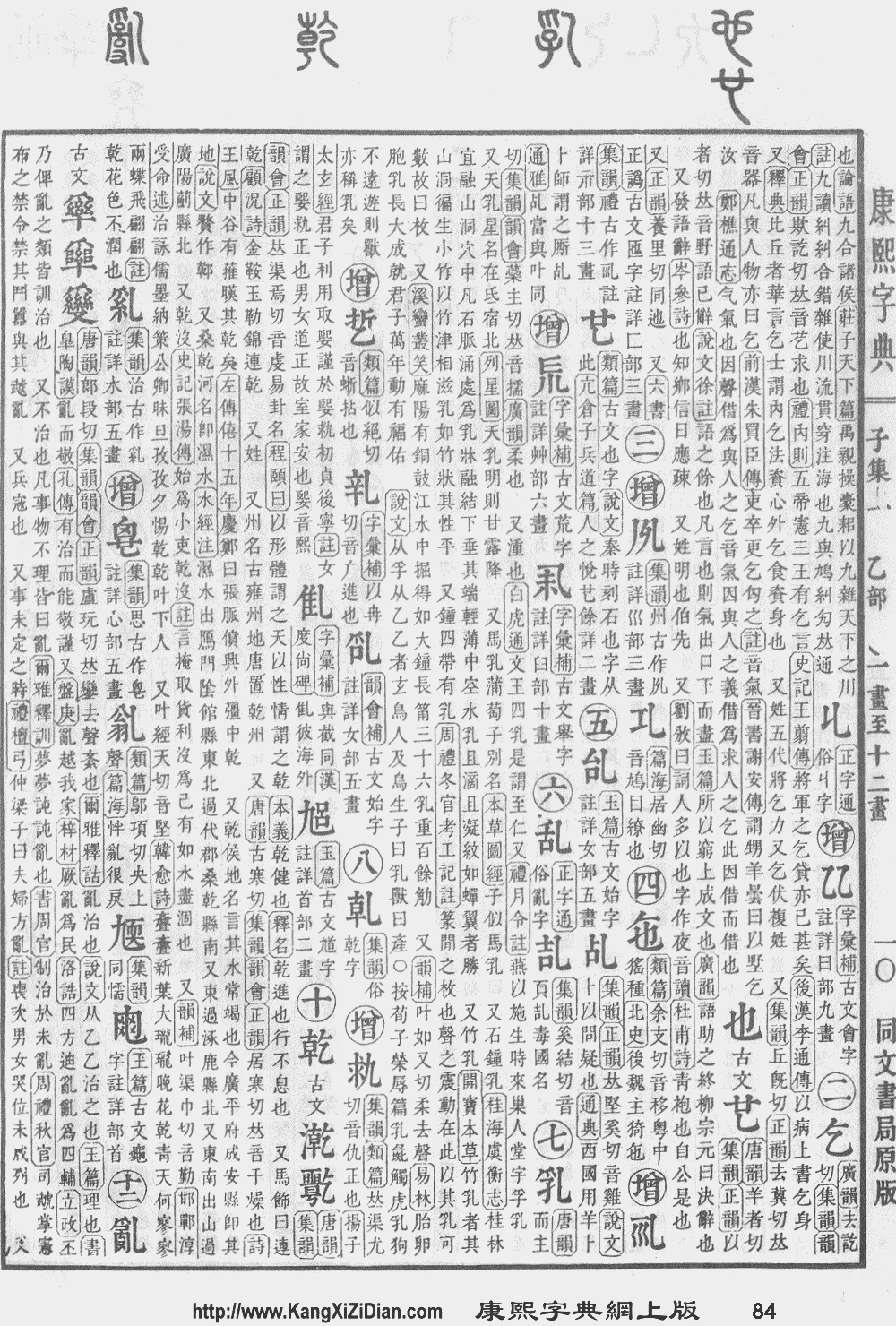
Kangxi Dictionary: page 84 , character 4
Dai Kanwa Jiten: character 171
Dae Jaweon: page 170, character 4
Hanyu Da Zidian (first edition): volume 1, page 50, character 5
Unihan data for U+4E5F
Glyph origin
edit
Old Chinese
他 *l̥ʰaːl
拖 *l̥ʰaːl, *l̥ʰaːls
駞 *l'aːl
池 *l'aːl, *l'al
灺 *ljalʔ
鍦 *ɦljaːl, *hljal, *hljals
虵 *ɦljal, *laːlʔ, *lal
也 *laːlʔ
忚 *hleːl
髢 *l'eːls
杝 *l̥ʰalʔ, *l'alʔ, *lal
肔 *l̥ʰalʔ, *lalʔ
馳 *l'al
阤 *l'alʔ, *hljalʔ
施 *hljal, *hljals
絁 *hljal
葹 *hljal
弛 *hljalʔ
箷 *lal
衪 *lel, *lalʔ
暆 *lel
迆 *lal, *lalʔ
酏 *lal, *lalʔ
匜 *lal, *lalʔ
迤 *lalʔ
扡 *lalʔ
崺 *lalʔ
貤 *lals, *ɦljels, *lels
地 *l'els
Uncertain. There are various possible explanations:
The traditional glyph origin given in Shuowen 象形
It is possibly a pictogram (象形 匜
It was once interchangeable with 它
It may have been created to represent the modal particle (語氣詞 / 语气词 yǔqìcí 口
It may have signified a big-headed scorpion with its legs flattened, signifying as something very "flat" or "stretched out". Etymology
edit
classical sentence-ending copulative particle, topic particle Unclear. Possibly Sino-Tibetan Tibetan ལ ( la ) , which is often used as a marker (for oblique locative, dative, possessor in constructions with a copula verb, etc.) but also a topicalizer like ནི ( ni , “ as for ” ) (Schuessler, 2007 ).
On the other hand, Pulleyblank (1995) notes the similarity with anteclassical 唯 OC *ɢʷi
also, too, as well
This etymology is missing or incomplete. Please add to it, or discuss it at the Etymology scriptorium . 亦 MC yek
This etymology is incomplete. You can help Wiktionary by elaborating on the origins of this term.
Pronunciation
edit
Mandarin
(Standard
(Pinyin : yě (ye3 )(Zhuyin : ㄧㄝˇ (Chengdu , Sichuanese Pinyin : ye3 (Dungan , Cyrillic and Wiktionary : е (i͡ə, II)Cantonese
(Guangzhou –Hong Kong , Jyutping : jaa5 (Taishan , Wiktionary : ya4 Gan (Wiktionary : ia3 Hakka
(Sixian , PFS : ya / yâ (Meixian , Guangdong : ya1 Jin (Wiktionary : ie2 Northern Min (KCR : ǎ / iǎ Eastern Min (BUC : iâ / iá Southern Min
(Hokkien , POJ : iā / iǎ / ā / ǎ / iá (Teochew , Peng'im : ia7 / a7 Wu (Wugniu
(Northern : 6 gha; 6 gha; 6 ye; 1 a / 8 ghaeq; 2 gha; 1 ie / 3 ie; 6 ghaXiang (Changsha , Wiktionary : ia3 / ie3
Note :
ǎ - vernacular;
iǎ - literary. Note :
iâ - vernacular;
iá - literary. Note :
iā/iǎ/ā/ǎ - vernacular;
iá - literary. Note : a7 - “if”.
Note :
6 gha (Shanghainese), 8 ghaeq (Suzhounese) - as particle;6 gha (Shanghainese), 2 gha (Suzhounese)- vernacular;6 gha & 6 ye (Shanghainese), 1 ie (Suzhounese) - literary;1 a (Shanghainese) - only in 也怕 3 ie (Hangzhounese)- main reading;6 gha (Hangzhounese) - younger speakers' alternative reading.
Baxter –Sagart system 1.1 (2014 )
Character
也
Reading #
1/1
Modern
yě
Middle
‹ yæX ›
Old
/*lAjʔ/
English
(final particle)
Notes for Old Chinese notations in the Baxter–Sagart system:
* Parentheses "()" indicate uncertain presence;
* Period "." indicates syllable boundary.
Zhengzhang system (2003)
Character
也
Reading #
1/1
No.
14773
Phonetic
也
Rime
歌
Rime
1
Corresponding
野
Old
/*laːlʔ/
Definitions
edit
也
also ; too ; as well ; ( in negative sentences ) neither ; either
我 也 去 了 。Wǒ yě qù le. also went.我 也 是 中國人 。/ 我 也 是 中国人 。Wǒ yě shì zhōngguórén. too .你 如果 不 去 ,我 也 不 去 。[MSC , trad. simp. Nǐ rúguǒ bù qù, wǒ yě bù qù. [Pinyin] If you don't go, I won't either . 我 也 沒有 看見 過 它 。[MSC , trad. 我 也 没有 看见 过 它 。[MSC , simp. Wǒ yě méiyǒu kànjiàn guò tā. [Pinyin] I haven't seen it either . Used for emphasis. 這 也 太 不像話 了 。[MSC , trad. 这 也 太 不像话 了 。[MSC , simp. Zhè yě tài bùxiànghuà le. [Pinyin] This is way too outrageous. With object fronting. 他 飯 也 不 吃 ,覺 也 不 睡 。[MSC , trad. 他 饭 也 不 吃 ,觉 也 不 睡 。[MSC , simp. Tā fàn yě bù chī, jiào yě bù shuì. [Pinyin] (Disappointingly) he neither eats nor sleeps. Used in the 連 ……也……/ 连 ……也……都 even
他 連 畜生 也 不如 ,連 自己 的 父母 也 不 養活 。[MSC , trad. 他 连 畜生 也 不如 ,连 自己 的 父母 也 不 养活 。[MSC , simp. Tā lián xùshēng yě bùrú, lián zìjǐ de fùmǔ yě bù yǎnghuó. [Pinyin] He is no better than an animal, because he doesn't even support his own parents. Used in the 再 ……也…… still , anyway , nevertheless
你 再 聰明 ,也 回答 不了 這 個 問題 。[MSC , trad. 你 再 聪明 ,也 回答 不了 这 个 问题 。[MSC , simp. Nǐ zài cōngmíng, yě huídá bùliǎo zhè ge wèntí. [Pinyin] No matter how smart you are, you won't be able to answer this question. ( Classical ) Particle used at the end of copular constructions involving a nominal predicate ; be (although not grammatically a verb)
我 亦 人 也 。[Literary Chinese ] ― Wǒ yì rén yě . [Pinyin] ― I am a person, too.其 西 有 大 山 ,天下 至 高 者 也 。[Literary Chinese , trad. simp. Qí xī yǒu dà shān, tiānxià zhì gāo zhě yě . [Pinyin] In the west there are great mountains, which are the tallest in the world. 君子 人 與 ?君子 人 也 。[Classical Chinese , trad. 君子 人 与 ?君子 人 也 。[Classical Chinese , simp. From: The Analects of Confuciusc. BCE Jūnzǐ rén yú? Jūnzǐ rén yě . [Pinyin] Is he a noble person? He is a noble person. 滕 小國 也 ,間 於 齊 楚 。事 齊 乎 ?事 楚 乎 ?[Classical Chinese , trad. 滕 小国 也 ,间 于 齐 楚 。事 齐 乎 ?事 楚 乎 ?[Classical Chinese , simp. From: Mencius c. th century BCE Téng xiǎoguó yě , jiān yú Qí Chǔ. Shì Qí hū? Shì Chǔ hū? [Pinyin] Teng is a small kingdom, between Qi and Chu. Should we serve Qi? Or Should we serve Chu? 由是 觀 之 ,無 惻隱 之 心 ,非 人 也 。[Classical Chinese , trad. 由是 观 之 ,无 恻隐 之 心 ,非 人 也 。[Classical Chinese , simp. From: Mencius c. th century BCE Yóushì guān zhī, wú cèyǐn zhī xīn, fēi rén yě . [Pinyin] From this we may see that if somebody lacks a commiserating heart, they are not a human being. 萬物 雖 多 ,其 治 一 也 。[Classical Chinese , trad. 万物 虽 多 ,其 治 一 也 。[Classical Chinese , simp. From: Zhuangzi rd – 2nd centuries BCE Wànwù suī duō, qí zhì yī yě . [Pinyin] Though the myriad things are many, their government is one. Often used more loosely than the English copula to indicate a cause or relation. 死 生 ,命 也 ,其 有 夜 旦 之 常 ,天 也 。[Classical Chinese , trad. simp. From: Zhuangzi rd – 2nd centuries BCE Sǐ shēng, mìng yě , qí yǒu yè dàn zhī cháng, tiān yě . [Pinyin] Life and death are [matters of] destiny. That there is the constancy of night and dawn is [a matter of] Heaven. 桀 紂 之 失 天下 也 ,失 其 民 也 ;失 其 民 者 ,失 其 心 也 。[Classical Chinese , trad. 桀 纣 之 失 天下 也 ,失 其 民 也 ;失 其 民 者 ,失 其 心 也 。[Classical Chinese , simp. From: Mencius c. th century BCE Jié Zhòu zhī shī tiānxià yě , shī qí mín yě ; shī qí mín zhě, shī qí xīn yě . [Pinyin] That Jie and Zhou lost the empire was because they lost their people; that they lost their people was because they lost their hearts. ( Classical ) Topic -marking particle used at the end of noun phrases.Synonym: 者 ( zhě ) 回 也 ,不 愚 。[Classical Chinese , trad. simp. From: The Analects of Confuciusc. BCE Huí yě , bù yú. [Pinyin] Hui is not foolish. 人 之 生 也 ,固 若 是 芒 乎 !其 我 獨 芒 ,而 人 亦 有 不 芒 者 乎 ![Classical Chinese , trad. 人 之 生 也 ,固 若 是 芒 乎 !其 我 独 芒 ,而 人 亦 有 不 芒 者 乎 ![Classical Chinese , simp. From: Zhuangzi rd – 2nd centuries BCE Rén zhī shēng yě , gù ruò shì máng hū! Qí wǒ dú máng, ér rén yì yǒu bù máng zhě hū! [Pinyin] As for a man's life, is it hazy like this all along? Or is it mine alone which is hazy, and there are others who are not?凡 法術 之 難 行 也 ,不 獨 萬乘 ,千乘 亦 然 。[Classical Chinese , trad. 凡 法术 之 难 行 也 ,不 独 万乘 ,千乘 亦 然 。[Classical Chinese , simp. From: Han Feizi nd century BCE Fán fǎshù zhī nán xíng yě , bù dú wànchéng, qiānchéng yì rán. [Pinyin] Generally concerning the difficulty of carrying out the law, not only the imperial realm but kingdoms are also [faced with] this. when , at the time of; especially commonly used for temporal topics, often as 及 其 ……也 丈夫 之 冠 也 ,父 命 之 ;女子 之 嫁 也 ,母 命 之 。[Classical Chinese , trad. simp. From: Mencius c. th century BCE Zhàngfū zhī guàn yě , fù mìng zhī; nǚzǐ zhī jià yě , mǔ mìng zhī. [Pinyin] When a man is capped [at the age of twenty], his father instructs him; when a girl is married, her mother instructs her.三代 之 得 天下 也 以 仁 ,其 失 天下 也 以 不 仁 。[Classical Chinese , trad. simp. From: Mencius c. th century BCE Sāndài zhī dé tiānxià yě yǐ rén, qí shī tiānxià yě yǐ bù rén. [Pinyin] When the Three Dynasties gained the empire, it was through benevolence; when they lost the empire, it was through lack of benevolence.昔者 ,魯 昭 公 少 喪 其 母 ,有 慈母 良 。及 其 死 也 ,公 弗 忍 也 。[Classical Chinese , trad. 昔者 ,鲁 昭 公 少 丧 其 母 ,有 慈母 良 。及 其 死 也 ,公 弗 忍 也 。[Classical Chinese , simp. From: The Book of Rites c. th – 2nd century BCE Xīzhě, Lǔ Zhāogōng shào sàng qí mǔ, yǒu címǔ liáng. Jí qí sǐ yě , gōng fú rěn yě . [Pinyin] Duke Zhao of Lu was once bereaved of his mother when he was a child, and had a foster mother who was kind. When she died, the Duke could not bear it. ( Classical ) Verb phrase-final particle marking continuous aspect , especially common for assertions of unchanging fact. 孟 武 伯 問 :「子路 仁 乎 ?」子 曰 :「不 知 也 。」[Classical Chinese , trad. 孟 武 伯 问 :「子路 仁 乎 ?」子 曰 :「不 知 也 。」[Classical Chinese , simp. From: The Analects of Confuciusc. BCE Mèng Wǔ Bó wèn: “Zǐlù rén hū?” Zǐ yuē: “Bù zhī yě .” [Pinyin] Meng Wu Bo asked. "Is Zilu benevolent?" The Master said, "I do not know." 當是 之 時 ,堅車 良馬 不 知 貴 也 ,刻鏤 文采 不 知 喜 也 。[Classical Chinese , trad. 当是 之 时 ,坚车 良马 不 知 贵 也 ,刻镂 文采 不 知 喜 也 。[Classical Chinese , simp. From: Mozi c. th century BCE Dāngshì zhī shí, jiānchē liángmǎ bù zhī guì yě , kèlòu wéncǎi bù zhī xǐ yě . [Pinyin] In that age, they did not find value in sturdy chariots and good horses; they did not find pleasure in carvings and adornments. 人 皆 知 有用 之 用 ,而 莫 知 無用 之 用 也 。[Classical Chinese , trad. 人 皆 知 有用 之 用 ,而 莫 知 无用 之 用 也 。[Classical Chinese , simp. From: Zhuangzi rd – 2nd centuries BCE Rén jiē zhī yǒuyòng zhī yòng, ér mò zhī wúyòng zhī yòng yě . [Pinyin] Everybody knows the use in being useful, but nobody knows the use in being useless. ( Teochew ) if a surname . Ye Synonyms
edit
Dialectal synonyms of
也 (“also, too”)
[map]
Variety
Location
Words
Classical Chinese
亦
Formal (Written Standard Chinese )
也
Mandarin
Beijing
也
Taiwan
也
Jinan
也
Xi'an
也
Wuhan
也
Chengdu
也
Guilin
也
Yangzhou
也
Hefei
也
Malaysia
也
Singapore
也
Cantonese
Guangzhou
都 亦
Hong Kong
都 亦 亦都
Macau
都 亦 formal
Zhongshan (Shiqi)
都 也
Taishan
亦
Kaiping (Chikan)
亦 都 亦都
Yangjiang
也
Kuala Lumpur (Guangfu)
都
Singapore (Guangfu)
都 亦都
Gan
Nanchang
也
Hakka
Meixian
也
Wuhua (Meilin)
也
Miaoli (N. Sixian)
乜
Pingtung (Neipu; S. Sixian)
乜 也
Hsinchu County (Zhudong; Hailu)
乜
Taichung (Dongshi; Dabu)
乜
Hsinchu County (Qionglin; Raoping)
乜
Yunlin (Lunbei; Zhao'an)
嘛
Kuching (Hepo)
呠
Huizhou
Jixi
也
Jin
Taiyuan
也
Northern Min
Jian'ou
也
Eastern Min
Fuzhou
也
Southern Min
Xiamen
也 嘛
Quanzhou
也 嘛
Zhangzhou
也 嘛
Taipei
也 嘛
Penang (Hokkien)
呠
Singapore (Hokkien)
也 呠 嘛
Manila (Hokkien)
也 嘛
Chaozhou
也
Shantou
也
Jieyang
也
Singapore (Teochew)
呠 也 嘛
Pontianak (Teochew)
也
Wenchang
也
Zhongshan Min
Shaxi (Longdu)
都
Wu
Shanghai
也
Suzhou
亦
Wenzhou
也
Xiang
Changsha
也
Shuangfeng
也
Compounds
edit
Further reading
edit
Caboara, Marco (2010) The particle ye 也 and related constructions in the Guodian manuscripts of IV century BCE (PhD)[1] Japanese
edit
也 (eumhun 잇기 야 ( itgi ya ) )
This term needs a translation to English. Please help out and add a translation , then remove the text {{rfdef }}. 也 (eumhun 어조사 야 ( eojosa ya ) )
This term needs a translation to English. Please help out and add a translation , then remove the text {{rfdef }}. 也 (eumhun 잇달을 야 ( itdareul ya ) )
This term needs a translation to English. Please help out and add a translation , then remove the text {{rfdef }}. Vietnamese
edit
Han character
edit
也 : Hán Việt giã dã 也 : Nôm dạ dã giã rã
This term needs a translation to English. Please help out and add a translation , then remove the text {{rfdef }}. References
edit
Hồ Lê (1976). Bảng Tra Chữ Nôm . Hanoi: Viện Ngôn Ngữ Học .
Nguyễn, Quang Hồng (2014). Tự Điển Chữ Nôm Dẫn Giải (Nôm Characters with Quotations and Annotations). Hanoi: Nhà xuất bản Khoa học Xã hội (Social Sciences Publishing House).
Williams, Noriko Kurosawa (2010). "The Key to Kanji". Boston: Cheng & Tsui Company, Inc.